“King’s Grave” from Izmir

Another tantalizingly vague one from Hurriyet:

A king’s grave was uncovered during construction in İzmir’s Kemalpaşa district. The area has been taken under protection and İzmir Museum Directorship officers have started an inspection of the grave and its contents.

The king’s grave was found in a 211-square-meter area owned by Behçet Aktaş in Kemalpaşa’s Atatürk neighborhood. It was discovered when a construction digger struck a rock that was part of the grave during excavation work for a newly-planned building.

The landlord of the building next to the excavated area, İlker Yıldız, said they saw an empty space inside the rock, which contained ancient pieces. “After we saw the pieces we understood that the area being dug contained historic pieces and we called the gendarmerie. They stood on guard for a day until the İzmir Museum Directorship’s officers and experts arrived,” Yıldız said. He also said they collected the unearthed pieces but that the grave was still there because part of the land containing the grave was under a building and if they were to dig more the building could collapse.

The area is now protected with wires and the uncovered pieces are being cleaned and will be studied to discover the king’s identity.

It would have been nice if there was at least a hint at the date, no?
Sardonic Smile Origins

Homer is usually cited as the origin of the phrase, ‘sardonic smile’, specifically, from Odyssey 20.302 (or thereabouts):

So saying, he hurled with strong hand the hoof of an ox, taking it up from the basket where it lay. But Odysseus avoided it with a quick turn of his head, and in his heart he smiled a right grim and bitter smile; and the ox’s hoof struck the well-built wall.

Now Sardianian scientists are claiming to have discovered the plant whence was derived a drug which induced such a smile:

Sardinian scientists believe they’ve traced the roots of the ‘death-defying’ sardonic grin to a plant commonly found on the Italian island.

Greek poet Homer first used the word, an adaptation of the ancient word for Sardininan, to describe a defiant smile or laugh in the face of death.

He was believed to have coined it because of the belief that the Punic people who settled Sardinia gave condemned men a potion that made them smile before dying.

The association with Sardinia has often been disputed, but Cagliari University botanists think they’ve settled the case – and the plant in question could have beneficial properties too.

The plant, tubular water-dropwart (oenanthe fistulosa), is common in Sardinia, where it is popularly known as ‘water celery’.

”Our discovery supports what many cultural anthropologists have said about death rituals among the ancient Sardinians,” said Cagliari University Botany Department chief Mauro Ballero.

”The Punics were convinced that death was the start of new life, to be greeted with a smile,” he said.

Ballero’s team, whose work appears in the latest edition of the US Journal of Natural Products, have established that a toxic substance in the dropwart plant does, in fact, cause facial muscles to contract and produce a grimace or rictus.

The discovery could have a brighter side, he said, leading to drugs that might help certain conditions where parts of the face are paralysed.

”The good news is that the molecule in this plant may be retooled by pharmaceutical companies to have the opposite effect,” he said.

… I’ve always wondered whether the smile one sees on depictions of the Medusa are considered such a grin …

Exaentus of Agrigentum

Every so often something shows up in a scan which you never, ever expect to see … in this case, the New York Times has a review of a book called Playbooks and Checkbooks: An Introduction to the Economics of Modern Sports which includes:

The ancient Greeks even pioneered a form of the ticker-tape parade when, in 412 B.C., the Olympic running champion Exaentus of Agrigentum was driven through the streets in a chariot followed by 300 prominent citizens. Clearly, the Greeks were able practitioners of the phenomenon we now know as hype.

Actually, it was even more impressive than that. From the Perseus translation of Diodorus Siculus (13.82):

And in the Olympiad previous to the one we are discussing, namely, the Ninety-second, when Exaenetus of Acragas won the “stadion,” he was conducted into the city in a chariot and in the procession there were, not to speak of the other things, three hundred chariots each drawn by two white horses, all the chariots belonging to citizens of Acragas.

The passage comes from a long section commenting on the wealth of Acragas (modern-day Agrigento) at the time (412 B.C.). The stadion, incidentally, was (give or take) the ancient equivalent of the 200 metres. Clearly, they’re still talking about the parade …

Envisioning the Colosseum

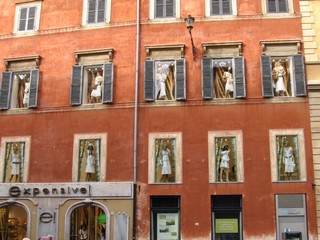
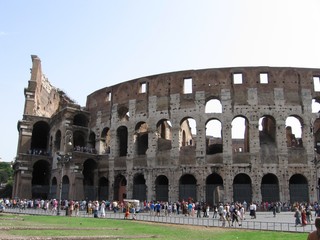
As long as I’m in my photo file, here’s something else I meant to post from my trip to Rome — We’ve all seen your standard touristy photo of the Colosseum, to wit:

118_1818

… and we are usually told that all those little arches originally had statuary in them. So, presumably, it looked something like this store front from near the Spanish Steps:

118_1851

… or so it seemed to me on a very hot day when the kids were insisting on seeing what McDonalds tasted like in Italy …

SPQR

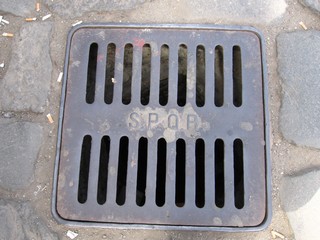
I’ve got to do some photoshopping this weekend and I just remembered something I’ve been meaning to post for a couple of years now. Many of the folks reading rogueclassicism have likely been sitting in a classroom and had their teacher tell them that — even now — SPQR is written all over Rome. Usually appended to that claim is that it’s even written on the drain covers. Rarely, however, is the claim ever actually demonstrated, so as a (Re)public service, here’s a photo of a drain cover from Rome which I took a couple of years ago:

118_1819

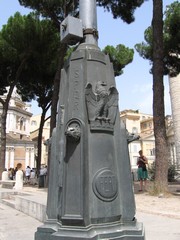
… and just to provide another example, here’s a lamppost (admittedly on the Via  dei Fori Imperiali):

118_1831

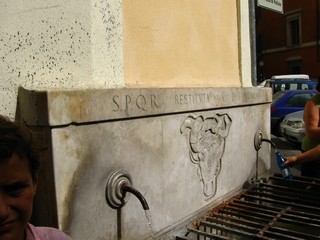
… and fulfilling the scholastic rule of three (and connecting to a post at Eternally Cool), one of Rome’s many, many water taps:

118_1846

Tags: