More Roman Humour

Mary Beard continues to make the rounds talking about ancient humour, and it appears she was asked about who she believed was the funniest Roman. She decided it was Cicero (!) and you can read the Times coverage to find out why … I’m using this as an excuse to excerpt the chunk which shows other Romans’ histohumorical quips:

A funny thing happened on the way to the amphitheatre

— The elder Crassus was said to have laughed only once in his life. What caused Crassus to crack up? The sight of a donkey eating thistles and the well-known saying that came to mind: “Thistles are like lettuce to the lips of a donkey”

— In the middle of the Civil War the exasperated Pompey is reputed to have said of his reluctant ally Cicero: “I wish to goodness Cicero would go over to the enemy, then he would learn to fear us”

— A man leaving the Roman theatre was asked by another whether he had seen the play. “No, stupid,” he replied. “I was playing ball in the orchestra”

— Gaius Memmius, the tribune of 111BC, was said to have had taken a bite out of the arm of a man called Largus, as they were tussling over the affections of a woman.

— Crassus claimed that all over the town of Terracina the letters MMLLL were pasted up on the walls: “Mordacious Memmius Lacerates Largus’ Limb”

— A joke made to a one-eyed man, Gaius Sextius: “I shall dine with you my friend, for I see you’ve got a place for another one.” “This,” said Cicero, “is the unacceptable joke of a scurra [professional clown] both because it was unprovoked, and because it could be used against any one-eyed individual”

— Cicero was defending his client Milo on the charge of murdering the infamous Clodius in 52 BC and was under interrogation from the prosecution. The case was going to hinge on exact timing. When did Clodius die, they asked him. And here is the joke, the one that is, on its own, enough to justify the whole category of double entendres: Cicero replied with just one word, sero. The pun is on the two senses of sero: both “late” and “too late”. Clodius died late in the day, and he should have been got rid of years before.

In a related item, Charlotte Higgins ponders whether Cicero is actually worthy of our praise:

See also/cf. (from May of last year … a piece by Dr Beard for the Times):
‘Jesus Ossuary’ Trial Update

In case you were wondering … the trial of all those folks associated with the so-called ‘Jesus Ossuary’ has ‘stalled’ (for want of a better term, I suppose). The Jerusalem Post has a lengthy piece … here’s the interesting bits:

According to the Antiquities Authority, Deutsch and Golan conspired to forge an ancient decanter, several inscribed pieces of pottery and dozens of seal impressions – known as bulae – some bearing the names of Israelite kings mentioned in the Bible. They are accused of publishing scholarly papers on the items to enhance their value, and then selling them for thousands of dollars to unsuspecting collectors.

After Deutsch was indicted, he was fired from a teaching post at the University of Haifa and dismissed as a supervisor at the Megiddo excavations.

“I have never faked anything in my life,” said Deutsch. “I’m the first person to call something a fake, because it pollutes the profession that I have made my expertise.”

On the witness stand, Deutsch said he knew Golan, his alleged co-conspirator, only through business. He said the Antiquities Authority and police had failed to find a single e-mail between the two men, or any evidence linking him to forgery despite repeated raids on his home and shops.

Deutsch said the trial was an attempt to shut down the licensed trade in antiquities in Israel, even though it is legal and he has held a license from the authority for the past 30 years.

“The Antiquities Authority thinks we are no better than antiquities thieves,” he said. “They believe that our legal trade is worse than theft because we are encouraging the robbers.”

“They went to the Knesset and tried to pass legislation banning trade in antiquities and they failed. Now they are using this trial to destroy our business,” he said.

“I don’t know how much lower they can get, the people who cooked up this trial,” he said. “They misled the prosecution, they misled the press and they came up with all sorts of stories with no basis in reality.”

One charge against Deutsch and Golan is that in 1995 they conspired to inscribe an ancient decanter with a text linking it to the Temple service and sell it to billionaire collector Shlomo Moussaieff.

“To increase the significance of the decanter and enhance its price,” the indictment charges, “Defendant No. 2 published the decanter in a volume of archeology which he authored on the subject of Hebraic inscriptions from the First Temple period.”

But Deutsch produced the book in court – exhibit No. 4 – and showed that it was already at the printer in 1994, by which time the decanter was already in the Moussaieff collection. The book cannot have been used to enhance the sale price.

In addition, Deutsch and Golan have both produced compelling evidence to show that the decanter, like the rest of the items, is authentic.

The prosecution, which took nearly three years to present its case, has had difficulty proving the alleged conspiracy. When Oded Golan took the stand last year, he produced plausible explanations for the all the apparent evidence of forgery found in repeated raids on his home, business premises and storage facilities.

Expectations that the prosecution would produce an Egyptian craftsman it alleges actually faked most of the items were dashed when he refused to come to Israel to give evidence.

The star prosecution witness, Tel Aviv University’s Prof. Yuval Goren, was forced to recant some of his testimony based on scientific tests that showed the patina – the encrustation that adheres to ancient objects – to be a modern concoction. Further scientific evidence based on isotopic analysis of the patina looked increasingly unconvincing after other scientists tested the same items and came to the opposite conclusion.

Last October, the trial appeared close to collapse after Judge Aharon Farkash advised the prosecution to consider dropping the proceedings.

“After all the evidence we have heard, including the testimony of the prime defendant, is the picture still the same as the one you had when he was charged?” the judge pointedly asked the prosecutor. “Maybe we can save ourselves the rest.”

“Have you really proved beyond a reasonable doubt that these artifacts are fakes as charged in the indictment? The experts disagreed among themselves” Farkash said.

The trial continues.

Sounds like someone seriously mishandled this one …

Hannibal Flick Update

Vin Diesel’s Fast and the Furious is getting a pile of reviews right now … at the end of the one in the LA Times (and probably elsewhere) we read:

And for the last six years, Diesel has remained relentlessly dedicated to bringing a biopic about the Carthaginian military commander Hannibal to the screen. Over that time, producers have balked at its initial price tag of $230 million as well as Diesel’s insistence on directing. Still, the ambiguously ethnic actor has gone as far as hiring a screenwriter to translate the script he and other writers have been working on into Punic — an ancient language that has been extinct for more than 2,000 years.

Diesel said he identified with Hannibal on several levels.

“It’s about overcoming insurmountable odds. But nothing speaks more to me than the fact that this was the first champion of multiculturalism,” he said. “Rome’s empire flourished because they were able to adopt the idea that many nationalities could coexist together. They learned that from Hannibal.”

He weighed the consequences of pursuing his dream project.

“It takes someone with enough of an ego to believe they can tell this story better than anybody else. That’s where I’m at,” Diesel said, breaking into a wide grin. “They can’t stop me. They can stomp me. Kick me when I’m down. But they won’t stop me. Cross your fingers for me, brother!”

Perhaps further evidence that the project is still going on  is word that Diesel is also developing an online video game which is clearly connected. Neoseeker reports (inter alia):

This new game — that has been in development for 2 or 3 years already, apparently — is going to be a MMO with RPG qualities, set around 200 B.C, in the Punic Wars. (Shotgun blast history lesson: the Punic Wars were a series a battles in the Mediterranean against the dominating empire of day, the Carthaginian State, against the upstart Roman Republic. Hannibal Barca was a fearsome, legendary talented Carthaginian general, raised from birth to kill Romans.)

“The reason why it’s my dream game is because it is an MMO …  where you create an avatar that lives in the reality of Hannibal Barca, the Punic Wars and life 200 B.C,” Vin Diesel said to Destructoid. “You would have avatars that you would invest [in] — it would be an RPG game — and creating that ancient world as your backdrop. Creating an ancient world that is your ‘Azeroth.’ That is probably my dream scenario,” Diesel went on to say.

From the interview, it seems that Diesel has a sincere interest and affinity for the world of the ancient West. In that period before the Roman Empire began, when the whole ‘civilization’ ball really started to roll, warfare was entering a new conceptual stage of tactics, and massive, well-equipped armies where deciding the entire course of history in the West.

It appears that Barca B.C has at least a few years of development before it will see the light of day. But it is a project the Diesel is personally motivated to see through to the end: “We all know those games take a lot of work to create, a lot of funds. We are just in the first two or three years of putting it together. It could probably take another four years before we see that game…When we talk about dream case scenarios, man, I would love to play as a Carthaginian soldier 200 years before Christ. Sailing around the Mediterranean, that’d be pretty damn cool. If you could add some historical elements to it, the better.”

So I guess all these Fast-and-Furious-type flicks are subsidizing the Hannibal one …

Lucy Lawless in Spartacus Flick?

Variety reports (inter alia):

Lucy Lawless is returning to her action-hour roots, signing on to star in the new fantasy-and-fighting series from “Xena: Warrior Princess” masterminds Rob Tapert and Sam Raimi. The previously announced project from Starz Media, “Spartacus: Blood and Sand,” will feature the New Zealand-bred thesp, who starred in “Xena” from 1995-2001, as the proprietor of a camp for gladiators.

A female lanista?

Hellenistic Harbour Remains from Ptolemais/Akko/Acre

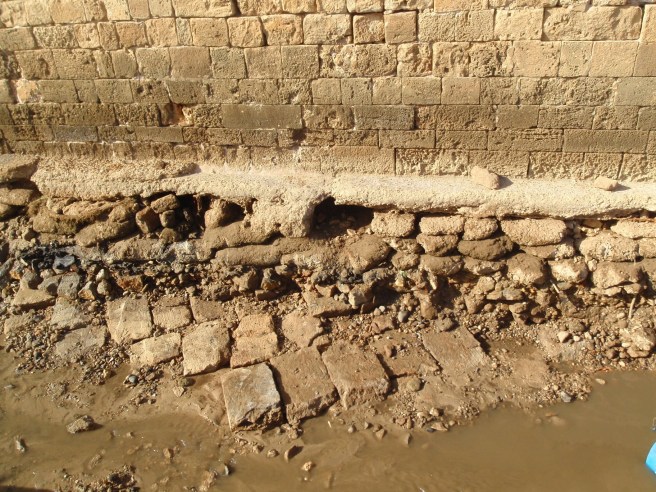
By whatever name you recognize it, this is interesting … the Israel Antiquities Authority has issued a press release (and photos) of evidence of a floor (pavement is probably a better word) one metre below the water level in the harbour at Akko, the erstwhile Ptolemais. An excerpt from the press release:

As part of the project, a temporary rampart that serves as both a road and dam was built in the sea. The pool of water that formed between the rampart and the seawall was pumped out so as to create dry conditions for rehabilitating the seawall.

The part of the floor that has been revealed so far extends for a distance of 15 meters and is 4 meters wide (the full dimensions of the floor have not yet been exposed). The floor was built of rectangular, smoothly dressed kurkar stones that were placed atop a foundation course of roughly hewn kurkar stones arranged next to each other as “headers”. In probes that were conducted beneath the floor, numerous fragments of ceramic jars of Aegean provenance (from Rhodes, Kos and elsewhere) were found that were used to transport wine, as well as tableware and cooking vessels. Among the other artifacts recovered were a Greek style bronze arrowhead and bronze coins that are covered with marine encrustations. A preliminary identification of the finds shows that the floor was constructed in the Hellenistic period (end of the third century until the middle of the second century BCE) as part of a national project.
According to Kobi Sharvit, director of the Israel Antiquities Authority Marine Archaeology Unit, “The location of the floor, its size, the building style and the building method, which is mainly known from the construction of harbor installations, indicate with a high degree of certainty that the floor has a marine connection suggesting it belongs to a large pier or dockyard structure”.

The floor constitutes an extremely important indicator for studies that deal with changes in sea level and in the location of the shoreline during the Hellenistic period in Akko. This find raises other questions regarding the tectonic changes that occurred in Akko, which is located on a geologic fault, and sea levels.

Not sure how they recognize this as part of a “national project”, unless that comes from text-based evidence vel simm. Whatever the case, here’s a relevant photo:

IAA photo
IAA photo