Damnatio Memoriae in Modern Egypt

Nice bit of comparanda from the New York Times:

LAST month, a Cairo court ordered that images of the ousted Egyptian president, Hosni Mubarak, and his wife, Suzanne, as well as their names, be removed from all “public squares, streets, libraries and other public institutions around the country.” Posters and portraits of the Mubaraks are ubiquitous in Egypt. Squares, sports fields, libraries, streets and more than 500 schools bear their names.

… after some similar sentiments and notice of the practice in Ancient Egypt, the Times notes:

Romans saw it as a punishment worse than execution: the fate of being forgotten. It was suffered by numerous ignominious emperors of Rome in the early empire, and, even in the later empire, it was a mark of great disgrace. After the rebellious Maximian was subjected to damnatio memoriae around A.D. 311, his friend and co-ruler Diocletian was said to be so grief-stricken that he soon died as well.

Excisions like Maximian’s from frescoes and statues can be viewed in the most basic sense as announcements from rulers to the populace about the end of one reign and the beginning of another. But when the populace engages in the destruction itself, it can also serve a cathartic purpose.

According to the historian Suetonius, in the chaos that followed the assassination of the emperor Caligula in A.D. 41, “some wanted all memory of the Caesars obliterated, and their temples destroyed.” The new emperor, Claudius, ultimately blocked the Senate’s attempt to decree a formal damnation of his predecessor’s memory. (Now on the throne himself, he probably wanted to avoid condoning regicide.) Yet Suetonius’ statement indicates that common people wanted the chance to vent their frustrations over Caligula’s corrupt reign and senseless brutality. […]

… some folks will remember that last January we were blogging about (oft-made) claims that Caligula had undergone damnatio memoriae: Purported Tomb of Caligula ~ Followup
Also Seen: Bristol Classical Podcasts on the Aeneid

Tip o’ the pileus to Terrence Lockyer for pointing this one out on Twitter a while back … currently there are four podcasts available, all about the Aeneid (specifically, an introduction, and one for books I, IV, and VII respectively).

CONF: The Greek Theatre in the Fourth Century BC

Seen on the Classicist list:

Death of Drama or Birth of an Industry? the Greek Theatre in the Fourth Century BC
Conference 19-20 July, 2011
The Centre for Classical & Near Eastern Studies of Australia (CCANESA)
University of Sydney, Australia
Faculty of Arts and Social Sciences

Some limited financial assistance in the form of bursaries to support the attendance of post-graduate students may be available. Please enquire at greek.theatre@sydney.edu.au

Draft programme:

July 19
THEATRE AND SANCTUARY ARCHITECTURE

Christina Papastamati-Von Moock (Greek Ministry of Culture)
The Theatre of Dionysus in Athens: New Data and Observations on its ‘Lycurgan’ Phase

Hans Rupprecht Goette (DAI, Berlin)
Archaeology of the Rural Dionysia

Jean-Charles Moretti (University of Lyon)
The Evolution of Theatre Architecture outside Athens in the Fourth Century BC

DRAMA IN THE FOURTH CENTURY

Sebastiana Nervegna (University of Sydney)
The Classical Canon in the Fourth Century BC

Andrew Hartwig (University of Sydney)
The Evolution of Comedy in the Fourth Century BC

Johanna Hanink (Brown University)
Aristotle (and Others) as Evidence of Fourth-Century Drama

July 20
THEATRE AND MACEDON

Brigitte Le Guen (University of Paris 8)
Theatre and Politics at Alexander’s Travelling Royal Court

Eoghan Moloney (University of Adelaide)
“Philippus in acie tutior quam in theatro fuit…” (Curt. 9.6.25): the Macedonian Kings and Greek Theatre

THEATRE IN THE WEST

Ted Robinson (University of Sydney)
Theatre in Indigenous Italy and Sicily

Zachary Biles and Jed Thorn (Franklin and Marshall College)
Imitation and Innovation in West Greek Theatre Vases

Richard Green (University of Sydney)
Boundaries of Comic Theatre in Fourth Century Italy

THEATRE FINANCE

Robert Pitt (British School at Athens)
Theatres and the Ancient Construction Industry

Peter Wilson and Eric Csapo (University of Sydney)
Funding the Athenian Theatre in the Fourth Century

FOR MORE INFORMATION GO TO

http://sydney.edu.au/ccanesa/news/

Minoan Antikythera Mechanism?

Tip ‘ the pileus to Diana Wright, who sent in this tantalizingly brief item from Athens News (and it’s a month old … not sure why it hasn’t really spread outside of a handful of newspapers):

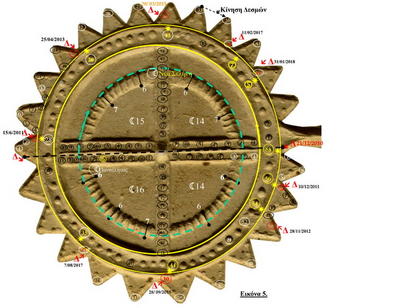
Researcher Minas Tsikritsis who hails from Crete — where the Bronze Age Minoan civilization flourished from approximately 2700 BC to 1500 century BC — maintains that the Minoan Age object discovered in 1898 in Paleokastro site, in the Sitia district of western Crete, preceded the heralded “Antikythera Mechanism” by 1,400 years, and was the first analog and “portable computer” in history.

“While searching in the Archaeological Museum of Iraklion for Minoan Age findings with astronomical images on them we came across a stone-made matrix unearthed in the region of Paleokastro, Sitia. In the past, archaeologists had expressed the view that the carved symbols on its surface are related with the Sun and the Moon,” Tsikritsis said.

The Cretan researcher and university professor told ANA-MPA that after the relief image of a spoked disc on the right side of the matrix was analysed it was established that it served as a cast to build a mechanism that functioned as an analog computer to calculate solar and lunar eclipses. The mechanism was also used as sundial and as an instrument calculating the geographical latitude.

Not sure what discipline Tsikritsis is a professor of  (a quick check of the web most often gives the rather vague ‘specialist in ancient Aegean writing systems; not sure about that), but it’s interesting that he sees this — apparently — as a 25 tooth gear of some sort. One of the gears in the Antikythera Mechanism’s ‘sun-moon assembly’  has 24 teeth, so potentially this is a somewhat less ‘sophisticated’ (for want of a better word) method of calculation. Then again, it would be interesting to know the diameter of this ‘gear’ (which I can’t seem to find anywhere on the web, except associated with this article in various forms) in order to try and figure out how large the ‘minoan mechanism’ would have to be. And yet then again, perhaps we should suspicious because Tsikritsis apparently also claims to have translated/decoded Linear A (not sure how much weight to give this item google translated in a discussion forum).  I think we’ll defer judgement on this one …

CFP: Warfare in Antiquity: Approaches and Controversies

Seen on the Classicists list:

Call for Papers
Warfare in Antiquity: Approaches and Controversies
Conference

August 12-13th 2011 in University College Dublin, Ireland

The study of ancient warfare is a broad and well established subject that stretches across a range of disciplines. However, persistent controversies regarding interpretations of and approaches to the subject matter remain. In light of this and in celebration of the recent 2,500 year anniversary of the battle of Marathon, the UCD Schools of Archaeology and Classics will be co-hosting a two-day interdisciplinary conference entitled ‘Warfare in Antiquity: Approaches and Controversies’ .

The aim of the conference is to provide a platform for discussion and exchange of ideas on current approaches and controversies regarding the study of ancient warfare. The conference is aimed equally at postgraduate students, early career researchers and established academics. There are no specific spatial or temporal parameters regarding the subject matter of papers, although it is anticipated that contributions will focus on the Mediterranean basin and North Western Europe from the Bronze Age to Late Antiquity.

Proposals/abstracts should be no longer than 250 words and should be sent to warfare.antiquity AT gmail.com

The deadline for submission of proposals is June 18th, 2011.

For more information contact Peter Myler or Kevin de Groote at:

Peter.myler AT ucdconnect.ie

99802686 AT ucdconnect.ie