Did the Ancient Greeks Discover America?

In a word, no, but that doesn’t stop the Epoch Times for wasting electrons on a nutty theory … here are just enough exerpts to smack your gob:

The year 1492 is one of history’s most famous dates, when America was discovered by Europeans. However that “New World” may have been already known to the ancient Greeks, according to a book by Italian physicist and philologist Lucio Russo.

The translated title for Russo’s book would be “The Forgotten America: The Relationship Among Civilizations and an Error Made by Ptolemy.” But the author told the Epoch Times that the title for the English version, which isn’t ready yet, will probably be “When the World Shrunk.”
Some Clues

Among the many clues of contact between ancient Europeans and Native Americans are the few pre-Columbian texts to have survived the Spanish devastation.

In a book about the origins of the Maya-Quiché people there are many interesting points. The fathers of that civilization, according to the text, were “black people, white people, people of many faces, people of many languages,” and they came from the East. “And it isn’t clear how they crossed over the sea. They crossed over as if there were no sea,” says the text.

However, researchers later decided to translate the Mayan word usually meant for “sea” as “lake.”

There are also many Mayan depictions and texts about men with beards. But Native Americans do not grow beards.

Furthermore, some artworks of the ancient Romans show pineapples, a fruit that originated in South America.

Ways of Thought

Russo, who currently teaches probability at Tor Vergata University of Rome, says the main reason why researchers think America wasn’t known to ancient Greeks is not due to lack of proof, but to scientific dogma. […]

… now since they mentioned that old canard about pineapples in Roman art, we feel compelled to comment. We should make note of the photo that accompanies the original article:

Photo in the Epoch Times, apparently from Lucio Russo’s book

I won’t go too much into detail about the background on this claim (which ultimately goes back to Ivan Van Sertima … see Jason Colavito’s excellent post from a year or so ago: The “Pineapple” of Pompeii), but there clearly is something wrong with people if they look at those things and see pineapples. Begin with the mosaic and you’re looking at something that looks like it’s smaller than most of the fruit there. Then look at the fresco and see that the things are only slightly larger than the snake’s head. Then you can argue with yourself about the statue and decide whether it’s a child or an adult. If you’ve been around Classics for a while, however,  the thing is obviously a  pinecone, not a pineapple, which are similarly-depicted on plenty of pots relating to Dionysus/Bacchus and usually brandished by a Maenad, and often by Dionysus himself E.g.:
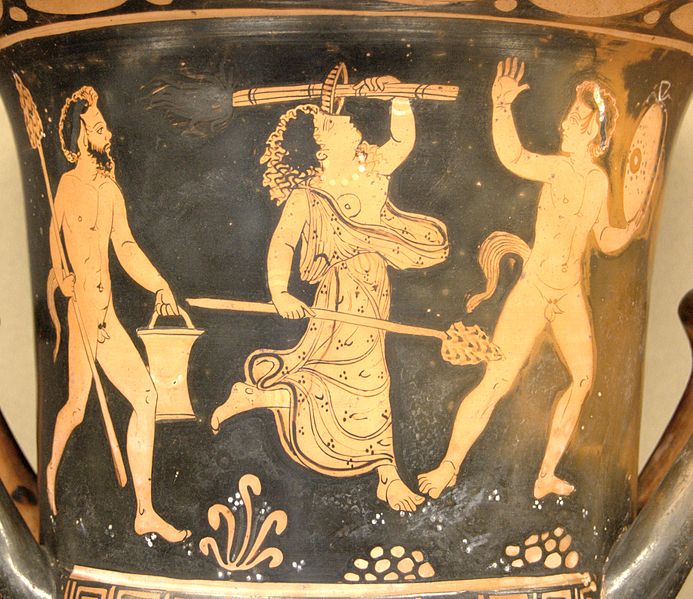
via Wikipedia

There are countless other examples, including architectural elements and the like. Once again we see the ‘danger’ of non-specialists building theories on rather common elements of ancient Greek and Roman life (more common than they want to believe) …

Possible Praetorium from Balaklava

Interesting item from PAP:

Praetorium, Roman garrison commander’s property, has been discovered by found Polish archaeologists working in the Crimea, told PAP Dr. Radosław Karasiewicz-Szczypiorski of the Institute of Archaeology, University of Warsaw, head of excavations in Balaklava, Ukraine.

Until now, researchers have speculated that this house was located at the citadel in nearby Chersonesus.

Archaeologists studied the building of unknown purpose in previous seasons. This year’s work allowed for its full exploration.

“At first we thought that we were digging up the common barracks or quarters of one of the officers – centurions. However, the structure turned out to be more extensive than we thought. We uncovered a large house with rooms surrounding a stone-paved courtyard from three sides. Analogies with similar Roman forts indicate that the house belonged to the garrison commander” – said Dr. Karasiewicz-Szczypiorski.

The commander of the garrison was a high-ranking officer (tribune), who probably only visited outposts, and had permanent quarters on the Lower Danube.

Best preserved was the last construction phase of the building, dating back to the turn of the second and third century and the first decades of the third century.

“Discovery of the praetorium in Balaklava suggests that, at least in the beginning of the third century, the quarters of the Roman army commander in Tauris (the ancient name of Crimea – ed. PAP) was the fort in Balaklava, and not, as previously thought in the nearby Chersonesus citadel” – said Dr. Karasiewicz-Szczypiorski .

Warsaw archaeologists first visited Balaklava in the 1990s. The excavations are carried out jointly with the staff of the local museum ” Chersonesus Taurica” in Sevastopol. The result of these studies include the discovery of the temple of Jupiter Dolichenus. The current project was carried out for three seasons with the funds from the Ministry of Science and Higher Education.

The relevant scholarly paper seems to be at http://www.archeo.uw.edu.pl/zalaczniki/upload1187.pdf

CJ Online Review: Sedley, The Philosophy of Antiochus

posted with permission:

The Philosophy of Antiochus. Edited by David Sedley. Cambridge and New York: Cambridge University Press, 2012. Pp. ix + 377. Hardcover, $110.00. ISBN 978-0-521-19854-7.

Reviewed by Joseph McAlhany, Carthage College

The philosopher Antiochus of Ascalon, influential teacher to leading intellectual lights of 1st-century bce Rome such as Cicero and Varro and companion to dimmer bulbs such as Lucullus, is best known for his revival of the "Old Academy" in a hostile reaction, known as the Sosus affair, to the skepticism that had come to reign among the heirs of Plato, including his own teacher Philo of Larissa. Treatments of the man and his thought have not been lacking, though for anything approaching a digestible yet substantial overview in English, nothing surpassed Barnes’ lucid and concise "Antiochus of Ascalon" in Philosophia Togata I (Oxford 1989). However, David Sedley has now edited an outstanding collection of papers on Antiochus, and even though he explicitly denies any attempt to produce a "Cambridge Companion to Antiochus," this comprehensive volume featuring a stellar cast of contributors all but renders one unnecessary (or, at least, even more unnecessary). A product of the Cambridge-based project on "Greco-Roman Philosophy in the First Century bc," the collection begins with coverage of Antiochus’ biography and intellectual background, proceeds through his philosophical positions and arguments, and ends with his influence-a natural arrangement that allows free and fruitful overlap, which is one of the strengths of this volume: rather than redundant and repetitious re-visitations of the same ground, the internal engagement among individual contributors sounds a stimulating polyphony.

Little about Antiochus’ life and teachings rises above controversial conjecture, since, with only one verbatim quotation surviving from Sextus Empiricus for sources, we are left with interpretative quagmires such as Cicero’s Academica and Philodemus’ Index Academicorum. Yet even though this pivotal figure of late Republican intellectual culture remains enshrouded in hermeneutic murk, every contribution in this volume offers its own insights, always based on close engagement with the sources. In fact, a notable feature that alone makes this book a valuable resource is the collection of testimonia (and fragment) with translations at the end of the book, including David Blank’s new readings of the Index Academicorum. (The longer speeches from Cicero are not reproduced in full, but neatly summarized.) A thorough reading of the book thus paints the most complete portrait one could hope to have of Antiochus at present, without offering the illusion of settled conclusions.

After Sedley’s introduction sets the stage for the volume as a whole, the next three chapters contextualize Antiochus’ life and teaching: Hatzimichali ("Antiochus’ biography") and Polito ("Antiochus and the Academy") give thorough accounts of what is known of his life and career, not without challenges to the status quo, while Flemming in "Antiochus and Asclepiades: medical and philosophical sectarianism at the end of the Hellenistic era" makes a welcome comparison of intellectual networks. The chapters that focus on Antiochus’ philosophical thought open with Sedley’s "Antiochus as historian of philosophy," an examination of Antiochus’ evolution in his (mis)use of philosophical history, which serves as a useful introduction to the chapters on epistemology and ethics that follow: "Antiochus’ epistemology" (Brittain), "Antiochus on contemplation and the happy life" (Tsouni), "Antiochus, Aristotle and the Stoics on degrees of happiness" (Irwin), and "Antiochus on social virtue" (Schofield), all notable for a clarity of exposition in their wider discussions of Antiochus and Greco-Roman philosophy than the plain-spoken titles suggest. The next three chapters cover physics and, if not logic strictly speaking, at least argumentation: Inwood ("Antiochus on physics"), Boys-Stones ("Aristochus’ metaphysics"), and Schofield again ("The neutralizing argument: Carneades, Antiochus, Cicero") all present closely argued challenges to the other readings of Antiochus. Blank leads off the final chapters on Antiochus’ influence with "Antiochus and Varro," a fine portrait of the Roman polymath’s intellectual debt to Antiochus, while Lévy ("Other followers of Antiochus") treats the question of influence more broadly, including a convincing reading of Brutus. Bonazzi’s "Antiochus and Platonism," while more speculative than the others, is a comprehensive and sympathetic reading of Antiochus’ efforts at philosophical reconciliation and a fitting conclusion to the collection.

Antiochus’ troublesome claim that the doctrines of the Stoics, Peripatetics, and Academics differed only in terminology, not substance, underlies much of the more technical discussion: What does apatheia really mean? If katalepsis itself can constitute knowledge, what then is knowledge? Can ennoiai be understood as Platonic Forms? There’s a vita beata,a vita beatior,and a vita beatissima-seriously? For Antiochus, these questions had important consequences and literally defined philosophical identity: what did it really mean to be a Stoic, or a Peripatetic, or an Academic in the 1st century bce? It is a virtue of this collection that the detailed engagement with the philological and philosophical technicalities is likewise never unmoored from larger intellectual issues, making it a significant advance in the study of post-Hellenistic philosophy. Well-produced and remarkably accessible, The Philosophy of Antiochus will remain a standard for scholarly reference and engagement for a long time to come

©2013 by The Classical Association of the Middle West and South. All rights reserved.

The Archaeology of the Mediterranean World | Three Dimensional Field Recording in Archaeology: An Example from Gabii

@The Archaeology of the Mediterranean World

Three Dimensional Field Recording in Archaeology: An Example from Gabii
http://mediterraneanworld.wordpress.com/2013/09/19/three-dimensional-field-recording-in-archaeology-an-example-from-gabii/