Hodie est a.d. V Kal. Oct, 2772 AUC ~ 10 Boedromion in the fourth year of the 699th Olympiad
In the News
- Aquileia, svelata la Domus imperiale di Tito Macro: un tesoro di 320 metri quadri di mosaici
- [Paywalled] Oldest Roman body armour discovered in Germany | World | The Times
- Archeologists discover sun disk in NW Turkey
In Case You Missed It
- Italy Hands Over Stolen Ancient Artifact to Turkey – Archaeology Magazine
- Colosseum: Irish tourist accused of defacing Rome monument | CNN Travel
Greek/Latin News
- [AkropolisWorldNews] Ἡ ἐν τῇ Λευκορωσίᾳ κατάστασις
Public Facing Classics
Fresh Bloggery
- Solon Says: Sue Bad Leaders of State – SENTENTIAE ANTIQUAE
- A Natural Fix for the Public Housing Crisis – SENTENTIAE ANTIQUAE
- Four Years of Presidential Memories:…Simon Knows Me: A Proverb for Our Times – SENTENTIAE ANTIQUAE
- Scribes as editors: tracking changes in the Linear B documents – It’s All Greek To Me
- Philosophical Benefits and Warnings – SENTENTIAE ANTIQUAE
- A Confirmed Bachelor Wishes to Marry – Papyrus Stories
- Stadium in Ephesus | Turkish Archaeological News
- Roman Times: Iron Age Warriors of Eastern Iberia
- Weekend Reading: Art for Art’s Sake – Classical Studies Support
- AWOL – The Ancient World Online: The Academic Research Institute in Iraq
- 4 Years of Presidential Memories: People-eating, Tyrant-Loving, Money-Makers and More Useful Greek Compounds – SENTENTIAE ANTIQUAE
- Bestiaria Latina Blog: Latin Proverbs and Fables Round-Up: Sept. 25
- Resources for Classical Civilisation and Ancient History – ACE Classics
- Ataulf and Galla Placidia – Novo Scriptorium
- Collections: Iron, How Did They Make It? Part II, Trees for Blooms – A Collection of Unmitigated Pedantry
- The Denouement of the Enigma of the Roman Mosaic from the House of Aion in Paphos – The Archaeology News Network
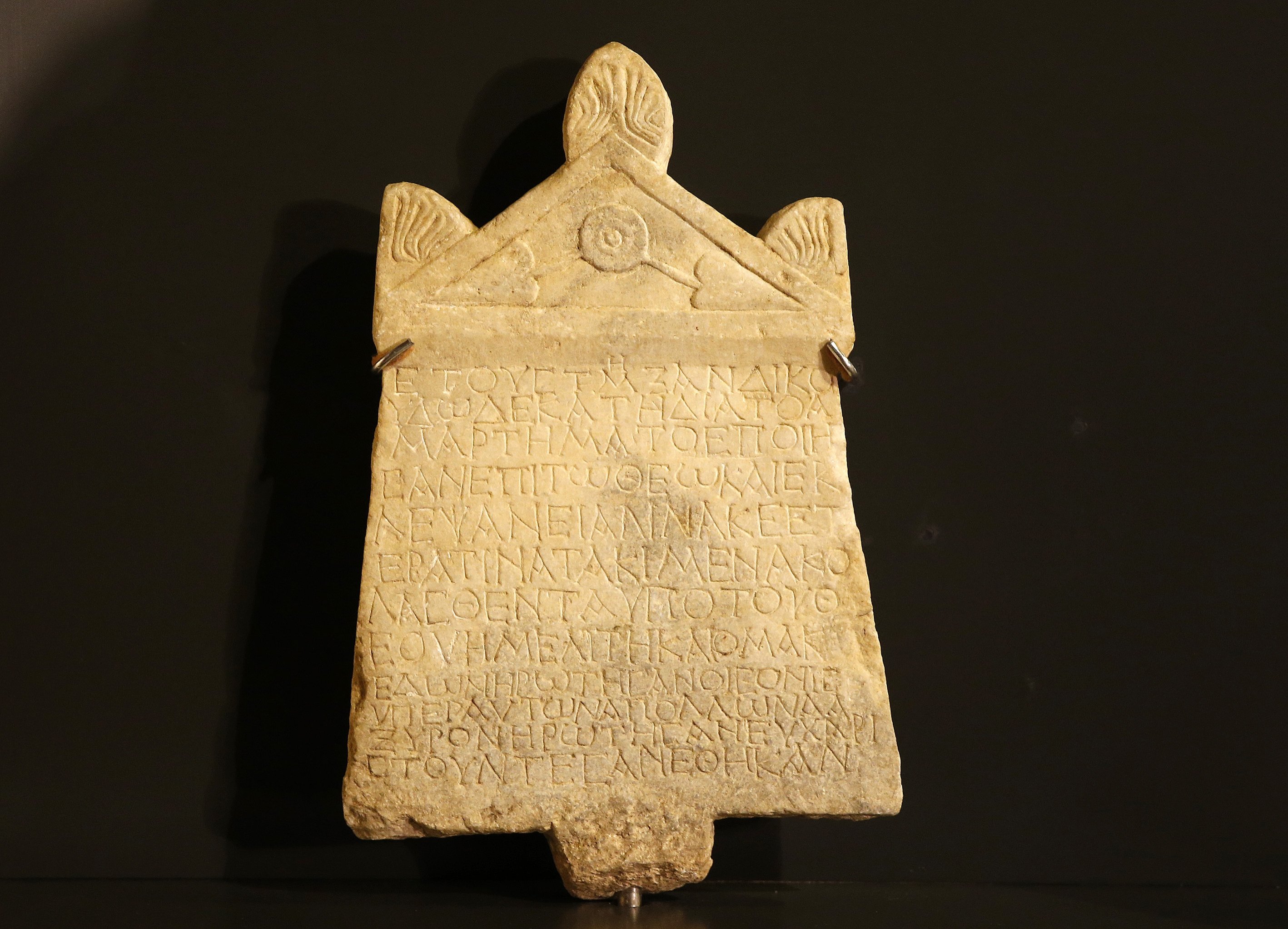
- Turkish security forces seize 1,800-year-old inscribed stele – The Archaeology News Network
- PaleoJudaica.com: Gruen, Ethnicity in the Ancient World
- PaleoJudaica.com: The full Gospel of Thomas
- Laudator Temporis Acti: Not a Man
- Guest comic – Lex Fajardo’s Kid Beowulf: The Tarpeian Rock | Greek Myth Comix
- Roman Times: Roman auxilia cavalry
- Four Years of Presidential Memories: Cranky about the State of the Country – SENTENTIAE ANTIQUAE
- The History Blog » Blog Archive » Oldest Roman body armour found in Germany
- Like Something Written By a Child: Self-Publishing Rich Guys – SENTENTIAE ANTIQUAE
- The Edithorial: Downs but More Ups in the North-East and Denmark
Blog-like Publications
- How does one interpret figurative art? – A look behind the curtain – Ancient World Magazine
- Seeing Through the History of Ancient Roman Glass
Fresh Podcasts
When we last left our Roman ladies, Octavia and Livia, their lives were changing fast. After all that bloodshed and drama, Octavian has finally been left as the last man standing in the fight for control over Rome. What happens now? Octavian becomes Augustus, Rome’s very first emperor, and the ladies become the imperial legends. Let’s explore the extreme highs (and sometimes very low lows) of the women in his life.
The Satyr play is one of the most enigmatic elements of Ancient Greek drama and we have few surviving examples of it. A look at the stories it told, its development and it’s place in the story of Ancient Greek theatre.
Persia launches its first invasion against Greece
This week, lovely Listeners, we bring you … a third person! Let us introduce you to the third of our triumvirate (ooohhh – Roman joke): Ms Eden Wood. Eden teaches Latin and Classical Civilisation in a Scottish secondary school and is doing all the hard work of getting kids into Classics. For the most part, we’ll be chatting about HEROISM – a subject studied in the Highers Curriculum – so, for any students studying the same course: listen up, she offers some serious GOLD here.
Possibly the most influential theologian in history, Paul codified and clarified Christianity as it emerged into the diverse world of the Eastern Mediterranean.
A desperate family become separated while fleeing a war zone in this famous story from Virgil’s epic poem The Aeneid, 2.624-795. I’m delighted to be joined on this episode by Dr Olivia Knops, from the University of Birmingham, and Ed Harrisson, who has composed all the music for the podcast. We have a good old natter about ancient and modern music, different musical moods, what we know about ancient music and how this can be transformed for modern listeners. The story features a new arrangement of the ancient Greek Seikilos Epitaph, the earliest known musical composition including musical notation.Content warning: war, fire, urban destruction, references to sexual violence.
What does it take to be a hero? Nowadays rescuing others, not being a coward, or just standing up for you principles seems to be the key. In the Trojan war you could spend years in a tent sulking while everyone else fights simply because you were denied a sex slave, and STILL be considered a Hero. Natalie Haynes has released a novel about the silenced women of the Trojan War, and chats to Iszi about a not-so-famous Amazon warrior – Penthesia, and debunks some of the myths surrounding her.
The odds are never a problem if you own half the racers. This is a story of a populist who brought down his own people. Born into wealth and unrivalled privilege, at least this particular politician fought in the wars alongside his friends. It didn’t stop him turning on them to save his skin, or indeed turning on his new friends to do it again. Featuring: Alcibiades David Stuttard is a writer, lecturer, theatre director, dramaturg and Fellow of Goodenough College, London.His Nemesis: Alcibiades and the Fall of Athens was published by Harvard University Press in April 2018. Iszi Lawrence is a presenter of BBC’s Making History and The British Museum Membercast. and on twitter:
Natalie Haynes joined me on the podcast to retell the stories of remarkable women at the heart of Greek myths, from Medusa, Penelope, and Pandora, to the Amazons.
Book Reviews
- [BMCR] Kaja Harter-Uibopuu, Epigraphische Notizen Zur Erinnerung an Peter Herrmann. Hamburger Studien zu Gesellschaften und Kulturen der Vormoderne, 6. Stuttgart: Franz Steiner Verlag, 2019.
- [BMCR] Carol Dougherty, Travel and home in Homer’s Odyssey and contemporary literature: critical encounters and nostalgic returns. Classical Presences. Oxford; New York: Oxford University Press, 2019.
Professional Matters
- CALL. 01.10.2020: Spartacus @ 60A Virtual Conference – (Online)
- CALL. 16.11.2020: Annus nefastus. Infortunios, cambios y oportunidades en el mundo romano – (Online)
Alia
- Ancient Agora of Athens | Athens | Year-Round | Survival Guide | ekathimerini.com
- New museum in Stabia tells story of Roman ‘otium’ – Culture – ANSAMed.it
- Why Homer may not have existed
- Plants and Trees Featured on Ancient Greek Coins: Catawiki
‘Sorting’ Out Your Day:
- Homeromanteion | Online Homeric Oracle
- Sortes Virgilianae (English)
- Sortes Virgilianae (Latin)
- Consult the Oracle at UCL
Today on the Etruscan Brontoscopic Calendar:
If it thunders today, it portends powerful men harnessing hatred and taking sides against each other.
… adapted from the text and translation of:
Jean MacIntosh Turfa, The Etruscan Brontoscopic Calendar, in Nancy Thomson de Grummond and Erika Simon (eds.), The Religion of the Etruscans. University of Texas Press, 2006. (Kindle edition)
 rogueclassicism