
John Pearce, King’s College London
In the amphitheatre of Gladiator II, Ridley Scott trains his lens on fighters and emperors – but no account of ancient gladiators is complete without its devotees.
Eclipsing the modern superfan in adulation for their heroes, fans massed in the amphitheatre to see their favourites fight, taking on a mania with potential for disaster. According to the Roman historian Tacitus, in AD27 a poorly built arena at Fidenae, just outside Rome, collapsed under the spectators. The incident left 50,000 dead or injured.
But gladiator fandom extended well beyond the arena. In the summer of 2019, archaeologists uncovered a tavern in Pompeii that had been decorated to show the bloody outcome of a gladiator fight. This hints at the way “sports talk” pervaded life in the city.
There’s more evidence in Roman author Petronius’s mid-first-century BC satire The Satyricon. His fictional freedmen banter about the merits of various fighters over dinner. The ubiquitous gladiator motifs found on Roman wine cups show that this kind of convivial exchange over dinner and drinks was common.
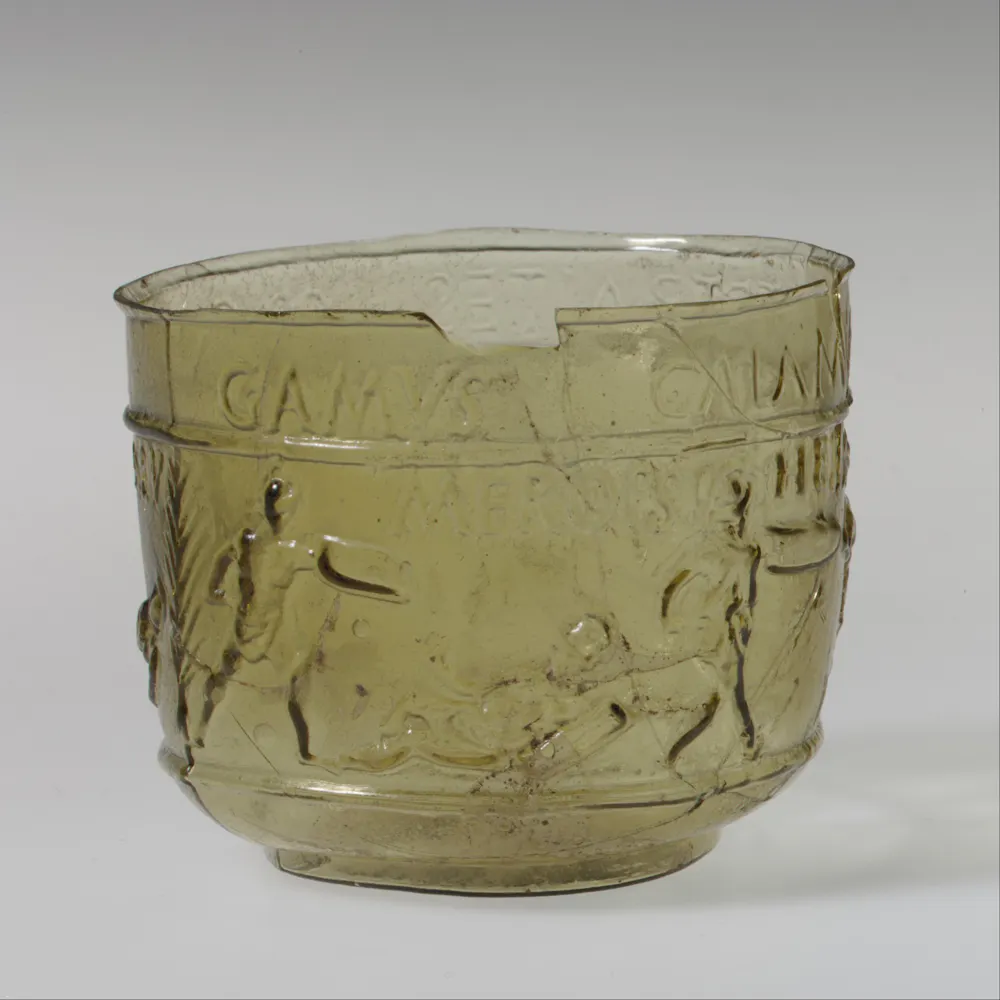
Their passion could, however, turn fans from drinkers into fighters. At Pollentia (modern day Majorca), Emperor Tiberius needed soldiers to quell riots borne of frustration at the absence of gladiators from a local bigwig’s funeral.
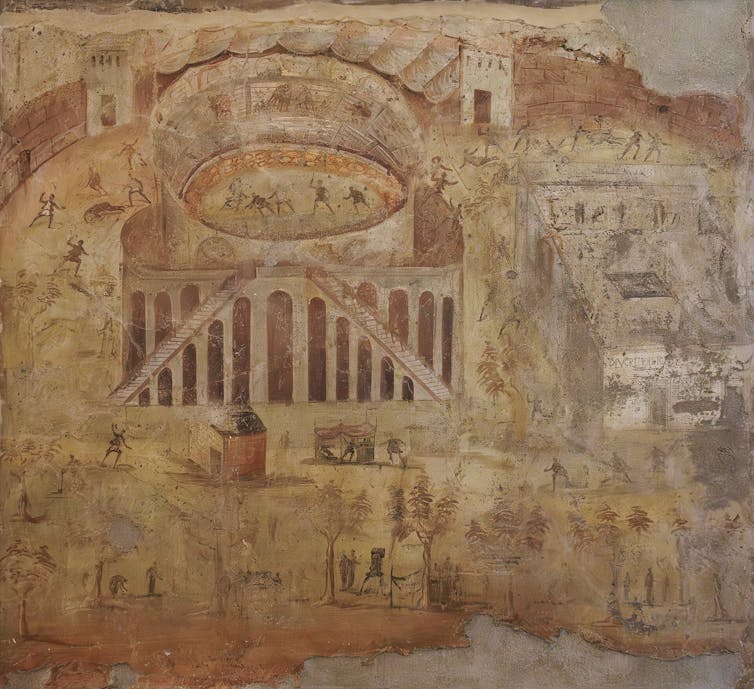
Much like modern-day football hooliganism, gladiator fandom could be weaponised in intercommunal violence. In a 59BC gladiatorial show, Pompeians murderously assaulted their neighbours from Nuceria (modern day Nocera, near Naples), causing games to be banned at Pompeii and leading to exile for the instigator.
Fan favourites
Fans were drawn to gladiators for more than just their fighting skills. Stage names could emphasise their good looks, lent by physique, coiffure and armour. Pearl and Emerald, for example, sparkled with jewel-like lustre. Callimorphus flaunted his peerless body and Chrysomallos and Xanthos their blonde locks.
It was common for Romans to illustrate the erotic appeal of a gladiator by naming the Roman women who, metaphorically, lost their heads to fighters. The Roman poet Juvenal wrote of the fictional, or perhaps fictionalised, wife of a Roman senator, Eppia, who allegedly preferred the battered arena veteran Sergius to her husband.
Meanwhile Faustina, wife of Marcus Aurelius, is said in a 4th century biography of the emperor, to have confessed a passion for gladiators to her husband.
But these examples more reliably testify to elite male misogyny than to ancient reality. Seating regulations may have confined them to the higher tiers of the amphitheatres, but many women likely also had an interest in combat itself. Some were perhaps authors of the gladiatorial graffiti still legible on Pompeii’s walls.
Tombstones tell a less sensational story of gladiators’ sex lives, where their partnerships are described by the language of respectable matrimony.
Who were the gladiator superfans?
Gladiator fans could be found in all strata of Roman society. But the voices of elite fans are loudest today, as they were preserved in literary texts. Members of powerful families and emperors well knew that they must put on gladiatorial and other games, since presiding at them was central to political theatre.
Wary of Julius Caesar’s reputation for obvious disdain for gladiatorial combat, Emperor Augustus was instead a visibly enthused spectator. The crowd’s acclaim for his generosity and its appreciation of his sharing common pleasures helped to bolster the emperor’s authority. At the Colosseum, senators could see how the political land lay as the emperor was applauded (or not) by their public.
Some emperors appreciated fighting technique close up. Titus was a parmularius (a fan of the “small shield” men), while his brother Domitian preferred the heavier-armed murmillones, named after the fish-like crest on their helmets.
But when they addressed the subject of gladiators directly, most elite men were usually ambivalent. Pagan and Christian authors, including Seneca and St Augustine, had no qualms over the shedding of gladiatorial blood. But they did regret the loss of reason among their peers as spectators, heady with emotion at the slaughter.
The genre in which these authors wrote also dictated what they said. Seneca, like Cicero, turned gladiators into philosophical examples, persevering in combat despite the vagaries of fortune.
But incidental literary references suggest that Roman elite males were closely acquainted with real gladiatorial nitty-gritty. Instructing would-be lawyers, for example, the Roman educator Quintilian reached for a gladiator’s fencing steps as a metaphor for a well-rehearsed argument.
Exceptionally well-preserved graffiti discovered on houses and tombs in Pompeii has brought us closer to understanding the ordinary fans of gladiators. In particular, the drawings of armoured combatants, which are captioned with their names, types and schools.

Looking for something good? Cut through the noise with a carefully curated selection of the latest releases, live events and exhibitions, straight to your inbox every fortnight, on Fridays. Sign up here.
Thoroughly versed in performer biographies, fans counted fights, wins and reprieves. This affinity went beyond individuals – men of the same status, neighbourhood or town crowded the stepped seating of the amphitheatres together, vociferously unified by ecstasy at a favourite’s success, or anguish at their defeat and death.
Yet while cinema foregrounds gladiators in our modern consciousness, ancient fans likely reserved greater passion for other performers – above all theatre and chariot racing.
When Roman authors, such as Pliny, decried the triviality of popular obsessions, it was chariot racing that came first to mind. And factions linked to chariot teams threatened political order on a scale never equalled by the amphitheatre. No known gladiator aficionado came close, for example, to the devoted fan who threw himself onto the burning pyre of his favourite chariot driver.
John Pearce, Reader in Archaeology, King’s College London
This article is republished from The Conversation under a Creative Commons license. Read the original article.

 rogueclassicism
