ROGUECLASSICIST’S BULLETIN January 6, 2025

===========================================================
ROGUECLASSICIST’S BULLETIN January 6, 2025
===========================================================
===========================================================
LEGENDA
===========================================================
Crocodile and eel mosaics discovered in Roman bath
https://www.hurriyetdailynews.com/crocodile-and-eel-mosaics-discovered-in-roman-bath-204337

UC Classics discovery to go on display in Greece for first time | University of Cincinnati
https://www.uc.edu/news/articles/2025/01/uc-classics-discovery-to-go-on-display-in-greece-for-first-time.html

Ancient Griffin Warrior Artifacts Displayed in Greece For the First Time – GreekReporter.com

Ancient Griffin Warrior Artifacts Displayed in Greece For the First Time

Ancient Greek “School Yearbook” Rediscovered in Scottish Museum Storage – GreekReporter.com

Ancient Greek “School Yearbook” Rediscovered in Scottish Museum Storage

Roman Bath and Magnificent Mosaics Used as Stables by the Villagers For Many Years – Arkeonews

Roman Bath and Magnificent Mosaics Used as Stables by the Villagers For Many Years

Dancing dwarf: A 2,300-year-old ancient Egyptian statue of a godlike man with a muscular 6-pack | Live Science
https://www.livescience.com/archaeology/ancient-egyptians/dancing-dwarf-a-2-300-year-old-ancient-egyptian-statue-of-a-godlike-man-with-a-muscular-6-pack

Israel uses ‘archaeology’ to justify Palestinian home demolition
https://www.newarab.com/features/israel-uses-archaeology-justify-palestinian-home-demolition

Roman stone coffin unearthed during roadworks in UK | Archaeology News Online Magazine

Roman stone coffin unearthed during roadworks in UK

In ancient Egypt, elite burial practices included sheep horn manipulation
https://www.ynetnews.com/travel/article/s1lksgo8ke

Roman Empire grew after catastrophic volcanic eruption, study finds | Live Science
https://www.livescience.com/archaeology/romans/roman-empire-grew-after-catastrophic-volcanic-eruption-study-finds

Evidence suggests Howard Carter stole artifacts from Tutankhamun’s tomb – The Jerusalem Post
https://www.jpost.com/archaeology/archaeology-around-the-world/article-836232

Turkish farmer discovers rare mosaic of ancient hunt
https://www.theartnewspaper.com/2025/01/06/turkish-farmer-discovers-rare-mosaic-of-ancient-hunt

Turkish Farmer Finds Massive Roman Mosaic While Planting Cherry Trees
https://www.artnews.com/art-news/news/farmer-unearths-massive-roman-mosaic-turkey-1234729259/

Polish archaeologists mark 60 years of discoveries in ancient Cypriot city – English Section
https://www.polskieradio.pl/395/7791/Artykul/3466896,polish-archaeologists-mark-60-years-of-discoveries-in-ancient-cypriot-city

Archaeologists Unearth Unknown Early Christian Settlement and Monastery in Israel – Archaeology – Haaretz.com
https://www.haaretz.com/archaeology/2025-01-06/ty-article-magazine/archaeologists-unearth-unknown-early-christian-settlement-in-israel/00000194-3bd4-d96e-a1d6-3bfc57c60000

Photo: The Israel Antiquities Authorities Reveal A Large Monastery Complex And Winepress – JER2025010616 – UPI.com
https://www.upi.com/News_Photos/view/upi/fc01eba0a897717d405e64d453041f1c/The-Israel-Antiquities-Authorities-Reveal-A-Large-Monastery-Complex-And-Winepress/

December 2024 in Turkish archaeology | Turkish Archaeological News
https://turkisharchaeonews.net/article/december-2024-turkish-archaeology

Archaeology in Turkey – 2024 in review | Turkish Archaeological News
https://turkisharchaeonews.net/article/archaeology-turkey-2024-review

2025 Proves the Theorem of Ancient Greek Philosopher Nicomachus – GreekReporter.com

2025 Proves the Theorem of Ancient Greek Philosopher Nicomachus

Are Etruscan artifacts in Italian Museums linked to Turkish evil eye beads? – Türkiye Today

Are Etruscan artifacts in Italian Museums linked to Turkish evil eye beads?

Archaeologists uncover Roman villa, reveal wine production secrets
https://www.vinetur.com/en/2025010383875/archaeologists-uncover-roman-villa-reveal-wine-production-secrets.html

Hagia Sophia’s Hidden Depths Revealed After 15 Centuries

Hagia Sophia’s Hidden Depths Revealed After 15 Centuries

An Economic Approach to Homer’s Odyssey: Part I – Econlib

An Economic Approach to Homer’s Odyssey: Part I

Stoic Opposition: The Philosophers Who Defied Roman Emperors

Stoic Opposition: The Philosophers Who Defied Roman Emperors

Open Socrates by Agnes Callard: 4-star review
https://www.telegraph.co.uk/books/non-fiction/review-open-socrates-agnes-callard/

How Romans accidentally lowered their IQs, according to Oxford University study
https://www.telegraph.co.uk/news/2025/01/06/how-romans-accidentally-lowered-iqs-lead-pollution-oxford/

Lead pollution across the Roman Empire would have caused IQ deficits | New Scientist
https://www.newscientist.com/article/2462766-lead-pollution-across-the-roman-empire-would-have-caused-iq-deficits/

They don’t make ’em like that anymore | The New Criterion

They don’t make ’em like that anymore

Plato: A Civic Life by Carol Atack — Open Letters Review
https://openlettersreview.com/posts/plato-a-civic-life-by-carol-atack

Why Is the Right Obsessed With Epic Poetry? | The Nation
https://www.thenation.com/article/culture/right-wing-epic-poetry/

AWOL – The Ancient World Online: Roman Identity: Between Ideal and Performance
https://ancientworldonline.blogspot.com/2025/01/roman-identity-between-ideal-and.html

AWOL – The Ancient World Online: The Archaeology of War: Studies on Weapons of Barbarian Europe in the Roman and Migration Period
https://ancientworldonline.blogspot.com/2025/01/the-archaeology-of-war-studies-on.html

AWOL – The Ancient World Online: Exaltation in the Epistles of St Paul Against the Background of Greek Classical Literature
https://ancientworldonline.blogspot.com/2025/01/exaltation-in-epistles-of-st-paul.html

AWOL – The Ancient World Online: Happy New Year and happy sixteenth birthday to AWOL
https://ancientworldonline.blogspot.com/2025/01/happy-new-year-and-happy-sixteenth.html

PaleoJudaica.com: Burke on defining “Christian Apocrypha”
https://paleojudaica.blogspot.com/2025/01/burke-on-defining-christian-apocrypha.html

Introducing “Storylife” – by Joel Christensen
https://joelchristensen.substack.com/p/introducing-storylife?publication_id=1870284&post_id=154285437&isFreemail=true&r=q7tlq&triedRedirect=true&utm_source=substack&utm_medium=email

Laudator Temporis Acti: Descendants of the Puritans
https://laudatortemporisacti.blogspot.com/2025/01/descendants-of-puritans.html

Laudator Temporis Acti: Scarcely Profitable Reading
https://laudatortemporisacti.blogspot.com/2025/01/scarcely-profitable-reading.html

Laudator Temporis Acti: No Loitering
https://laudatortemporisacti.blogspot.com/2025/01/no-loitering.html

Laudator Temporis Acti: Political Ads
https://laudatortemporisacti.blogspot.com/2025/01/political-ads.html

Berenike – Mainzer Beobachter

Berenike

Post Conference Reflections – Liv Mariah Yarrow

Post Conference Reflections

Divination, mostly Etruscan – Liv Mariah Yarrow

Divination, mostly Etruscan

Notes on the Capitoline – Liv Mariah Yarrow

Notes on the Capitoline

New Year, New Site – Classical Studies Support

New Year, New Site

Collections: Coinage and the Tyranny of Fantasy ‘Gold’ – A Collection of Unmitigated Pedantry

Collections: Coinage and the Tyranny of Fantasy ‘Gold’

Roman Times: Shopping for love in the House of the Colored Capitals, Pompeii
https://ancientimes.blogspot.com/2025/01/shopping-for-love-in-house-of-colored.html

Roman Times: Weighting the Pompeian wealth status calculation to avoid dominance of size alone
https://ancientimes.blogspot.com/2025/01/weighting-pompeian-wealth-status.html

So… You’ve Decided to Read the Odyssey – CSMFHT Writes
https://csmfht.substack.com/p/so-youve-decided-to-read-the-odyssey?publication_id=1211085&post_id=154058823&isFreemail=true&r=q7tlq&triedRedirect=true&utm_source=substack&utm_medium=email
===========================================================
AUDIENDA
===========================================================
Atlantis – The Ancients | Acast

The Early Alphabet (™) in Third Millennium Syria? Or, Spelling it Out, Lightly Baked Edition | This Week in the Ancient Near East
https://thisweekintheancientneareast.podbean.com/e/the-early-alphabet-%E2%84%A2-in-third-millennium-syria-or-spelling-it-out-lightly-baked-edition/
===========================================================
VIDENDA
===========================================================
De via silvestri by Satura Lanx – Latin language and literature for beginners

Studying Ancient History Can Be Annoying AF. – YouTube

VIRGIL Aeneid Book 1, 64-80: Juno asks Aeolus to destroy the fleet of Aeneas; Latin & English – YouTube

The Scutari | Warriors of History – YouTube

===========================================================
NOTANDA
===========================================================
Pompeii’s Secret Underworld | NOVA | PBS
https://www.pbs.org/wgbh/nova/video/pompeiis-secret-underworld/
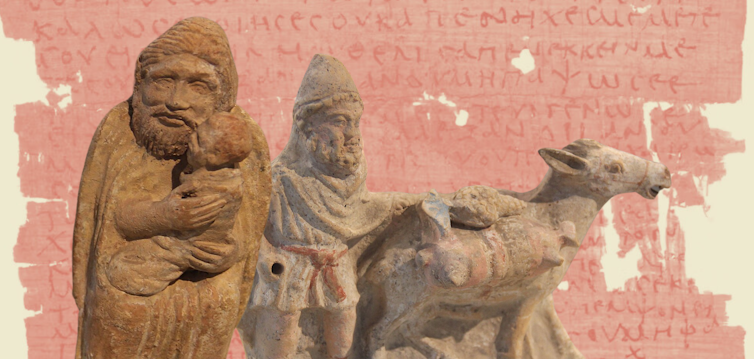
The Conversation: What were the Greeks and Romans like? Their letters suggest they weren’t so different from us

Ancient Greek clay statues of ordinary people, 3–1 century BCE.
Gary Todd/Wikimedia Commons

Konstantine Panegyres, The University of Melbourne

When we read about the Greco-Roman world, we often hear the stories of famous and wealthy men and women. But the letters of ordinary people, preserved on papyri in Egypt, show us what they were thinking and doing. Human nature, their contents suggest, hasn’t changed much.

Sometime in the 3rd century AD, in Egypt, a man called Zoilus wrote a letter to his mother Theodora about family news. He had just visited his sister Techosous, who was sick:

Zoilus to my mother Theodora, greetings. When I arrived in Thallou today, I found everyone at my brother’s house in good health. But my sister Techosous is fearfully ill, and I expect that she will give birth today to a seven months’ baby. If then she comes through it successfully, I will let you know what happened…

National Archaeological Museum of Athens 4BC.
George E. Koronaios/Wikimedia Commons, CC BY

We don’t know what happened to Zoilus’ sister Techosous. No letter about the events that occurred afterwards has been preserved. Maybe Techosous and her baby survived the birth. Maybe not.

Letters like this reveal ancient people’s everyday triumphs and tragedies. Brothers worry about their sisters, bosses rage at slack employees and children sulk at their parents.

Zoilus’s letter is one of many written by ordinary people from the Greco-Roman world that survive to the present day.

His letter was written in Greek on papyrus, a writing material made from the pith of the papyrus plant. The dry climate of Egypt allowed papyrus letters to survive buried under the ground, until they were excavated by modern researchers.

‘I should burn you!’

Ancient papyrus letters from Egypt sometimes preserve evidence of people’s strong emotions.

For example, in the 2nd century AD, Diogenes wrote a letter to his employee Apollogenes complaining about his failure to undertake some work:

A thousand times I’ve written to you to cut down the vines at Phai… But today again I get a letter from you asking what should be done. To which I reply: cut them down, cut them down, cut them down, cut them down, cut them down: there you are, I say it again and again!

Other letters also contain strong language. People weren’t afraid to hide their feelings.

In the 5th century AD, for example, someone called Valerius wrote a letter to a man named Athanasius calling him “a bad old man, a traitor and a pimp”, adding “I should burn you!”. The letter is only fragmentary. We don’t know what prompted Valerius to use this language.

Ancient Roman relief of a mêlée of Romans and Orientals from a sarcophagus.
Wikimedia Commons

A famously endearing letter is one written by a boy called Theon to his father in the 2nd or 3rd century AD. Theon was grumpy because his father was not going to take him to the big city, Alexandria:

If you won’t take me with you to Alexandria I won’t write you a letter or speak to you or say goodbye to you; and if you go to Alexandria I won’t take your hand nor ever greet you again. That it is what will happen if you won’t take me!

We don’t know if Theon’s father gave in and allowed his son to go with him to Alexandria.

Radish oil, bedspreads and other domestic items

The papyri also give us a glimpse of mundane everyday issues.

In the 2nd or 3rd century AD, a woman called Thaisarion – who was pregnant at the time – wrote a letter to her brothers. She talked about how she had seen off their sibling Ptolemaios earlier that day and asked them for various items she needed:

I want you to know that our brother Ptolemaios went upcountry early in the morning … I used for his dinner whatever you sent to me. Please send me the half two jars of radish oil of the same value as what I used. For I have need of them when I give birth … Send me also a jar of salve …

In a different letter of the same period, a man called Lucius wrote to his brother Apolinarius with a culinary request: “If you are making pickled fish for yourself send me a jar too”.

There are also letters in which people describe items they have sent to their addressees.

For example, in the 4th century AD, Psaeis wrote a letter to his wife Isis informing her of the goods she will soon receive: “I sent you two bedspreads, two pounds of purple dye, six baskets, and two towels made by Moueis”.

These letters give us insights into domestic details like what people ate, how they organised their households, and their interactions.

This painting of domestic kitchen items as created by an unknown 1st century AD Roman artist.
Stanley A Jashemski/Wikimedia Commons

The value of ordinary people’s letters

All of this makes the ancient world seem more relatable.

Researchers continue to work actively on excavating and translating this priceless material. Earlier this year, for instance, a trove of new Roman letters from the 1st and 2nd century AD was discovered in a cemetery in Egypt.

The more of these letters we discover from ordinary inhabitants of the ancient world, the more we learn about who they were.The Conversation

Konstantine Panegyres, McKenzie Postdoctoral Fellow, researching Greco-Roman antiquity, The University of Melbourne

This article is republished from The Conversation under a Creative Commons license. Read the original article.

The Conversation: Summer holidays haven’t changed much since ancient Greece and Rome (except maybe the sand wrestling)

Konstantine Panegyres, The University of Melbourne

Imagine a summer holiday at a seaside resort, with days spent sunbathing, reading books, exploring nature and chatting with friends.

Sounds like it could be anywhere in Australia or New Zealand in January, doesn’t it?

This is also how the Roman emperor Julian spent his summers in the 4th
century CE. Towards the end of 357 CE, Julian wrote a letter to his friend Evagrius, telling him how he spent his holidays at his grandmother’s estate as a boy and young man:

Very peaceful it is to lie down there and glance into some book, and then, while resting one’s eyes, it is very agreeable to gaze at the ships and the sea.

When I was still hardly more than a boy I thought that this was the most delightful summer residence, for it has, moreover, excellent springs and a charming bath and garden and trees.

As Julian got older, though, he had less time for summer holidays. Work consumed him. Even when he was on a break, he couldn’t fully relax.

This might sound familiar, too. It seems very little has changed from the days of the ancient Greek and Roman empires when it comes to finding time to unwind – and being on holidays, too.

Finding time for a break

Taking time off was important in ancient Greek and Roman times. Even Greek and Roman slaves were permitted to take a few holidays each year.

Not everyone could enjoy their holidays, however.

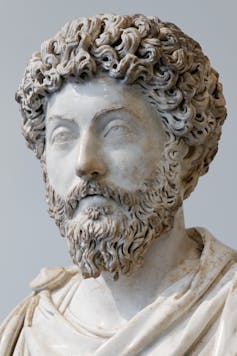
In 162 CE, Marcus Aurelius, then emperor of Rome, took four days of holiday at a resort in Alsium, a city on the coast of modern-day Italy.

Marcus Aurelius had a tough time relaxing.
Borghese Collection/Wikimedia Commons

According to his friend Marcus Cornelius Fronto (c. 95-166 CE), though, the emperor could not stop working. In a letter, Fronto criticises Marcus for continuing to work hard rather than sleeping in, exploring the seaside, rowing on the ocean, bathing and feasting on seafood.

Fronto amusingly says that Marcus, rather than enjoy his holiday, has instead “declared war on play, relaxation, good living, and pleasure”.

Going to the seaside

Relaxing by the coast was one of the things people in ancient Greece and Rome most enjoyed doing in the summer.

The rich built summer residences on the coast, while people of all walks of life flocked to seaside resorts to enjoy the fresh air and cool water.

The orator Libanius (314-393 CE) wrote that the people who really enjoy life the most are those who have the freedom to “drive to their estates, visit other towns, buy land, and visit the seaside”.

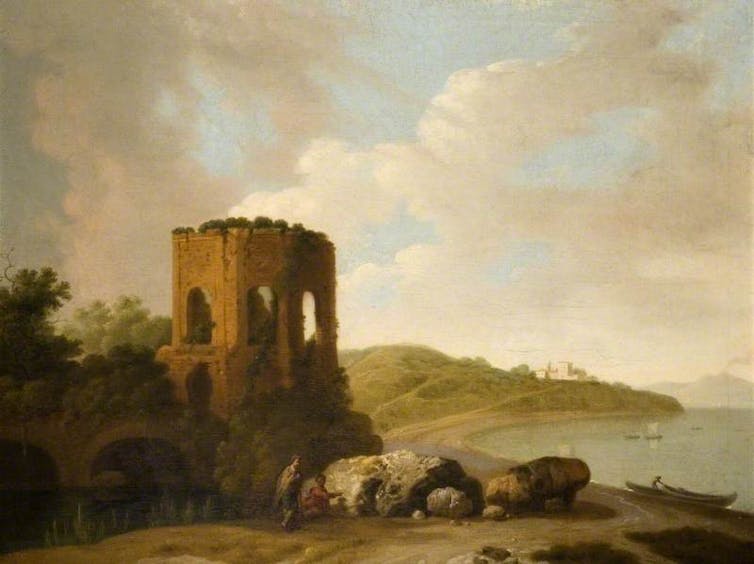
William Marlow painting of the ruins of the Temple of Venus at Baiae, a popular holiday spot for ancient Romans.
Birmingham Museums Trust/Wikimedia Commons

Health tourism was also a popular reason why people came to the seaside. Many ancient doctors recommended sea water and air as cures for all kinds of health problems, especially those related to the skin and respiratory system.

For example, the doctor Aretaeus of Cappadocia (c. 150-200 CE) recommended bathing in sea water, wrestling on sand and living by the sea as therapies for those who get frequent headaches.

Travelling abroad

Visiting foreign places was another of the things people in ancient Greece and Rome most enjoyed doing on their summer holidays.

For the Romans, trips to see Greece – and in particular Athens – were especially popular.

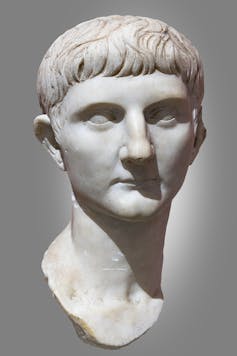
The Roman general Germanicus (15 BCE–19 CE) went on a tour of Greece in 18 CE, travelling from Athens eastward to Euboea, Lesbos, the coast of Asia Minor and then to Byzantium and Pontus.

Germanicus was drawn to the Greek classics.
Musée Saint-Raymond/Wikimedia Commons

According to the Roman historian Tacitus, Germanicus was motivated by a desire to see famous ancient sites. Like many Romans, he was fascinated by the old stories of the Greek past, so he was “eager to make the acquaintance of those ancient and storied regions”.

Another popular destination for ancient Greeks and Romans was Egypt, which had always been regarded as a land of wonder.

Roman tourists could catch regular boats from Puteoli to the great Egyptian city Alexandria. The trip took anywhere from one to two weeks, stopping along the way in Sicily and Malta.

Once there, the highlights were typically the great Nile River and Pyramids. Tourists marvelled at the immense temples and walls of hieroglyphic writing.

When Germanicus visited Egypt in 19 CE, he was so curious about the meaning of the hieroglyphics that he asked an old Egyptian priest to translate some for him.

In Alexandria, another attraction was the tomb of Alexander the Great (356-323 BCE). His body was stored in honey in a coffin made of glass. Ordinary tourists were not allowed to visit it, but VIPs like Roman emperors were.

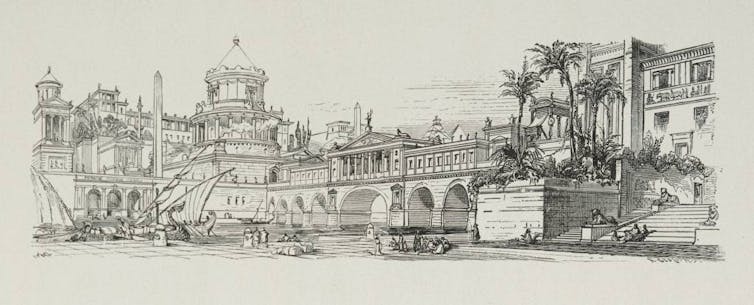
Tourists might also have enjoyed the different vibe in Alexandria. According to the Greek orator Dio of Prusa (c. 40-110/120 CE), the atmosphere in the coastal city was relaxed, with plenty of music, chariot racing and good food.

Line drawing of a scene from Alexandria in ancient times.
Adolf Gnauth/Wikimedia Commons

Lazy summer days

We can probably all relate to what the writer Pliny the Younger (61/62-112 BCE) said about his summer break.

Writing on a holiday in Tuscany, he said he can only work “in the lazy way to be expected during a summer holiday”. Working any other way was simply not possible. Many of us will be able to relate to that!The Conversation

Konstantine Panegyres, McKenzie Postdoctoral Fellow, researching Greco-Roman antiquity, The University of Melbourne

This article is republished from The Conversation under a Creative Commons license. Read the original article.

ROGUECLASSICIST’S BULLETIN January 2, 2025

===========================================================
LEGENDA
===========================================================
Large, well-preserved Roman-era bath mosaics discovered in Türkiye – Türkiye Today

Large, well-preserved Roman-era bath mosaics discovered in Türkiye

How Italy’s Carabinieri cultural heritage protection squad foiled tomb-raiders | Italy | The Guardian
https://www.theguardian.com/world/2025/jan/02/how-italys-carabinieri-cultural-heritage-protection-squad-foiled-tomb-raiders

Ancient Greek Shipwreck In Sicily Yields Rare “Atlantis Metal” Orichalcum

Ancient Greek Shipwreck in Sicily Yields Rare “Atlantis Metal” Orichalcum

Ancient Greek Inscriptions Found on Mountain in Central Asia – GreekReporter.com

Ancient Greek Inscriptions Found on Mountain in Central Asia

Unraveling the Secrets of Parion: An Ancient Greek City on the Hellespont – GreekReporter.com

Unraveling the Secrets of Parion: An Ancient Greek City on the Hellespont

‘Art in Gold: Jewellery in Hellenistic Times’ at Benaki continues

‘Art in Gold: Jewellery in Hellenistic Times’ at Benaki continues to April 2025

Lost site of Alexander the Great’s famous battle against ancient Persians discovered in Turkey | Live Science
https://www.livescience.com/archaeology/lost-site-of-alexander-the-greats-famous-battle-against-ancient-persians-discovered-in-turkey

Pyrrhus II, A Ruler Overshadowed By His Famous Grandfather

Pyrrhus II, a ruler overshadowed by his famous grandfather

Divers hoist 2,600-year-old shipwreck « Euro Weekly News
https://euroweeklynews.com/2025/01/02/spain-discovery-divers-hoist-2600-year-old-shipwreck-to-the-surface/

ArtDependence | Archaeologists discover Possible Bust of Cleopatra VII at Ancient Egyptian Temple
https://www.artdependence.com/articles/archaeologists-discover-possible-bust-of-cleopatra-vii-at-ancient-egyptian-temple/

Search for Cleopatra’s Tomb Yields Trove of Ancient Artifacts

Search for Cleopatra’s Tomb Yields Trove of Ancient Artifacts

A 2,000-year-old wooden tablet reveals the oldest Latin text written by – The Jerusalem Post
https://www.jpost.com/archaeology/archaeology-around-the-world/article-835799

Gauls, Galatians, and Galileans: Celts in the Holy Lands
https://substack.com/home/post/p-150308837

Beyond Togas and Gladiators: Why Latin Students Hate Roman Films – Inklings News

Beyond Togas and Gladiators: Why Latin Students Hate Roman Films

‘They see it is living’: Durham professor’s mission to get more pupils into classics | Classics and ancient history | The Guardian
https://www.theguardian.com/education/2025/jan/02/durham-professor-mission-classics-classical-education

Lessons for Keir Starmer from Cicero | The Spectator
https://www.spectator.co.uk/article/lessons-for-keir-starmer-from-cicero/

The ‘Myth and Marble’ of Rome Comes to America | National Review

The ‘Myth and Marble’ of Rome Comes to America

What Was Life Like in Pompeii? An Immersive Show Revives the Lost Roman City

What Was Life Like in Pompeii? An Immersive Show Revives the Lost Roman City

A Highly Hierarchical History: Same-Sex Relationships in the Biblical World | Bible Interp
https://bibleinterp.arizona.edu/articles/highly-hierarchical-history-same-sex-relationships-biblical-world

Blog Post #101: Peopling the Past Celebrates “Ancient Pasts for Modern Audiences” at the AIA – Peopling the Past

Blog Post #101: Peopling the Past Celebrates “Ancient Pasts for Modern Audiences” at the AIA

Roman Times: Gender fluidity in ancient Roman art
https://ancientimes.blogspot.com/2025/01/gender-fluidity-in-ancient-roman-art.html

Roman Times: The origin of elite red footwear in the ancient Mediterranean world
https://ancientimes.blogspot.com/2025/01/the-origin-of-elite-red-footwear-in.html

PaleoJudaica.com: Guide to ethnographic passages in Philo of Alexandria
https://paleojudaica.blogspot.com/2025/01/guide-to-ethnographic-passages-in-philo.html

Laudator Temporis Acti: A Wise Beast
https://laudatortemporisacti.blogspot.com/2025/01/a-wise-beast.html

Iceni updates: Expanding our understanding of Venta Icenorum – The Past

Iceni updates: Expanding our understanding of Venta Icenorum

Future Shock | Sphinx

Future Shock


===========================================================
AUDIENDA
===========================================================
Charlie Covell, Writer & Actor: Classics and Careers by The Classics Podcast

===========================================================
NOTANDA
===========================================================
Visiting Assistant Professor of Classics | Society for Classical Studies
https://classicalstudies.org/placement-service/2024-2025/38961/visiting-assistant-professor-classics

ROGUECLASSICIST’S BULLETIN January 1, 2024

===========================================================
LEGENDA
===========================================================
Guide to the classics: written more than 2000 years ago, Cicero’s On Old Age debunks stereotypes that persist today
https://theconversation.com/guide-to-the-classics-written-more-than-2000-years-ago-ciceros-on-old-age-debunks-stereotypes-that-persist-today-244173

British Museum unwraps secrets of Egyptian animal mummies using scans | The National
https://www.thenationalnews.com/news/uk/2025/01/01/british-museum-to-unwrap-the-secrets-of-its-animal-mummies-using-scans/

Ancient DNA sheds light on hidden European migrations in first millennium AD
https://phys.org/news/2024-12-ancient-dna-migrations-millennium-ad.html

Chilling Graffiti Found in an Ancient Greek Prison – GreekReporter.com

Chilling Graffiti Found in an Ancient Greek Prison

4th century mosaics from ancient Roman villa restored and reinstalled at – The Jerusalem Post
https://www.jpost.com/archaeology/archaeology-around-the-world/article-835645

Archaeologists Unearthed a Rare Hoard of Hasmonean Coins in Jordan Valley – Arkeonews

Archaeologists Unearthed a Rare Hoard of Hasmonean Coins in Jordan Valley

Colchester archaeologist recognised with MBE for Roman digs | Gazette
https://www.gazette-news.co.uk/news/24826385.colchester-archaeologist-recognised-mbe-roman-digs/

Deciphered Dead Sea Scroll Reveals 364-Day Calendar – Biblical Archaeology Society

Deciphered Dead Sea Scroll Reveals 364-Day Calendar

Archaeology in Turkey – 2024 in review | Turkish Archaeological News
https://turkisharchaeonews.net/article/archaeology-turkey-2024-review

December 2024 in Turkish archaeology | Turkish Archaeological News
https://turkisharchaeonews.net/article/december-2024-turkish-archaeology

AWOL – The Ancient World Online: Roundup of Resources on Ancient Geography
https://ancientworldonline.blogspot.com/2012/09/roundup-of-resources-on-ancient.html

AWOL – The Ancient World Online: List of Open Access Journals in Ancient Studies
https://ancientworldonline.blogspot.com/2015/12/alphabetical-list-of-open-access.html

Poëzie: het onontdekte land – Mainzer Beobachter

Poëzie: het onontdekte land

Anakreon – Mainzer Beobachter

Anakreon

Augustine’s “Enarrationes in Psalmos”, on Ps. 97/96:5 in the Vulgate – “terrae” or “terra” once more? – Roger Pearse

Augustine’s “Enarrationes in Psalmos”, on Ps. 97/96:5 in the Vulgate – “terrae” or “terra” once more?

PaleoJudaica.com: Satlow on what really happened on Hanukkah
https://paleojudaica.blogspot.com/2025/01/satlow-on-what-really-happened-on.html

PaleoJudaica.com: Minimal metal pollution at the Timna mines?
https://paleojudaica.blogspot.com/2025/01/minimal-metal-pollution-at-timna-mines.html
===========================================================
AUDIENDA
===========================================================
Anima Latina 01.01.2025 – Podcast – Radio Vaticana – Vatican News
https://www.vaticannews.va/it/podcast/rvi-programmi/anima-latina/2025/01/anima-latina-01-01-2025.html

2,000-Year-Old Mummy Unsealed in Italy’s Tomb of Cerberus | WION Podcast – YouTube

===========================================================
VIDENDA
===========================================================
Epiphany/Beckon/Banner #etymology – YouTube

A Very Basic Introduction To Ancient Carthage – YouTube