ROGUECLASSICIST’S BULLETIN February 25 , 2025

===========================================================
LEGENDA
===========================================================
The sweetest child in the world’: Mother’s tribute on Pergamon tombstone – The Jerusalem Post
https://www.jpost.com/archaeology/archaeology-around-the-world/article-843676

D.A. Bragg Announces Return Of 11 Antiquities To The People Of Greece – Manhattan District Attorney’s Office

D.A. Bragg Announces Return Of 11 Antiquities To The People Of Greece

Culture minister at The Met for return of ancient Greek bronze griffin | eKathimerini.com
https://www.ekathimerini.com/culture/1262570/culture-minister-at-the-met-for-return-of-ancient-greek-bronze-griffin/

The Met Returns Stolen Bronze Antiquity to Greece

The Met Returns Stolen Bronze Antiquity to Greece

Excavations reveal “Mosaic House” in ancient Pergamon
https://www.heritagedaily.com/2025/02/excavations-reveal-mosaic-house-in-ancient-pergamon/154611

Egypt completes revival of 3,000-year-old gold mining city at Jabal Sukari on Red Sea – Ancient Egypt – Antiquities – Ahram Online
https://english.ahram.org.eg/NewsContent/9/40/541051/Antiquities/Ancient-Egypt/Egypt-completes-revival-of-,yearold-gold-mining-ci.aspx

A Large Camp Where Gold Was Mined and Processed in Antiquity, Found in Southeastern Egypt

A Large Camp Where Gold Was Mined and Processed in Antiquity, Found in Southeastern Egypt

Ancient Egyptian wooden statuette from Saqqara found cracked upon discovery, now well-preserved – Ancient Egypt – Antiquities – Ahram Online
https://english.ahram.org.eg/NewsContentP/9/541004/Antiquities/Ancient-Egyptian-wooden-statuette-from-Saqqara-fou.aspx

Archaeologist Behind First Big Ancient Egyptian Find Since King Tut Says He’s Done It Again

Archaeologist Behind First Big Ancient Egyptian Find Since King Tut Says He’s Done It Again

Metal Detectorists Stumble Upon a Rare 2,000-Year-Old Roman Sword in Poland | Smithsonian
https://www.smithsonianmag.com/smart-news/metal-detectorists-stumble-upon-a-rare-2000-year-old-roman-sword-in-poland-180986101/

2,000-year-old Roman gossip book makes UK bestseller charts | Euronews
https://www.euronews.com/culture/2025/02/25/2000-year-old-roman-gossip-book-makes-uk-bestseller-charts

Archaeologists find Isis statue at ancient Roman site in Mallén, Spain – The Jerusalem Post
https://www.jpost.com/archaeology/archaeology-around-the-world/article-843669

Pyrrhus of Epirus: The Ancient Greek King’s Legacy Beyond the Battlefield – GreekReporter.com

Pyrrhus of Epirus: The Ancient Greek King’s Legacy Beyond the Battlefield

This ancient amphitheatre near Rome doesn’t know if it’s a football pitch or a tourist attraction | Euronews
https://www.euronews.com/travel/2025/02/25/this-ancient-amphitheatre-near-rome-doesnt-know-if-its-a-football-pitch-or-a-tourist-attra

AWOL – The Ancient World Online: Céramique en contextes. Érétrie au tournant des époques archaïque et classique
https://ancientworldonline.blogspot.com/2025/02/ceramique-en-contextes-eretrie-au.html

AWOL – The Ancient World Online: Sensory Experiences in the Roman North
https://ancientworldonline.blogspot.com/2025/02/sensory-experiences-in-roman-north.html

Gassy After Sex and Consuming Souls – SENTENTIAE ANTIQUAE

Gassy After Sex and Consuming Souls

Laudator Temporis Acti: Paying Taxes
https://laudatortemporisacti.blogspot.com/2025/02/paying-taxes.html

PaleoJudaica.com: JQR 115.1 (2025)
https://paleojudaica.blogspot.com/2025/02/jqr-1151-2025.html

The Way I Feel | Sphinx

The Way I Feel

Brock to make splash with Metamorphoses mainstage – The Brock News

Brock to make splash with Metamorphoses mainstage

Opium, castoreum and patchouli: What an eye ointment reveals about ancient Rome – Knowledge Blogs – derStandard.de › Knowledge and Society
https://www.derstandard.de/story/3000000258385/opium-castoreum-and-patchouli-what-an-eye-ointment-reveals-about-ancient-rome

Is Stoicism Too Cold and Logical?
https://stoicism.substack.com/p/is-stoicism-too-cold-and-logical

Why we’re stuck in Ancient Rome – New Statesman
https://www.newstatesman.com/culture/books/book-of-the-day/2025/02/why-were-stuck-in-ancient-rome

The politics of meaning what you say | Blog post | Mary Beard
https://www.the-tls.co.uk/regular-features/mary-beard-a-dons-life/the-politics-of-meaning-what-you-say-blog-post

Ephemeris ~ DE COMITIIS GERMANIS
https://ephemerisnuntii.eu/nuntius.php?id=2423

Christopher Nolan’s The Odyssey Movie Needs To Avoid One Flaw That Hurt Brad Pitt’s Troy
https://screenrant.com/christopher-nolan-odyssey-gods-troy-op-ed/

Demanding witness: women and the trauma of homecoming in Greek tragedy – Bryn Mawr Classical Review

Demanding witness: women and the trauma of homecoming in Greek tragedy

Didymus Alexandrinus. The fragments of the commentaries on comedy – Bryn Mawr Classical Review

Didymus Alexandrinus. The fragments of the commentaries on comedy

Roman Large Bronzes on the Limes: Fragments in the Raetian Region – Bryn Mawr Classical Review

Römische Grossbronzen am Limes: Fragmente im raetischen Raum


===========================================================
AUDIENDA
===========================================================
The Milkman Cometh: Lactantius, Christian Cicero Part I (Ad Navseam, Episode 174) | Ad Navseam
https://adnavseam.podbean.com/e/the-milkman-cometh-lactantius-christian-cicero-part-i-ad-navseam-episode-174/

===========================================================
VIDENDA
===========================================================
The City & God Assur (Ashur) in Ancient Mesopotamia – YouTube

===========================================================
NOTANDA
===========================================================
Visiting Assistant Professor Of Classics & Ancient Mediterranean Studies – HigherEdJobs
https://www.higheredjobs.com/region/details.cfm?JobCode=179064606&Title=Visiting%20Assistant%20Professor%20Of%20Classics%20%26amp%3B%20Ancient%20Mediterranean%20Studies

Harvard Academic Positions | Lecturer on Latin Language and Literature
https://academicpositions.harvard.edu/postings/14763

ICAEM 2025: Mobility in the Ancient Near East and Mediterranean: Movements of People, Objects and Ideas – RESEARCH CENTER OF ANCIENT NEAR EASTERN AND MEDITERRANEAN CULTURES (CAEMC)

ICAEM 2025: Mobility in the Ancient Near East and Mediterranean: Movements of People, Objects and Ideas

Call for contributions for Unearthing Ancient Horrors volume | Institute of Archaeology – UCL – University College London
https://www.ucl.ac.uk/archaeology/news/2025/feb/call-contributions-unearthing-ancient-horrors-volume

Wearing Antiquity: modern fashion and the past 2000 BCE – 1000 AD 9th International Conference IMAGINES | Institute of Classical Studies
https://ics.sas.ac.uk/events/wearing-antiquity-modern-fashion-and-past-2000-bce-1000-ad-9th-international-conference
The Conversation: How Roman society integrated people who altered their bodies and defied gender norms

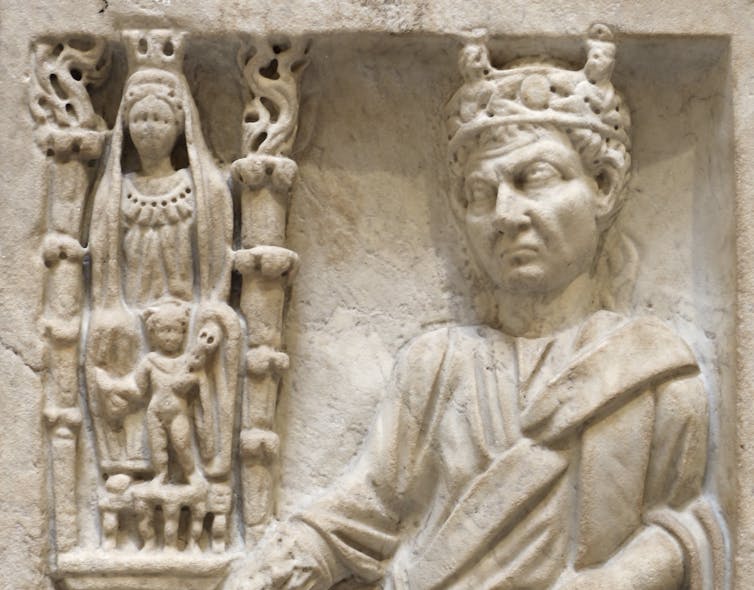
A relief showing a gallus making sacrifices to the goddess Cybele and Attis.
Sailko via Wikimedia Commons, CC BY

Tom Sapsford, Boston College

A few weeks into his second term, President Donald Trump signed two executive orders restricting the rights of trans workers in the federal government. The first was a renewal of the ban on transgender people joining the U.S. military – initially signed in 2017 and later repealed by President Joe Biden in 2021. The second was a more sweeping memo that recognizes only two sexes in federal records and policies.

In the ancient Roman world, which I study, biological sex and gender expression did not always line up as neatly as the president is demanding to see in today’s government.

In antiquity, there were masculine women, feminine men and people who altered their bodies to match their gender expression more closely. In particular, two figures – the cinaedus and the gallus – provide examples of men whose effeminate behavior and modified anatomies were striking yet still integrated into Roman society.

The cinaedus and the commander in chief

In ancient Rome, some men who did not fit neatly within gender categories were called “cinaedi.” They were usually adult males singled out for their extreme effeminacy and nonnormative sexual desires.

The cinaedus was already a recognizable figure in ancient Greece and was first mentioned in the fourth century B.C. by Plato. He says little more than that a cinaedus’ life was terrible, base and miserable. Later Roman authors provide more detail.

Martial, a Roman poet writing in the first century A.D., for instance, describes a cinaedus’ dysfunctional penis as like a “soggy leather strap” in one epigram. In the same century, the Roman novelist Petronius has a cinaedus suggest that both he and his fellows have had their genitals removed.

In a fable by Phaedrus, also written in the first century A.D., a barbarian is threatening the troops of the military leader, Pompey the Great. All are afraid to challenge this fierce opponent until a “cinaedus” volunteers to fight.

The cinaedus is described as a soldier of great size but with a cracked voice and mincing walk. After pleading permission in a stereotypically lisping manner from Pompey the Great, his commander in chief, the cinaedus steps into battle. He quickly severs the barbarian’s head and, with army agog, is summarily rewarded by Pompey.

In Phaedrus’ fable, the cinaedus is untrustworthy. He is described as having stolen valuables from Pompey early on in the tale and then later swears on oath that he hasn’t.

Yet the moral of Phaedrus’ fable of the soldier-cinaedus is that such deceptive appearances and actions might actually be strategically successful in military matters. The cinaedus has an edge over Pompey’s other soldiers precisely due to his disarming effeminacy. In the tale, this doesn’t at all diminish his skills as a lethal fighter. Rather, the cinaedus’ effeminacy combined with his martial valor ultimately lead to the barbarian’s defeat.

Trans priests and the safety of the Roman state

The galli, another group that lived in the heart of the city of Rome, also blurred gender roles. They were males who had castrated their genitalia in dedication to the Great Mother goddess Cybele, who was their protector.

As reported by several ancient sources, including Cicero and Livy, in 204 B.C. the Roman state consulted a set of prophetic scrolls called the Sibylline Oracles on how best to respond to the pressures it faced as a result of the Second Punic War – Rome’s prolonged conflict with Carthage and its fierce military general, Hannibal.

The oracles’ answer – and Rome’s subsequent action – was to import a strange and foreign religious order from Asia Minor into the heart of Rome, where it would remain for the next several hundred years.

The temple of Cybele was located on the Palatine Hill, next to several important shrines, monuments and later even the residence of the Emperor Augustus. As the poet Ovid tells us, each year during Cybele’s festival the galli would proceed through the streets of Rome carrying a statue of the goddess, while ululating wildly in time with the sound of wailing pipes, banging drums and crashing cymbals.

More so than the figure of the cinaedus, ancient literary sources present the galli’s gender difference similarly to modern-day trans women, often using feminine pronouns when describing them.

For instance, the poet Catullus details the origin story of the galli’s founder figure, Attis, who was Cybele’s mythical consort and chief priest. Notably, Catullus switches from using masculine adjectives to feminine ones at the very moment of Attis’ self-castration.

Attis.

Similarly, in his novel, “The Golden Ass,” the second century A.D. writer Apuleius has one gallus address his fellow devotees as “girls.”

While several ancient sources mock these figures for their gender-nonconforming appearance and behaviors, it is nevertheless evident that the galli held a sacred place within the Roman state. They were viewed as being important to Rome’s continued safety and prominence.

For example, Plutarch in his “Life of Marius” relates that a priest of the Great Mother came to Rome in 103 B.C. to convey an oracle that the Romans would be triumphant in war. Though believed by the Senate, this priest, Bataces, was mocked mercilessly in the plebian assembly. However, when the individual who had insulted Bataces swiftly died of a terrible fever, the plebians too gave this oracle and the goddess’s prophetic powers their backing.

Today’s trans issues

Behind Trump’s executive orders are two assertions: first, that transgender identity is a form of ideology: a modern invention created to justify deviance from one’s sex as assigned at birth; second, that transgender identity is both a form of disease and of dishonesty.

The reissued military ban doubles down on the perceived dishonesty of trans folk, contrasting it with the ideals and principles needed for combat. The order states that the “adoption of a gender identity inconsistent with an individual’s sex conflicts with a soldier’s commitment to an honorable, truthful, and disciplined lifestyle.”

Taking a long view of gender diversity across millennia has shown me that many individuals in antiquity certainly lived lives outside of the clear-cut formula that the Trump administration has stated, namely that “women are biologically female and men are biologically male.”

Gender diversity is not simply a late 20th- or early 21st-century phenomenon. However, the fear that gender-diverse people are diseased and devious likewise arises in several ancient sources. In the classical world, these fears seem limited to the realms of satire and fantasy; in our current time, we are seeing these fears being harnessed for government policy.

This article incorporates material from a story originally published on Aug. 1, 2017.The Conversation

Tom Sapsford, Assistant professor of Classical Studies, Boston College

This article is republished from The Conversation under a Creative Commons license. Read the original article.