ROGUECLASSICIST’S BULLETIN March 31, 2025

===========================================================
LEGENDA
===========================================================
First person from “Year 0” unearthed in an extraordinary grave and stumble upon a mysterious word – AS USA
https://en.as.com/latest_news/first-person-from-year-0-unearthed-in-an-extraordinary-grave-and-stumble-upon-a-mysterious-word-n/

In Ancient Greece and Rome, who were the harpies, and why did they stink so much?
https://theconversation.com/in-ancient-greece-and-rome-who-were-the-harpies-and-why-did-they-stink-so-much-249722

Archaeologists Uncover First Evidence Of Epic Biblical Battle “Armageddon” At Megiddo

Archaeologists Uncover First Evidence of Epic Biblical Battle “Armageddon” at Megiddo

[AI?]Did Roman historians mark the crucifixion of Jesus? – The Jerusalem Post
https://www.jpost.com/archaeology/archaeology-around-the-world/article-848111

[AI?]Homeric jug reveals wine was an everyday drink in Troy – The Jerusalem Post
https://www.jpost.com/archaeology/archaeology-around-the-world/article-848102

[AI?]Rare Roman coin of Emperor Vitellius sells for £4,700 – The Jerusalem Post
https://www.jpost.com/archaeology/archaeology-around-the-world/article-848274

Ancient Tomb with Gladiator Epitaph Discovered in Italy | TheCollector
https://www.thecollector.com/ancient-tomb-gladiator-epitaph-discovered-italy/

Unlocking the secrets of Roman Hispania: Rare coin mold found – The Jerusalem Post
https://www.jpost.com/archaeology/archaeology-around-the-world/article-848106

Abydos tomb: Penn Museum and Egyptian Archaeologists report

Abydos tomb: Penn Museum and Egyptian Archaeologists report

Why Catullus Continues to Seduce Us | The New Yorker
https://www.newyorker.com/magazine/2025/04/07/catullus-poems-book-review-stephen-mitchell-isobel-williams

Monsters of Rome: do emperors such as Nero and Caligula deserve their reputations? | HistoryExtra
https://www.historyextra.com/membership/monsters-rome-emperors-reputation-tom-holland/

Ephemeris ~ CONCUSSIO BIRMANICA
https://ephemerisnuntii.eu/nuntius.php?id=2427

Alex Lyras’ Aristotle/Alexander Play Premieres in Los Angeles – GreekReporter.com

Alex Lyras’ Aristotle/Alexander Play Premieres in Los Angeles

Hofstra Drama Puts a Modern Spin on an Ancient Greek Tragedy | News | Hofstra University, New York
https://news.hofstra.edu/2025/03/31/hofstra-drama-puts-a-modern-spin-on-an-ancient-greek-tragedy/

Theatre Performance: Ismene-A New Greek Tragedy – Truckee Meadows Community College
https://www.tmcc.edu/calendar/2025/04/25/theatre-performance-ismene-new-greek-tragedy

Only Bad Dudes Want Statues in the First Place – SENTENTIAE ANTIQUAE

Only Bad Dudes Want Statues in the First Place

Back to RGTO: Reading Tragedy Together When Sheltering Alone – SENTENTIAE ANTIQUAE

Back to RGTO: Reading Tragedy Together When Sheltering Alone

The Odyssey, Book 22 parts 1-2 | Greek Myth Comix
https://greekmythcomix.com/comic/the-odyssey-book-22-parts-1-2/

Hoe reconstrueer je een tempel? – Mainzer Beobachter

Hoe reconstrueer je een tempel?

Weekly Varia no. 124, 03/30/25 – Noodlings

Weekly Varia no. 124, 03/30/25

AWOL – The Ancient World Online: Αncient Greek II: A 21st-Century Approach
https://ancientworldonline.blogspot.com/2025/03/ncient-greek-ii-21st-century-approach.html

PaleoJudaica.com: Review panel on Neis, When a Human Gives Birth to a Raven (3-4)
https://paleojudaica.blogspot.com/2025/03/review-panel-on-neis-when-human-gives_31.html

PaleoJudaica.com: Podcast interview with Emanuel Tov on the scribes of Qumran
https://paleojudaica.blogspot.com/2025/03/podcast-interview-with-emanuel-tov-on.html

PaleoJudaica.com: Kitchen obituary
https://paleojudaica.blogspot.com/2025/03/kitchen-obituary.html

Neglected architectural decoration from the late antique city: public porticoes, small baths, shops/workshops, and ‘middle class’ houses in the east Mediterranean – Bryn Mawr Classical Review

Neglected architectural decoration from the late antique city: public porticoes, small baths, shops/workshops, and ‘middle class’ houses in the east Mediterranean

Die epigraphische Kultur an Oberrhein und Neckar in römischer Zeit – Bryn Mawr Classical Review

Die epigraphische Kultur an Oberrhein und Neckar in römischer Zeit

From Hannibal to Sulla: the birth of civil war in Republican Rome – Bryn Mawr Classical Review

From Hannibal to Sulla: the birth of civil war in Republican Rome


===========================================================
AUDIENDA
===========================================================
(5) March 2025 Q&A – by Jordan Galczynski and Kara Cooney
https://ancientnow.substack.com/p/march-2025-q-and-a?utm_source=podcast-email&publication_id=752411&post_id=159566917&utm_campaign=email-play-on-substack&utm_content=listen_now_button&r=q7tlq&triedRedirect=true&utm_medium=email

The Case of the Late Iron Age Building in the Middle of the Desert Filled With Dead Young Women Probably Going to Yemen for Unclear and Possibly Unsavory Reasons, or Worst Vacation Ever? | This Week in the Ancient Near East
https://thisweekintheancientneareast.podbean.com/e/the-case-of-thelateironagebuilding-in-themiddle-ofthedesert-filled-with-dead-youngwomenprobablygoingto-yemenfor-unclear-andpossiblyunsavory-reasons-or/

Versus: The Cimbrian War I by Deep into History

===========================================================
VIDENDA
===========================================================
(892) Strade, santuari e domus tra Palatino e Velia nella media età repubblicana (IV-III secolo a.C.) – YouTube

(892) The Celtiberian Warrior | Warriors of History – YouTube

===========================================================
NOTANDA
===========================================================
Studentship in Roman History or Latin Language and Literature

Studentship in Roman History or Latin Language and Literature

Assistant Professor in Egyptian Archaeology (ARCH_01) job with DURHAM UNIVERSITY | 390848
https://www.timeshighereducation.com/unijobs/listing/390848/assistant-professor-in-egyptian-archaeology-arch_01-/

3-year Visiting Assistant Professor of Classics | Society for Classical Studies
https://www.classicalstudies.org/placement-service/2024-2025/39044/3-year-visiting-assistant-professor-classics

Assessing the Sacred Significance of Figurative Terracottas
Assessing the Sacred Significance of Figurative Terracottas

The Conversation: In Ancient Greece and Rome, who were the harpies, and why did they stink so much?

Krikkiat / Shutterstock.com

Kitty Smith, University of Sydney

Once yelled at women seen to be pestering or annoying – or at feminists questioning and threatening the status quo – “harpy” has long been used as a derogatory term targeting women.

But have you ever wondered what a harpy was in the first place?

Much like similar derogatory titles “siren” and “fury”, the term “harpy” is derived from a group of monstrous female figures from ancient Greek and Roman mythology.

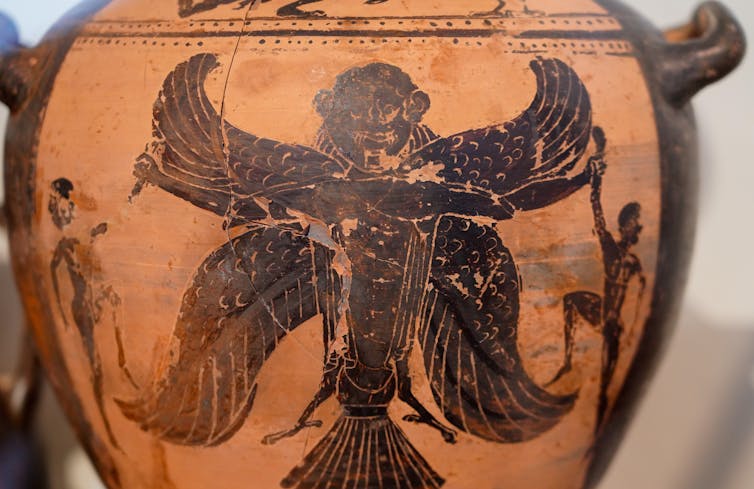
This picture depicts the harpies being driven from the table of King Phineus, a story told in the Argonautica by Apollonius of Rhodes, in which Jason and the Argonauts search for the golden fleece.
The Metropolitan Museum of Art/Rogers Fund, 1967

Who were the harpies?

In Greek and Roman myth, the harpies were a group of animal-human hybrid monsters on par with other such mythological creatures like the sirens, the sphinx, and the centaurs.

Harpies were commonly imagined as an amalgam of a bird’s body, such as wings and claws, with a woman’s head.

The ancient story of the Aeneid, by Latin poet Virgil, describes the story’s hero Aeneas encountering harpies on his quest to found Rome, saying:

Maiden faces have these birds, foulest filth they drop, clawed hands are theirs, and faces ever gaunt with hunger.

This description matches a common design from Greek and Roman art of birds with women’s heads.

In Greco-Roman myth, the harpies were typically tasked with meting out justice on behalf of Zeus and other gods by using their great speed from their wings and sharp talons.

The importance of their claws was likely a result of their name, which was derived from the Ancient Greek word for “snatching” (ἁρπάζω or harpazdo).

As was common of many mythological figures with hybrid features, the way their animal features were portrayed tended to vary across different media (art or literature), different narrative purposes, and over time.

Sometimes the claws were emphasised; other times it was their supernaturally swift wings and voracious hunger.

Harpies were a common motif in many parts of the world. This roughly 12th Century statue is from modern-day Iran.
Harpies were also a common motif in many parts of the Muslim world. This roughly 12th Century statue is from modern-day Iran.
The Metropolitan Museum of Art/Cora Timken Burnett Collection of Persian Miniatures and Other Persian Art Objects, Bequest of Cora Timken Burnett, 1956

Enforcers of swift justice

The harpies were not nice people. They existed in myth to dish out punishments from the gods.

Their primary target? Phineus, a seer and king of Salmydessus in Thrace, a city believed to have been located on the Western coast of the Black Sea near the modern day Turkish town of Kıyıköy.

His story is told in the Argonautica by ancient Greek author Apollonius of Rhodes. This tale centres on the journey of Jason and the Argonauts in search of the golden fleece.

In the story, Phineus is said to have abused his powers as a seer by sharing too many of the gods’ secrets with mortals.

This was among the most egregious of crimes in the eyes of the gods, so an especially awful punishment was decided upon.

Phineus was blinded and given the dubious gift of immortality while still allowed to age endlessly. And worst of all, he was set upon by the harpies.

Every time Phineus picked up and tried to eat food, the harpies would burst out from the clouds, moving as fast as lightning, and

with their crooked beaks incessantly snatched the food away from his mouth and hands.

The harpies brought a further gift for Phineus: their smell. This supernaturally “intolerable stench” could putrefy food, so any scraps the harpies didn’t grab were left rotting on the table. You couldn’t even stand near it, “so foully reeked the remnants of the meal”.

And while the harpies swooped in and out in seconds, their smell stuck to the rotting food (and probably poor Phineus).

Some ancient poets add a little extra zest and disgust by also suggesting the harpies may have been defecating on the food, and presumably Phineus.

Most notable is Virgil in his text the Aeneid who wrote about “foedissima ventris proluvies”, meaning:

the foulest discharges from their bellies.

This was likely an exaggeration of their bird-like qualities, used to emphasise how disgusting and monstrous they were.

Phineus was eventually given a reprieve from the harpies, by order of Zeus, so he could help the hero Jason on his quest for the golden fleece.

Having completed their job, the harpies then flew to Crete to live in a cave far away from annoying mortals – only being disturbed once by Aeneas on his meandering path to Rome.

The story of Phineus helped harpies become a metaphor for greed.

Those compared to harpies could include greedy house-guests overstaying their welcome, people living extravagantly or frivolously, or even family members taking advantage of wealthy relatives.

Although the harpies were female monsters, the term was not exclusively applied to women, but used to describe groups of greedy people.

Harpies were often associated with greed. In this Renaissance painting, part of a series depicting the Seven Deadly Sins, a harpy-drawn chariot is being used by Gluttony (who has wings, carries a jug and and wears wine leaves in her hair).
The Metropolitan Museum of Art, Gift of Mrs. Frederic R. Coudert Jr., in memory of Mr. and Mrs. Hugh A. Murray, 1957.

Harpies today

Happily, today the title of “harpy” is falling out of favour as a derogatory term. But the hordes of monstrous, snatching, winged women live on in modern books, games, comics, movies and TV shows.

From video games with swathes of harpy-like creatures snatching and clawing at the protagonist, like the 2020 video game Hades, to characters in stories inspired by Greek and Roman myth, the harpies are sticking around – like a bad smell.The Conversation

Kitty Smith, PhD Candidate in Classical Greek and Roman History, University of Sydney

This article is republished from The Conversation under a Creative Commons license. Read the original article.

ROGUECLASSICIST’S BULLETIN March 30, 2025

===========================================================
LEGENDA
===========================================================
Rare Roman coin found in Dudley field sells for nearly £5,000
https://www.bbc.com/news/articles/c0mwm8nw914o

Melsonby hoard: iron-age Yorkshire discovery reveals ancient Britons’ connections with Europe
https://theconversation.com/melsonby-hoard-iron-age-yorkshire-discovery-reveals-ancient-britons-connections-with-europe-253274

Demetrios: The Ancient Greek Who Traveled to England – GreekReporter.com

Demetrios: The Ancient Greek Who Traveled to England

Ancient Greek Masterpiece Painting at King Philip of Macedon’s Tomb Revived Digitally – GreekReporter.com

Ancient Greek Masterpiece Painting at King Philip of Macedon’s Tomb Revived Digitally

Exploring the hunting mural from the Tomb of Philip II in Vergina – ProtoThema English

Exploring the hunting mural from the Tomb of Philip II in Vergina

[AI?]Classical Greek fresco revived with the help of AI – The Jerusalem Post
https://www.jpost.com/archaeology/archaeology-around-the-world/article-848097

Slovakia Unearths Its First Ancient Roman Aqueduct

Slovakia Unearths Its First Ancient Roman Aqueduct

Music of the gods resonates at ancient Selinunte
https://www.heritagedaily.com/2025/03/music-of-the-gods-resonates-at-ancient-selinunte/154824

Mysterious artifacts from King Tut’s tomb might have been used in ‘awakening Osiris’ ritual | Live Science
https://www.livescience.com/archaeology/ancient-egyptians/mysterious-artifacts-from-king-tuts-tomb-might-have-been-used-in-awakening-osiris-ritual

PaleoJudaica.com: Schmied, Anklage Gottes im Midrasch zu den Klageliedern (Mohr Siebeck)
https://paleojudaica.blogspot.com/2025/03/schmied-anklage-gottes-im-midrasch-zu.html

At The Zoo | Sphinx

At The Zoo

Twelve Days in the Year: 27th March 2025 | Sphinx

Twelve Days in the Year: 27th March 2025

Bijbelse zoetigheden – Mainzer Beobachter

Bijbelse zoetigheden

De Romeinse tempel voor Concordia – Mainzer Beobachter

De Romeinse tempel voor Concordia

selfless eunuchs followed Panthea’s suicide at Abradatas’s death – purple motes

selfless eunuchs followed Panthea’s suicide at Abradatas’s death

(5) Please Allow Me To (Re)introduce Myself*
https://elizabethbobrick.substack.com/p/please-allow-me-to-reintroduce-myself?utm_source=post-email-title&publication_id=1331359&post_id=160143783&utm_campaign=email-post-title&isFreemail=true&r=q7tlq&triedRedirect=true&utm_medium=email

Vengeful ghost cat, divorce lizard, phantom horse: the animals that haunted Ancient Rome and Greece
https://theconversation.com/vengeful-ghost-cat-divorce-lizard-phantom-horse-the-animals-that-haunted-ancient-rome-and-greece-249482

Gap Week: March 28, 2025 – A Collection of Unmitigated Pedantry

Gap Week: March 28, 2025

AWOL – The Ancient World Online: Mistaken Identity. Identitäten als Ressourcen im zentralen Mittelmeerraum
https://ancientworldonline.blogspot.com/2025/03/mistaken-identity-identitaten-als.html

AWOL – The Ancient World Online: 100 Years of Archaeology at the University of Michigan: Essays on the Past, Present, and Future of the Discipline
https://ancientworldonline.blogspot.com/2025/03/100-years-of-archaeology-at-university.html

AWOL – The Ancient World Online: Cretan Hieroglyphic
https://ancientworldonline.blogspot.com/2025/03/cretan-hieroglyphic.html

AWOL – The Ancient World Online: Otto Rubensohn’s Excavations on Paros I: The Sanctuaries on Kounados Hill
https://ancientworldonline.blogspot.com/2025/03/otto-rubensohns-excavations-on-paros-i.html

AWOL – The Ancient World Online: What Would Hercules Do? Lessons for Autistic Children Using Classical Myth
https://ancientworldonline.blogspot.com/2025/03/what-would-hercules-do-lessons-for.html

AWOL – The Ancient World Online: Like a Captive Bird: Gender and Virtue in Plutarch
https://ancientworldonline.blogspot.com/2025/03/like-captive-bird-gender-and-virtue-in.html

PaleoJudaica.com: Chapman, The Victorians and the Holy Land (Eerdmans)
https://paleojudaica.blogspot.com/2025/03/chapman-victorians-and-holy-land.html

Clay Figurines of Olbia Pontica. Part I. Collection of the National Museum of the History of Ukraine | Spartokos read

Clay Figurines of Olbia Pontica. Part I. Collection of the National Museum of the History of Ukraine

It’s All Greek to Stephen Fry
https://www.publishersweekly.com/pw/by-topic/authors/profiles/article/97443-it-s-all-greek-to-stephen-fry.html

London Handel Festival – Tales of Apollo and Hercules | Review
https://www.londontheatre1.com/reviews/london-handel-festival-tales-of-apollo-and-hercules-review/

Why Joe Rogan Believes In Fake Archaeology
https://www.currentaffairs.org/news/flint-dibble

An Account of Roman Surgical Treatments for Ozena: Historical Review – Hammond – The Laryngoscope – Wiley Online Library
https://onlinelibrary.wiley.com/doi/full/10.1002/lary.32096
===========================================================
AUDIENDA
===========================================================
Anima Latina 30.03.2025 – Podcast – Radio Vaticana – Vatican News
https://www.vaticannews.va/it/podcast/rvi-programmi/anima-latina/2025/03/anima-latina-30-03-2025.html

Audio-Nachrichten auf Latein 29.03.2025 – Vatican News
https://www.vaticannews.va/de/podcast/audio-nachrichten-auf-latein/2025/03/audio-nachrichten-auf-latein-29-03-2025.html
===========================================================
VIDENDA
===========================================================
(862) Warfare in the Bronze Age Aegean: Myths and Realities, Angelos Papadopulos – YouTube

(864) Sound of Silence Cover in Classical Latin (BARDCORE) – YouTube

(864) De philologia, pars II || Spoken Latin podcast (52) – YouTube

(864) Hannibal (PARTS 18 – 20) ⚔️ Rome’s Greatest Enemy ⚔️ Second Punic War – YouTube

(865) Who were the Classical Attic Authors? – YouTube

(865) A Tomb of One’s Own: Playing Tomb Raider with an Archaeologist | Won’t You Be My Gamer? – YouTube

(867) Legamus Ovidium! Letter to wife, Tristia 3,3 – YouTube

===========================================================
NOTANDA
===========================================================
Recent Research at the Sanctuary of Zeus at Mt. Lykaion, Arcadia
https://as.nyu.edu/departments/classics/events/spring-2018/recent-research-at-the-sanctuary-of-zeus-at-mt–lykaion–arcadia.html

Living the Good Life: Lucretius and Epicureanism, Ancient and Modern
https://as.nyu.edu/departments/classics/events/spring-2018/living-the-good-life–lucretius-and-epicureanism–ancient-and-mo.html

Postdoctoral Fellowship, Tulane Global Humanities Center – Global Port Cities (Deadline April 21) – The Classical Association of Canada

Postdoctoral Fellowship, Tulane Global Humanities Center – Global Port Cities (Deadline April 21)

The Conversation: Melsonby hoard: iron-ageYorkshire discovery reveals ancient Britons’ connections with Europe

Duncan Garrow, University of Reading

The Melsonby hoard is a remarkable collection of more than 800 iron-age metal artefacts, which was found in a field near Melsonby, North Yorkshire, in December 2021.

Its discovery represents a triumph of cross-sector collaboration in British archaeology. This extraordinary find excavated from Yorkshire soil is not just a collection of ancient objects, but signals a need for a significant revision of how we understand iron-age Britain.

The presence of materials imported from the Mediterranean, and a type of continental European wagon new to Britain, challenges the idea that iron-age Britons were isolated. Instead, it tell us that “wealthy” iron-age people in northern England had contacts extending out across Europe.

This 2022 excavation, supported by a £120,000 grant from Historic England and expertise from the British Museum, revealed more than 800 items dating to the first century BC – around the time of the Roman conquest under Emperor Claudius. The objects are almost certainly associated with the Brigantes tribe who dominated northern England during this period.


Looking for something good? Cut through the noise with a carefully curated selection of the latest releases, live events and exhibitions, straight to your inbox every fortnight, on Fridays. Sign up here.


The scale of this discovery sets it apart from typical iron-age finds. The hoard includes partial remains of at least seven four-wheeled wagons and/or two-wheeled chariots, harnesses for at least 14 horses, 28 iron tyres (many deliberately bent), three ceremonial spears and two ornate cauldrons.

In iron-age Britain, communities regularly placed metalwork in rivers and bogs to mark significant life events, including death. The Thames has yielded deliberately deposited human skulls alongside weapons and metal objects. The Melsonby hoard can be seen as a land-based equivalent of these water deposits.

One of the most significant aspects of this discovery is the first evidence of four-wheeled wagons used by iron-age British tribes, possibly imitating vehicles seen in continental Europe. This finding suggests that northern Britain was far from isolated, instead participating in widespread networks spanning Europe to the Mediterranean.

The craftsmanship displayed in the hoard as whole is exceptional. Some horse harnesses feature Mediterranean coral and coloured glass, showcasing the distinctive curving patterns typical of Celtic Art. One cauldron, likely used for mixing wine, combines Mediterranean and iron age artistic styles – concrete evidence of cultural exchange between Britain and continental Europe.

Particularly intriguing is evidence that many items were deliberately burned or broken before burial. This practice of ritually “killing” valuable objects has deep roots in British prehistory, stretching back to the bronze age. By destroying such items, iron age elites may have been demonstrating their wealth and status through conspicuous consumption.

However, the burning might also relate to funerary practices in some way. Though no human remains were found, the objects could have been burned on a funeral pyre in a cremation ritual. This places the Melsonby hoard in an interesting position between traditional archaeological categories. It is part “hoard” (a deliberate deposit of objects) and part “grave goods” (items placed with the dead).

This dual nature isn’t without precedent. Chariot burials are well-documented in iron-age Yorkshire, while collections of horse equipment appear in other discovered hoards. The Melsonby find might represent a combination of these traditions.

However, we wouldn’t know about any of this if it hadn’t been for the decision of metal detectorist Peter Heads to resist unearthing the hoard himself.

On making the discovery in December 2021, Heads immediately contacted archaeologists at Durham University, setting in motion a textbook example of proper archaeological practice. This allowed crucial contextual information that would have been lost forever had the site been disturbed without professional supervision.

The hoard’s objects were carefully identified using scanning technology at the University of Southampton, allowing archaeologists to excavate without causing damage. This meticulous approach will enable years of productive research into these artefacts.

Valued at £254,000, the Melsonby hoard is now the subject of a fundraising campaign by the Yorkshire Museum. A selection of objects is already on display, giving the public access to these remarkable artefacts.

As research continues on this extraordinary find, it stands as a powerful example of how proper archaeological practice – from responsible metal detecting to collaborative, well-funded excavation – can transform our understanding of Britain’s past.

The Melsonby hoard offers a unique window into iron-age life in Britain, challenging long-held historical assumptions about regional development and cultural sophistication.The Conversation

Duncan Garrow, Professor of Archaeology, University of Reading

This article is republished from The Conversation under a Creative Commons license. Read the original article.

The Conversation: Vengeful ghost cat, divorce lizard, phantom horse: the animals that haunted Ancient Rome and Greece

djkett/Shutterstock

Rebecca Willis, University of Newcastle

You wake up at night sensing a weight on your legs that you thought was your pet dog – only to remember they died years ago. Or perhaps you know someone who swears they can still hear their childhood cat moving around the house, scratching at the door at night.

Tales of ghost animals in our modern world are often framed as a comfort; the beloved pet returning to visit. But this has not always been the case.

In ancient Greece and Rome, you might assume that the close relations between humans and animals would result in many tales of animal ghosts, but this is not the case. In fact, such stories are actually incredibly rare.

And the handful of examples that do exist depict the ghostly animals not as friendly visitors but as mere tools for humans – often to do evil.

1. Revenge of the ghost cat

One such example comes from the Greek Magical Papyri, a document from Graeco-Roman Egypt that’s written mostly in ancient Greek.

This handbook of spells and magic rituals was used by professional magicians dating from the second century BCE to the fifth century CE.

It includes a spell that allows a practitioner of magic to use a ghost cat to get revenge on their enemy.

This spell, listed in the document as “PGM III 1-164” does not have a specific goal but is described as suitable for:

every ritual purpose: a charm to restrain charioteers in a race, a charm for sending dreams, a binding love charm, and a charm to cause separation and enmity.

A translation note observes that all of these are forms of malicious magic.

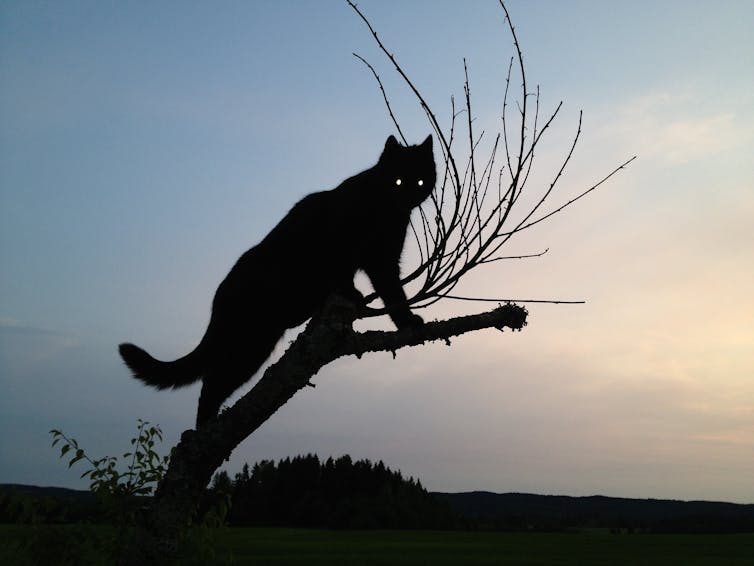
A spooky cat shaded in red looks down the camera at the viewer.
In this spell, the ghost cat is a mere tool of a nefarious human.
Evgrafova Svetlana/Shutterstock

The focus of this spell is the ritual drowning of a cat. While holding the cat’s body underwater, the magician recites an incantation and calls to the “cat-faced god[ess]” to inform them of the mistreatment that their sacred animal is suffering.

However, the magician boldly lies to the god, claiming that it is their chosen human target who is responsible for the killing.

The enterprising magician then offers a solution to this affront, asking the god to allow the cat to return as a ghost to serve them as a daimon (a supernatural being with mystical powers).

With the god’s support the magician was then free to curse or bind their chosen victim, suitably reframing the action as the cat’s own revenge against its presumed murderer.

2. The divorce lizard

Our second example also comes from the Greek Magical Papyri (listed as “PGM LXI. 39-71”).

Like many erotic spells of antiquity, this spell was designed to attract a chosen target to the magician.

However, some targets were easier to attract than others.

This text offers a ritual solution to would-be magicians whose chosen victim was already married. By harnessing the power of another ghostly animal daimon, this ritual aims to destroy the marriage.

The text begins by instructing the magician to find a spotted lizard “from the place where bodies are mummified”, kill it with hot coals and make it into a ghostly daimon.

A lizard is displayed in silhouette against a mottled green-grey background
Take one lizard ‘from the place where bodies are mummified’…
Cheshir.002/Shutterstock

While the lizard is dying, the magician recites an incantation. This spell aims to destroy the couple’s relationship by making them hate each other.

Later, hiding outside the couple’s home with the lizard’s ashes, the magician calls upon the newly dead lizard to return as a ghost daimon and force the target to abandon her marital home using its supernatural powers.

Once complete, the target would become especially vulnerable to an attraction spell.

3. The ghostly cavalry

The final example comes from a document known as Descriptions of Greece, written by Greek traveller and geographer Pausanias in the second century CE.

The author recounts a local tale about a haunted field where the Battle of Marathon took place in 490 BCE.

Here, Pausanias claims, the sounds of “horses neighing and men fighting” can be heard every night as the ghosts of fallen Greek and Persian soldiers continue to do battle.

Interestingly, Pausanias is careful to warn his readers that those who deliberately seek out these ghosts will suffer their wrath. Thankfully, though, anyone that stumbles upon them by accident will remain safe.

Unlike the first two examples, these ghost horses are not facilitated by magic or divine power. So, why were they believed to return as ghosts when other horses did not? Just as the ghosts of infantry men retained their swords and shields so they could continue to battle each night, the horses remained an essential tool for the ghosts of the cavalrymen.

A ghostly horse and its ancient rider are displayed white against a black background.
The sound of ‘horses neighing and men fighting’ can be heard at one battlefield, Greek traveller Pausanias reports.
knight of silence/Shutterstock

Animals with a ghostly purpose

These examples provide a fascinating window into the perception of animals in antiquity.

It is well evidenced that the Greeks and Romans adored their pets, and in everyday life animals were given many different roles in society.

However, after death these roles are drastically narrowed. In ancient times, animals seem only to return as ghosts in situations where they exist as tools for human use.

It remains to be seen what afterlife the ancients believed would be experienced by animals without a ghostly purpose.The Conversation

Rebecca Willis, PhD Candidate, Classics and Ancient History, University of Newcastle

This article is republished from The Conversation under a Creative Commons license. Read the original article.