ROGUECLASSICIST’S BULLETIN March 23, 2025

===========================================================
LEGENDA
===========================================================
Dozens of Amphorae Recovered From Ancient Byzantine Shipwreck in Greece – GreekReporter.com

Dozens of Amphorae Recovered From Ancient Byzantine Shipwreck in Greece

No discoveries were made beneath Pyramid of Khafre: Zahi Hawass – Ancient Egypt – Antiquities – Ahram Online
https://english.ahram.org.eg/NewsContent/9/40/543433/Antiquities/Ancient-Egypt/No-discoveries-were-made-beneath-Pyramid-of-Khafre.aspx

Relics in Tutankhamun’s tomb hint he invented elaborate burial rites | New Scientist
https://www.newscientist.com/article/2473095-relics-in-tutankhamuns-tomb-hint-he-invented-elaborate-burial-rites/?utm_campaign=RSS%7CNSNS&utm_source=NSNS&utm_medium=RSS&utm_content=currents

High ranking tomb of military commander unearthed in Ismailia
https://www.heritagedaily.com/2025/03/high-ranking-tomb-of-military-commander-unearthed-in-ismailia/154767

Controversial study claims massive structures discovered under pyramids in Egypt – Egypt Independent
https://www.egyptindependent.com/controversial-study-claims-massive-structures-discovered-under-pyramids-in-egypt/

Egyptologist questions claims of hidden tunnels and chambers under Giza pyramids | The National
https://www.thenationalnews.com/news/mena/2025/03/23/renowned-egyptologist-debunks-claims-of-hidden-tunnels-and-chambers-under-giza-pyramids/

Excavations in Bulgaria reveal Roman settlement destroyed in 4th century
https://www.finestresullarte.info/en/archaeology/excavations-in-bulgaria-reveal-roman-settlement-destroyed-in-4th-century

STA: Finds hinting at major Roman-era battle unearthed in Vipava area
https://english.sta.si/3407359/finds-hinting-at-major-roman-era-battle-unearthed-in-vipava-area

Ancient Greek statues were once vibrantly colored, not white, KNEWS
https://knews.kathimerini.com.cy/en/news/ancient-greek-statues-were-once-vibrantly-colored-not-white

[AI?]Long-lost Roman aqueduct discovered near Bratislava, Slovakia – The Jerusalem Post
https://www.jpost.com/archaeology/archaeology-around-the-world/article-847198

The First Roman Aqueduct Ever Found in Slovakia Sports an Ancient Manufacturer’s Stamp and a Paw Print | Smithsonian
https://www.smithsonianmag.com/smart-news/the-first-roman-aqueduct-ever-found-in-slovakia-sports-an-ancient-manufacturers-stamp-and-a-paw-print-180986290/

In Campania, new discoveries in the necropolis of ancient Liternum
https://www.finestresullarte.info/en/archaeology/in-campania-new-discoveries-in-the-necropolis-of-ancient-liternum

Archaeologists make several major discoveries in ancient Liternum
https://www.heritagedaily.com/2025/03/archaeologists-make-several-major-discoveries-in-ancient-liternum/154774

Well-Preserved Funerary Enclosures, Mausoleums, and Gladiator Epitaph Discovered in Ancient Roman Colony of Liternum, Italy – Arkeonews
https://arkeonews.net/well-preserved-funerary-enclosures-mausoleums-and-gladiator-epitaph-discovered-in-ancient-roman-colony-of-liternum-italy/

World Poetry Day: Ancient Greece’s Classics, From Homer to Sappho’s Poems – GreekReporter.com

World Poetry Day: Ancient Greece’s Classics, From Homer to Sappho’s Poems

[AI?]Philip II’s restored city, Philippopolis, opens at Nebet Tepe – The Jerusalem Post
https://www.jpost.com/archaeology/archaeology-around-the-world/article-847006

[AI?]Commoners and pharaohs: Ancient Nubian site reveals unique evidence – The Jerusalem Post
https://www.jpost.com/archaeology/archaeology-around-the-world/article-847200

[AI?]1,700-year-old Roman settlement in Bulgaria linked to Emperor Decius – The Jerusalem Post
https://www.jpost.com/archaeology/archaeology-around-the-world/article-847201

Echoing Gospel account, traces of ancient garden found under Church of Holy Sepulchre | The Times of Israel
https://www.timesofisrael.com/echoing-gospel-account-traces-of-ancient-garden-found-under-church-of-holy-sepulchre/

The Stele of the Twin Babies: A Rare Glimpse into Ancient Greek Funerary Art – GreekReporter.com

The Stele of the Twin Babies: A Rare Glimpse into Ancient Greek Funerary Art

[AI?]How Ancient Egyptians used the blue lotus in the ‘Journey of the Soul’ – The Jerusalem Post
https://www.jpost.com/archaeology/archaeology-around-the-world/article-847202

Museums are a-changing | Mario Trabucco della Torretta | The Critic Magazine
https://thecritic.co.uk/museums-are-a-changing/

Ancient Greek Comedy ‘Lysistrata’ Makes Modern Return to Pasadena City College Stage – Pasadena Weekendr

Ancient Greek Comedy ‘Lysistrata’ Makes Modern Return to Pasadena City College Stage

In defence of Oxford’s non-binary Latin – UnHerd
https://unherd.com/newsroom/in-defence-of-oxfords-non-binary-latin/

Ancient Greek and Roman Statues Used to Be Scented

British Museum is right to keep Parthenon marbles, says new trustee | British Museum | The Guardian
https://www.theguardian.com/culture/2025/mar/23/british-museum-is-right-to-keep-parthenon-marbles-says-new-trustee

Parthenon Sculptures: “Negotiations for reunification have advanced further than ever before” – ProtoThema English

Parthenon Sculptures: “Negotiations for reunification have advanced further than ever before”

London Conference Highlights Renewed Efforts to Reunite the Parthenon Marbles – GreekReporter.com

London Conference Highlights Renewed Efforts to Reunite the Parthenon Marbles

How Much Did The Roman Empire Spend On the Army | Short History
https://short-history.com/how-much-did-the-roman-empire-spend-on-the-army-f105f9d9c685

Laudator Temporis Acti: Death
https://laudatortemporisacti.blogspot.com/2025/03/death.html

Laudator Temporis Acti: A Hyphen
https://laudatortemporisacti.blogspot.com/2025/03/a-hyphen.html

Laudator Temporis Acti: Credo
https://laudatortemporisacti.blogspot.com/2025/03/credo.html

Laudator Temporis Acti: Self-Love
https://laudatortemporisacti.blogspot.com/2025/03/self-love.html

I Could Write A Book | Sphinx

I Could Write A Book

Collections: The Siege of Eregion, Part IV: What Siege Equipment? – A Collection of Unmitigated Pedantry

Collections: The Siege of Eregion, Part IV: What Siege Equipment?

Friday Varia and Quick Hits | Archaeology of the Mediterranean World

Friday Varia and Quick Hits

Using Deepseek on an obscure Greek “Life” of St Isidore of Pelusium (d. 435 AD) by Morton Smith – Roger Pearse

Using Deepseek on an obscure Greek “Life” of St Isidore of Pelusium (d. 435 AD) by Morton Smith

(5) Welcome to 58 BCE – by Tate – e-pistulae
https://epistulae.substack.com/p/welcome-to-58-bce?utm_source=post-email-title&publication_id=944078&post_id=159584439&utm_campaign=email-post-title&isFreemail=true&r=q7tlq&triedRedirect=true&utm_medium=email

(5) 22? March 58 BCE: From Cicero (on his way into exile) to Atticus (in Rome)
https://epistulae.substack.com/p/22-march-58-bce-from-cicero-on-his?utm_source=post-email-title&publication_id=944078&post_id=159588334&utm_campaign=email-post-title&isFreemail=true&r=q7tlq&triedRedirect=true&utm_medium=email

De wrede munten van Julius Caesar – Mainzer Beobachter

De wrede munten van Julius Caesar

Caesar bezet Córdoba – Mainzer Beobachter

Caesar bezet Córdoba

Ach ja, de val van Rome – Mainzer Beobachter

Ach ja, de val van Rome

(PDF) Book review: Archaeology of the Roman Conquest: Tracing the Legions, Reclaiming the Conquered
https://www.researchgate.net/publication/389760721_Book_review_Archaeology_of_the_Roman_Conquest_Tracing_the_Legions_Reclaiming_the_Conquered

Portable Antiquity Collecting and Heritage Issues: Egyptian Stone Vase Heritage
https://paul-barford.blogspot.com/2025/03/egyptian-stone-vase-heritage.html

PaleoJudaica.com: Florentin & Tal, The Samaritan Pentateuch (parallel English-Hebrew edition, Open Book)
https://paleojudaica.blogspot.com/2025/03/florentin-tal-samaritan-pentateuch.html

PaleoJudaica.com: Bauer & Doole (eds.), Ideas of Possession (OUP)
https://paleojudaica.blogspot.com/2025/03/bauer-doole-eds-ideas-of-possession-oup.html

Mouldmade bowls of the Black Sea region and beyond: from prestige object to an article of mass consumption | Spartokos read

Mouldmade bowls of the Black Sea region and beyond: from prestige object to an article of mass consumption

Military Book Review The Crisis of Catiline: Rome, 63 BCE
https://www.strategypage.com/bookreviews/2695#gsc.tab=0

Review: The race to decipher an ancient language | Pittsburgh Post-Gazette
https://www.post-gazette.com/ae/books/2025/03/22/mesopotamian-riddle-joshua-hammer/stories/202503230058
===========================================================
AUDIENDA
===========================================================
Anima Latina 23.03.2025 – Podcast – Radio Vaticana – Vatican News
https://www.vaticannews.va/it/podcast/rvi-programmi/anima-latina/2025/03/anima-latina-23-03-2025.html

The Fall of Athens – The Ancients | Acast

diē vīcēsimō prīmō mēnsis Martiī — Nuntii Latini

diē vīcēsimō prīmō mēnsis Martiī

Audio-Nachrichten auf Latein 22.03.2025 – Vatican News
https://www.vaticannews.va/de/podcast/audio-nachrichten-auf-latein/2025/03/audio-nachrichten-auf-latein-22-03-2025.html
===========================================================
VIDENDA
===========================================================
(698) Megastructures under Giza Pyramids⁉️ ARCHAEOLOGY REWRITTEN or viral 💩? – YouTube

===========================================================
NOTANDA
===========================================================
Job details: Lecturer in  Digital History
https://www.ucl.ac.uk/work-at-ucl/search-ucl-jobs/details?jobId=33053&jobTitle=Lecturer+in%E2%80%AF+Digital+History%E2%80%AF

War in the Ancient World International Conference (WAWIC) 2025 | College of Arts, Humanities, and Social Sciences | UMN Duluth
https://cahss.d.umn.edu/departments/history-political-science-international-studies/history/wawic

The Conversation: How can we ethically display the dead in museums? What about resin casts of those who died violently in Pompeii?

Georgia Pike-Rowney, Australian National University

We are used to seeing dead bodies in movies and TV shows, but how should we feel when presented with a dead person from the ancient past in a museum?

The collection and display of human remains is a complex topic. Around the world, some museums are choosing to remove human remains from display, with some arguing those who have died cannot consent to being displayed (let alone being collected).

This has been of particular concern for collections that include First Nations Ancestors. Often taken violently and without consent, many Ancestors are now being returned from museums and collections through formal restitution and repatriation.

The display of death in a museum space raises a range of issues. Is it ethical to display those who have died? Who has given consent for the display? Will it potentially distress visitors? Is the display necessary? Or are we shying away from the basic facts of life and death if we choose not to show those who have died?

Advances in technology have opened up further questions. Our ability to scan and digitise, make resin casts, copies and moulds of human remains, means that lifelike versions of people who have died – sometimes violently – can theoretically be displayed anywhere in the world.

Should these casts be repatriated just as the biological remains have been? Are scans, copies and casts invasive in their depictions of the dead? And should museum-goers be warned as to the traumatic nature of what is on display, even if a copy or impression?

From Egypt to Italy

Human remains, such as mummified people, attract great public interest. The National Museum of Australia’s recent Egypt exhibition was its most popular to date, with more than 208,000 visitors.

The museum’s exhibition included a display of mummified people in a separate room accessible from the main exhibition space. Visitors could not see the mummified people unless they chose to enter the room. The bodies were presented in their wrapped state, with a scan nearby revealing details of what lay beneath the wrapping. This slightly separated space provided the viewer with an opportunity for a moment of quiet reflection.

The museum’s current exhibition, Pompeii: Inside a Lost City, displays resin copies of 19th and 20th century casts of those who perished in the volcanic eruption of Vesuvius in 79 CE.

Through the ingenuity of archaeologists, the original casts were created by injecting plaster into cavities left by those who died in the now solidified pyroclastic flow. Unlike some of the original casts, the resin copies on display at the museum include no biological remains.

The exhibition has been designed to mimic a Pompeiian streetscape, with the casts displayed in a group in a semi-open space to the side of, but still amongst, the main exhibition space. The display is delineated by a low barrier of about knee height.

One cast is partially visible over this low barrier – an adult clutching their face in their hands. Visitors are required to come closer and peer over the barrier to see the other casts, including two adult men in a semi-embrace, a three-year-old child, and a dog. The comparatively open display does not provide the same opportunity for quiet reflection made possible in the Egypt exhibition.

The Pompeii exhibition is accompanied by an animated eruption of Mount Vesuvius, complete with visualisations of falling lapilli and soundscape. While this display is impressive, the casts in the exhibition provide the main intimation of the horrific deaths suffered by some 2,000 Pompeiian victims. As our eyewitness Pliny the Younger records:

You could hear the shrieks of women, the wailing of infants, and the shouting of men; some were calling their parents, others their children or their wives, trying to recognise them by their voices.

The museum was criticised by critic John McDonald for the “over the top” way it created a separate space for mummified people in the Egypt exhibition. Critic Christopher Allen questioned a ceremony where Traditional Custodians welcomed the mummified people on to Country, suggesting a mummified person would not have thought this ceremony “relevant or appropriate”.

I would ask whether the mummified person would have approved of being on display at all.

But what of the Pompeiian casts? They contain no biological remains. Yet they reveal the facial expressions of people in their last agonised and traumatic moments, including those of a very small child. Given the visceral nature of these impressions, they have the potential to distress some museum visitors perhaps more so than a wrapped mummified person.

The museum’s decision to display them in a comparatively open setting, particularly after the careful approach in the Egypt exhibition, is intriguing. Some signage warns visitors of the loud eruption and the presence of the copies of casts, as it’s possible to view at least one of them accidentally as you move through the exhibition space.

A fraught world

Museums across the globe are seeking to balance the need to minimise possible distress for the public with maximising educational opportunity and access. This is, at times, a complex task, particularly in the fraught world of the ancient Mediterranean, imbued as it is with violence, enslavement, conquest, sexual violence, gender inequality and colonial legacies.

Many museums are conducting research to find some answers. Dr Melanie Pitkin of The Chau Chak Wing Museum at the University of Sydney leads the Human Remains Research Project involving culturally specific approaches to caring for human remains. For Egyptian mummified remains, this involves consulting with Egyptian descent communities and the public through surveys and round table discussions. Thus far, this project has developed culturally specific guidelines and removed unwrapped body parts from their displays.

Other museums, such as the Smithsonian, have chosen to remove all human remains from display. A recently released policy brief by a group of MPs in the UK, Laying Ancestors to Rest, calls for all human remains to be removed from British museums. It is mostly focused on colonial collecting of African human remains.

The ethics of casts, moulds and copies of human remains is an area of growing concern and research, particularly in relation to colonial collections that include First Nations Ancestors. Anthropological moulds of both dead and live people have historically been collected in colonial contexts, often without consent and in violent circumstances.

For instance, Otto Finsch (1839-1917), a self-taught German naturalist, ethnologist and museum curator made a series of 164 “ethnic” casts, comprising 155 casts of human faces and nine casts of other human body parts. Some of these were taken from First Nations’ Australians in largely unknown circumstances.

The Staatliche Museen zu Berlin recently returned Ancestral Remains to Australia. The case is building for the return of 19th century moulds in their collection as well. In 2023, Germany’s Staatliche Ethnographische Sammlungen Sachsen returned eight plaster casts of Māori people to Aotearoa New Zealand, one of which was based on a “life mask” made by Finsch.

We cannot apply the same ethical frameworks around casts of First Nations Ancestors to the Pompeiian casts, belonging as they do to very different times, places, and cultural contexts. And whilst consent from the ancient Pompeiians themselves might be lacking, the country of origin, Italy, is collaborating with the National Museum of Australia to make the copies available for display.

The casts help us to be mindful of the human tragedy at Pompeii, as we appreciate their artworks and the material of their everyday lives. Despite this, I feel more could be done to allow visitors a choice as to whether or not to view the casts, in a way that promotes greater reflection and reverence for those who perished.

This is not an easy task. We need creative and respectful ways to engage meaningfully with the realities of life and death. Most importantly we need conversation, the sharing of different and sometimes conflicting perspectives. The Pompeii exhibition provides a perfect opportunity for such discussions to take place.The Conversation

Georgia Pike-Rowney, Friends’ Lecturer in Classics and Curator, ANU Classics Museum, Australian National University

This article is republished from The Conversation under a Creative Commons license. Read the original article.

The Conversation: Figs, meat – and not too much sex. A good diet in ancient times was more than what you ate

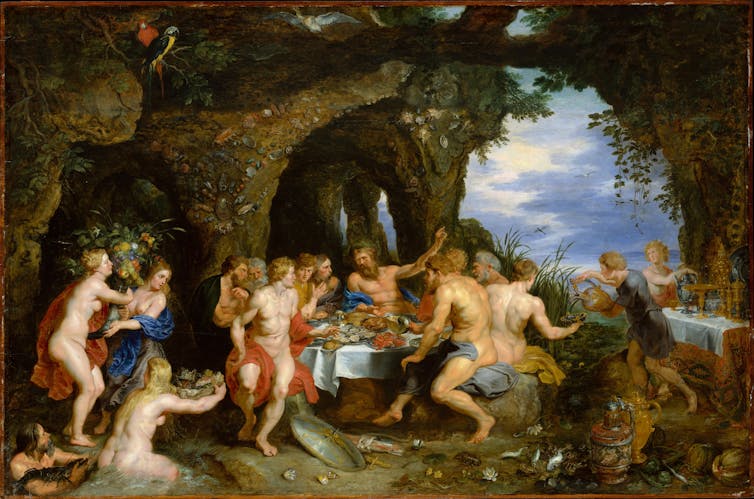
The Feast of Acheloüs by Peter Paul Rubens and Jan Brueghel the Elder, ca. 1615.
The Metropolitan Museum of Art

Konstantine Panegyres, The University of Western Australia

In the modern world, we know good nutrition is essential for our health.

Doctors in ancient Greece and Rome knew this too – in fact diet advice was a mainstay of medical practice and health routines. There were extensive and intricate discussions of how to regulate food and drink to stay healthy.

Some of their ideas – such as eating fish and vegetables as a healthy way to lose weight – make sense today. But others may raise eyebrows, such a fig-only diet for Olympic athletes.

So, what did diet and nutrition look like in ancient times? And is there anything we can learn today?

An expansive diet

In modern times, diet refers to food and drink. In ancient times, however, the idea of diet was more expansive.

Our word “diet” comes from the ancient Greek word diaita. This could refer to what we eat and drink, but it could also refer to our lifestyle as a whole – including exercise, sleep, sex and other activities.

When prescribing a diaita, ancient doctors did not just tell patients what to eat and drink. They also advised them on what sorts of other activities they should be doing, like exercising or even going to the theatre.

For instance, in the sixth book of the Epidemics, a medical text written in the late fifth century BC, the author calls for moderation not just in what we eat and drink, but also in exercise, sleep and sex.

Ancient doctors believed balance was important for health.

Extreme dieting

However, not all ancient texts advocate moderation. There are some extreme cases of dieting. For example, the historian Hegesander of Delphi (2nd century BC) wrote:

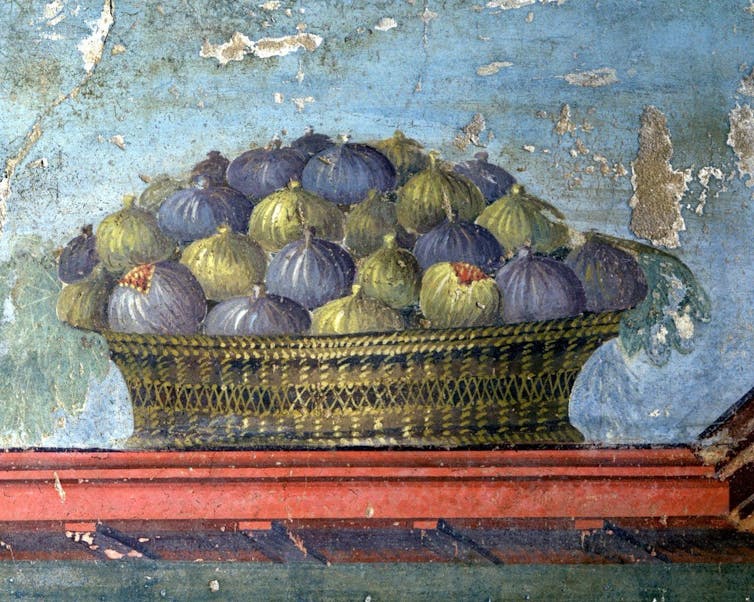
Anchimolus and Moschus, who were sophistic teachers in Elis, drank nothing but water all their lives and ate nothing but figs, but were no less physically vigorous than anyone else. Their sweat, however, smelled so bad that everyone tried to avoid them in the baths.

Roman fresco of a basket of green and purple figs.
Some ancient athletes swore by a fig-only diet.
Wikimedia Commons

In the seventh century BC, athletic trainers also focused on diet as a way to improve their athletes’ physical condition. Trainers such as Iccus of Tarentum introduced strict diets for their athletes to try and gain a competitive edge.

However, their methods were often questionable, according to today’s standards and our knowledge about nutrition.

For example, the Olympic runner Chionis of Laconia apparently also had a strict diet of figs when he was training for his competitions. He won in his event at the Olympics in 668, 664, 660, and 656BC, a remarkable record. Other athletes, such as Eurymenes of Samos (sixth century BC), opted for a diet entirely comprised of meat.

However, there is no evidence to show these restricted diets would have improved athletic performance – and would not be recommended today.

Side portrait of the physician Galen in red and white.
The physician Galen.
Pierre-Roch Vigneron/Wikimedia Commons

An ancient doctor’s perspective

Greek and Roman doctors could not conduct controlled trials as scientists do today.

Nevertheless, they were keen observers of the effects of certain foods on their patients – and saw with their own eyes that a bad diet is not good for us.

For example, the physician Galen of Pergamum (129-216AD) in his work Hygiene attributes his patients’ ill health to poor diet.

He observed

some who are continuously diseased, not due to the intrinsic constitution of the body, but through a bad regimen, or living an idle life, or working too hard, or being in error regarding the qualities, quantities or times of foods, or practicing some exercise that is harmful, or erring in regard to the amount of sleep, or excessive indulgence in sex, or needlessly tormenting themselves with grief and anxiety. Every year I see very many who are sick through such a cause.

Galen thought hard about how certain foods and drinks affect our health and wrote various books on the subject, such as On the Powers of Foods.

This work contains many anecdotes. For instance, one young man drank the juice of the scammony plant, “to cleanse his system” (presumably as a laxative). However

five hours after the dose no evacuation had taken place, and he complained that his stomach felt compressed, his belly was heavy and swollen, consequently he was pale and anxious.

Galen also recognised different diets affect people in different ways:

some people are harmed and some are benefited by the same things and similarly with opposites. […] I know of some who immediately become sick, if they remain three days without exercise, and others who continue indefinitely without exercise and yet are healthy.

Nutrition and balance

Galen’s advice for overweight or obese patients may sound familiar: a “thinning” diet and a lot of fast running. So, exercise, combined with foods that fill you up but don’t make you gain weight.

According to Galen this meant eating vegetables and fish and avoiding wheat, red meat, fruit and wine.

A lot has changed in the world of diet and nutrition. We now have professional dietiticians and empirical methods to measure the nutritional values of foods.

However in their broader definition of “diet”, ancient doctors identified something that remains as true today: the importance of eating well as part of a healthy lifestyle, one that takes care of body and mind and includes exercise, sleep and pleasure.The Conversation

Konstantine Panegyres, Lecturer in Classics and Ancient History, The University of Western Australia

This article is republished from The Conversation under a Creative Commons license. Read the original article.

The Conversation: Long before debates over ‘wokeness’, Epicurus built a philosophy that welcomed slaves, women and outsiders

German Vizulis/Shutterstock

Thomas Moran, University of Adelaide

If you peruse the philosophy section of your local bookshop, you’ll probably find a number of books on Stoicism – an ancient philosophy enjoying a renaissance today. But where are the Epicureans?

Both philosophical schools were popular in the ancient world. However, while stoic works such as Meditations by Marcus Aurelius and Seneca’s letters still fill the shelves, alongside contemporary takes such as The Daily Stoic (2016), Epicureanism largely remains a historical curiosity.

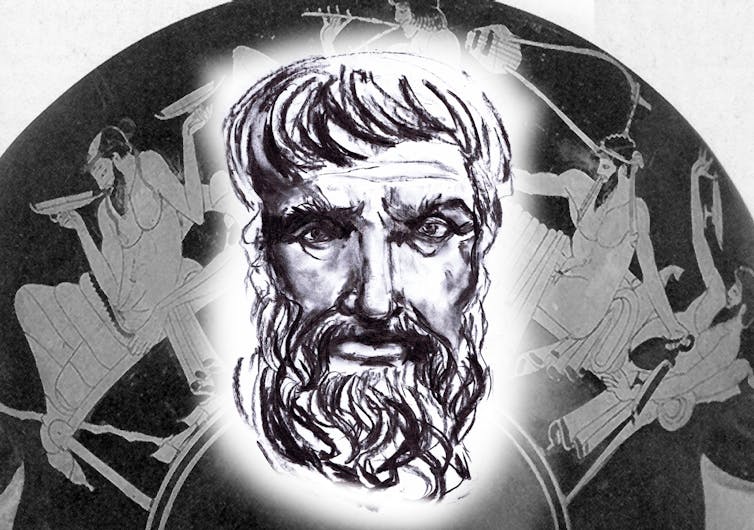
Today, the Greek thinker Epicurus (341–270 BCE) is mostly remembered as the originator of the term “epicurean”, which describes someone devoted to sensual enjoyment, particularly of fine food and drink.

And while it’s true Epicurus argued pleasure is the highest human good, there’s a lot more to Epicureanism than merely savouring a glass of Shiraz with haute cuisine.

Philosophers in the garden

Epicurus was born on the island of Samos to Athenian parents. He studied philosophy in Athens before travelling to the island of Lesbos to establish a philosophical academy.

Epicurus was born on the island Samos, a birthplace he shares with the famous polymath Pythagoras.
Wikimedia

Upon returning to Athens in 306 BCE, he bought a tract of land and began a philosophical community known as the Garden.

The Garden was radically different from other philosophical communities at the time. While Plato’s Academy generally trained the children of the Athenian elite, and Aristotle tutored nobles such as Alexander the Great, Epicurus’ Garden was far more inclusive. Women and slaves were welcome to join the dialogue.

The community led a frugal life and practised total equality between men and women, which was uncommon at the time. In this atmosphere, noblewomen and courtesans, senators and slaves, all engaged in philosophical debate.

While many early Epicureans have disappeared from the annals of history, we know of some women, such as Leontion and Nikidion, who were early proponents of Epicurean thought.

A garden wall
Away from the main city of Athens, Epicurus’ Garden became a space for his followers to seek relief.
gka photo/Shutterstock

Philosophy as a way of life

It isn’t just the Garden’s inclusivity that gives it contemporary appeal, but its entirely unique notion of what constitutes a philosophical life.

According to Epicurus, a philosopher wasn’t someone who taught or wrote philosophical tracts. A philosopher was someone who practised what the French philosopher Pierre Hadot describes, in his work on Epicureanism, as “a certain style of life”.

Epicureanism was a daily practice, rather than an academic discipline. Anyone who strove to live a philosophical life was part of the Epicurean community and was considered a philosopher.

The concept of philosophy Epicurus promoted was more egalitarian and all-encompassing than the narrow definition we often see used today.

The pursuit of pleasure

But what did it mean to be a practising Epicurean? Epicurus conceived of philosophy as a therapeutic practice. “We must concern ourselves with the healing of our own lives,” he wrote.

This process of healing involves developing an inner attitude of relaxation and tranquillity known as anesis in Ancient Greek. To do this, Epicureans sought to turn their minds away from the worries of life and focus instead on the simple joy of existence.

Epicurus distinguished between different types of pleasure and advocated for a life of moderate pleasure, rather than excessive indulgence.
Wikimedia

According to Epicurus, unhappiness comes because we are afraid of things which should not be feared, and desire things which are not necessary and are beyond our control.

Most notably, he rejected the idea of an afterlife, arguing the soul did not continue to exist after death. He also argued it was wrong to fear death as it

gives no trouble when it comes [and] is but an empty pain in anticipation.

Instead of fearing punishment in the beyond, he said we should focus on the possibilities for pleasure in the here and now. But that doesn’t mean chasing every pleasure which comes our way; the task of the Epicurean is to understand which pleasures are worth pursuing.

The highest pleasures are not those which yield the highest intensity or last the longest, but those which are the least mixed with worry and the most likely to ensure peace of mind. In this vein, Epicurus sought to cultivate feelings of gratitude and appreciation for even the simplest everyday experiences.

While his critics cast him and his followers as unrestrained hedonists, he wrote in one letter that a single piece of cheese was as pleasurable as an entire feast.

For Epicureans, it is precisely the brevity of life that gives us such an exquisite capacity for pleasure. As one Epicurean Philodemus wrote:

Receive each additional moment of time in a manner appropriate to its value; as if one were having an incredible stroke of luck.

A philosophy for outsiders

Epicurus’ perennial appeal resides in how his philosophy gave strength and inspiration to outsiders. In the late 19th century, aesthetes such as critic Walter Pater and playwright Oscar Wilde praised Epicureanism as a way of life.

In Wilde’s letter De Profundis (From the depths) – written in 1897 while imprisoned in Reading Gaol on charges of indecency – he wrote that Pater’s novel Marius the Epicurean (1885) had given him both intellectual and spiritual solace during his trial.

Pater, too, had faced discrimination at Oxford for having homosexual relationships. His novel is an evocative celebration of the possibilities of a life lived in the pursuit of sensual and spiritual beauty.

In one of his earlier texts, The Renaissance (1873), Pater paraphrases Victor Hugo, writing

we are all under a sentence of death but with a sort of indefinite reprieve […] we have an interval, and then our place knows us no more. […] Our one chance lies in expanding that interval, in getting as many pulsations as possible into the given time.

This profoundly Epicurean sentiment, of a life lived in the interval, remains appealing to those who seek to turn their lives into a work of art.The Conversation

Thomas Moran, Lecturer in the Department of English, Creative Writing and Film, University of Adelaide

This article is republished from The Conversation under a Creative Commons license. Read the original article.

ROGUECLASSICIST’S BULLETIN March 21, 2025

===========================================================
LEGENDA
===========================================================
Longest Known Inscription in the Undeciphered Linear A Script of Minoan civilization, Found on an Ivory Scepter in Knossos

Longest Known Inscription in the Undeciphered Linear A Script of Minoan civilization, Found on an Ivory Scepter in Knossos

High ranking tomb of military commander unearthed in Ismailia
https://www.heritagedaily.com/2025/03/high-ranking-tomb-of-military-commander-unearthed-in-ismailia/154767

A History of Archaeology at Sparta « Archaeology# « Cambridge Core Blog

A History of Archaeology at Sparta

Iron Age House From the 10th Century BC Discovered in Greece – GreekReporter.com

Iron Age House From the 10th Century BC Discovered in Greece

A 1,500-Year-Old Roman Settlement Discovered in Bulgaria – Arkeonews

A 1,500-Year-Old Roman Settlement Discovered in Bulgaria

AAR honors pioneering women of Rome’s archaeological golden age through photographic exhibition | Archaeology News Online Magazine

AAR honors pioneering women of Rome’s archaeological golden age through photographic exhibition

Archeologia. Trovate a Giugliano, in Campania, tombe romane e un epitaffio a un gladiatore, eroe degli anfiteatri. Perché bambini nelle anfore? Scoperto anche un pozzo cultuale
https://stilearte.it/archeologia-trovate-a-giugliano-in-campania-tombe-romane-e-un-epitaffio-a-un-gladiatore-scoperto-anche-un-pozzo-cultuale/

Did Michelangelo Pull Off Art History’s Greatest Hoax With ‘Laocoön’?

Did Michelangelo Pull Off Art History’s Greatest Hoax With ‘Laocoön’?

New Discovery in Egypt Unveils Ancient Egyptian, Greek and Roman Graves and Artifacts – GreekReporter.com

New Discovery in Egypt Unveils Ancient Egyptian, Greek and Roman Graves and Artifacts

Ancient Greek jar holds curse against 55 people | University of Cincinnati
https://www.uc.edu/news/articles/2025/03/ancient-greek-jar-holds-curse-against-55-people.html

Ancient Egyptian soldiers and Greek mercenaries were at ‘Armageddon’ when biblical king was killed, study suggests | Live Science
https://www.livescience.com/archaeology/ancient-egyptian-soldiers-and-greek-mercenaries-were-at-armageddon-when-biblical-king-was-killed-study-suggests

Ancient Mesopotamian clay tablets discovered in Iraq reveal intricate details of how empire was governed – The Art Newspaper – International art news and events
https://www.theartnewspaper.com/2025/03/20/ancient-mesopotamian-clay-tablets-discovered-iraq-reveal-intricate-details-how-empire-governed

Amphipolis Finds: Child’s Tooth, Figurines Reveal Cultic Practices – GreekReporter.com

Amphipolis Finds: Child’s Tooth, Figurines Reveal Cultic Practices

What does Herodotus say about the occult and mystery cults of his time? Was he initiated into any? – Herodotus Helpline

What does Herodotus say about the occult and mystery cults of his time? Was he initiated into any?

(5) A Restless night of Grief – by Joel Christensen
https://joelchristensen.substack.com/p/a-restless-night-of-grief?utm_source=post-email-title&publication_id=1870284&post_id=159505961&utm_campaign=email-post-title&isFreemail=true&r=q7tlq&triedRedirect=true&utm_medium=email

A satyr meets an emperor | Blog post | Mary Beard
https://www.the-tls.co.uk/regular-features/mary-beard-a-dons-life/a-satyr-meets-an-emperor-blog-post

Friday Varia and Quick Hits | Archaeology of the Mediterranean World

Friday Varia and Quick Hits

Italian Fringe Researchers Claim to Find Massive Structures Beneath Giza – JASON COLAVITO
https://www.jasoncolavito.com/blog/italian-fringe-researchers-claim-to-find-massive-structures-beneath-giza

Rome, the Temple of Vibia Sabina and Hadrian will welcome the public with a humanoid robot
https://www.finestresullarte.info/en/news/rome-the-temple-of-vibia-sabina-and-hadrian-will-welcome-the-public-with-a-humanoid-robot

Faits divers (35) – Mainzer Beobachter

Faits divers (35)

Laudator Temporis Acti: Graffito
https://laudatortemporisacti.blogspot.com/2025/03/graffito.html

Laudator Temporis Acti: Diogenes Laertius
https://laudatortemporisacti.blogspot.com/2025/03/diogenes-laertius.html

Laudator Temporis Acti: They Wanted to Turn the Clock Backward
https://laudatortemporisacti.blogspot.com/2025/03/they-wanted-to-turn-clock-backward.html

PaleoJudaica.com: The ASOR Punic Project Digital Initiative
https://paleojudaica.blogspot.com/2025/03/the-asor-punic-project-digital.html

PaleoJudaica.com: Hybrid event: Zoroastrian Hermeneutics in Late Antiquity
https://paleojudaica.blogspot.com/2025/03/hybrid-event-zoroastrian-hermeneutics.html

PaleoJudaica.com: Pilate’s Legal Path to Crucifying Jesus
https://paleojudaica.blogspot.com/2025/03/pilates-legal-path-to-crucifying-jesus.html

AWOL – The Ancient World Online: Digital South Caucasus Collection
https://ancientworldonline.blogspot.com/2025/03/digital-south-caucasus-collection.html

AWOL – The Ancient World Online: “In Second Use”. An archaeological and anthropological survey of recycling and reuse in the Greek world
https://ancientworldonline.blogspot.com/2025/03/in-second-use-archaeological-and.html

The World of An Altar of Indignities – Part X – The Odeon of Herodes Atticus |

The World of An Altar of Indignities – Part X – The Odeon of Herodes Atticus

The Death of Britannicus, by Alexandre Denis Abel de Pujol (c. 1785–1861) – The Historian’s Hut

The Death of Britannicus, by Alexandre Denis Abel de Pujol (c. 1785–1861)

Ovid – The Historian’s Hut

Ovid

World Poetry Day: Ancient Greece’s Classics, From Homer to Sappho’s Poems – GreekReporter.com

World Poetry Day: Ancient Greece’s Classics, From Homer to Sappho’s Poems

‘Iliad’ vigil: Eternal words resound in Homer’s true land on World Poetry Day – Türkiye Today

‘Iliad’ vigil: Eternal words resound in Homer’s true land on World Poetry Day

The Identification of the Sacred “Chiton” (Sarapis) of Pharaoh Alexander the Great in Tomb II at Vergina, Macedonia, Greece: Journal of Field Archaeology: Vol 50 , No 3 – Get Access
https://www.tandfonline.com/doi/full/10.1080/00934690.2024.2409503

On Memory and the Afterlife in Hellenistic Kallatis. The mound cemeteries. | Spartokos read

On Memory and the Afterlife in Hellenistic Kallatis. The mound cemeteries.

Resistant form: Aristophanes and the comedy of crisis – Bryn Mawr Classical Review

Resistant form: Aristophanes and the comedy of crisis

Thucydides’s Melian dialogue and Sicilian expedition: a student commentary – Bryn Mawr Classical Review

Thucydides’s Melian dialogue and Sicilian expedition: a student commentary


===========================================================
AUDIENDA
===========================================================
Nimi Shephard-Patel, Fundraising Manager: Classics and Careers by The Classics Podcast

Ancient Warfare Podcast: AWA349 – Were there any inspiring elites in ancient warfare?
https://sites.libsyn.com/91136/awa349-were-there-any-inspiring-elites-in-ancient-warfare

===========================================================
NOTANDA
===========================================================
Seneca and Stoicism – 30th April 2025 | Classically Inclined

Seneca and Stoicism – 30th April 2025

Summer Language Institute – Latin | Summer Session
https://summer.virginia.edu/summer-language-institute-latin

Meroe: a Hellenistic kingdom in Sudan (?)

Meroe: a Hellenistic kingdom in Sudan (?)

Nominations for Council/ Appel à candidatures pour le Conseil (Deadline/ date limite April 22) – The Classical Association of Canada

Nominations for Council/ Appel à candidatures pour le Conseil (Deadline/ date limite April 22)

Julie Gallego Lecture Series from March 25 to 27, 2025: Greco-Latin Antiquity in Comics and Manga – The Classical Association of Canada

Série de conférences de Julie Gallego du 25 au 27 mars 2025 : L’Antiquité gréco-latine dans les BD et les Manga (Greco-Latin Antiquity in Comics and Manga)

Travel, Connection, and the Uses of History

Travel, Connection, and the Uses of History