ROGUECLASSICIST’S BULLETIN~April 4, 2025

===========================================================
LEGENDA
===========================================================
“House of Life” Discovered at the Ramesseum in Luxor, Filled with Drawings and School Games

“House of Life” Discovered at the Ramesseum in Luxor, Filled with Drawings and School Games

A 1st Century AD Roman “Vivarium” in the Submerged Heart of the Venice Lagoon

Un “vivarium” romano del I secolo d.C. nel cuore sommerso della Laguna di Venezia

Mass grave of Roman soldiers tells gruesome tale of military disaster | CNN
https://www.cnn.com/2025/04/04/science/mass-grave-roman-soldiers-austria-intl-scli/index.html

A mass grave for fighters in a Roman Empire-era battle is revealed in Vienna
https://phys.org/news/2025-04-mass-grave-fighters-roman-empire.html

Explore the Ancient Greek World Through a Revolutionary Digital Map – GreekReporter.com

Explore the Ancient Greek World Through a Revolutionary Digital Map

Discovery of mass grave under football pitch changes what we know about the Roman Empire | The Independent
https://www.independent.co.uk/news/science/archaeology/vienna-archaeology-roman-mass-grave-b2726613.html

Extensive Roman settlement found beyond the borders of the Roman Empire
https://www.heritagedaily.com/2025/04/extensive-roman-settlement-found-beyond-the-borders-of-the-roman-empire/154865

Ancient secret uncovered: experts stumble upon a mysterious tunnel that could link Rome to a distant city – AS USA
https://en.as.com/latest_news/ancient-secret-uncovered-experts-stumble-upon-a-mysterious-tunnel-that-could-link-rome-to-a-distant-city-n/

A funerary relief from a tomb in the necropolis of Porta Sarno

A funerary relief from a tomb in the necropolis of Porta Sarno

Humanities studio presents Stephanie McCarter on female agency in the classics – The Student Life

Humanities studio presents Stephanie McCarter on female agency in the classics

(5) Taking Helen Seriously – by Joel Christensen
https://joelchristensen.substack.com/p/taking-helen-seriously?utm_source=post-email-title&publication_id=1870284&post_id=160528263&utm_campaign=email-post-title&isFreemail=true&r=q7tlq&triedRedirect=true&utm_medium=email

Apropos of Nothing, Achilles Calls the Commander-in-Chief a Dog[-face] – SENTENTIAE ANTIQUAE

Apropos of Nothing, Achilles Calls the Commander-in-Chief a Dog[-face]

PaleoJudaica.com: Gaza archaeology exhibition in Paris
https://paleojudaica.blogspot.com/2025/04/gaza-archaeology-exhibition-in-paris.html

PaleoJudaica.com: Albert Pietersma (1935–2025)
https://paleojudaica.blogspot.com/2025/04/albert-pietersma-19352025.html

FIEC Blog: Petition to preserve Greek teaching in Zurich high schools
https://fiecnet.blogspot.com/2025/04/petition-to-preserve-greek-teaching-in.html

The Life and Death of Antiquities Trafficker Leonardo Patterson: A Dealer in Stolen History ~ ARCAblog
https://art-crime.blogspot.com/2025/04/the-life-and-death-of-leonardo.html

Numa’s legacy – Liv Mariah Yarrow

Numa’s legacy

Conserv* legend usage – Liv Mariah Yarrow

Conserv* legend usage

Portable Antiquity Collecting and Heritage Issues: Under-Pyramid-Scan Scam: Sarah Parcak on Flint Dibble
https://paul-barford.blogspot.com/2025/04/under-pyramid-scan-scam-sarah-parcak-on.html

Working with Manuscripts | Variant Readings

Working with Manuscripts

Friday Varia and Quick Hits | Archaeology of the Mediterranean World

Friday Varia and Quick Hits

Winter AD 124/5 – Hadrian tours the Peloponnese (part 2) and visits Sparta and Corinth (#Hadrian1900) FOLLOWING HADRIAN

Winter AD 124/5 – Hadrian tours the Peloponnese (part 2) and visits Sparta and Corinth (#Hadrian1900)

Laudator Temporis Acti: A General Admits His Mistake
https://laudatortemporisacti.blogspot.com/2025/04/a-general-admits-his-mistake.html

Leonardo Patterson has Died at age 82

Leonardo Patterson has Died at age 82

Fireside Friday, April 4, 2025 – A Collection of Unmitigated Pedantry

Fireside Friday, April 4, 2025

Ancient history is humanity’s first draft – The Queen’s Journal

Ancient history is humanity’s first draft

The unprecedented discovery that now explains centuries of history thanks to science: a 2,300-year-old Greek ship full of preserved treasures – AS USA
https://en.as.com/latest_news/the-unprecedented-discovery-that-now-explains-centuries-of-history-thanks-to-science-a-2300-year-old-greek-ship-full-of-preserved-treasures-n/

The Hittite Prince Who Stole an Empire – The Ancient Near East Today

The Hittite Prince Who Stole an Empire

Pompeii Funerary Relief Potentially Features a Priestess

Nearly Life-Sized Relief Sculptures in Exceptional Condition Discovered in Pompeii

Ancient Rome used high tariffs to raise money too – and created other economic problems along the way
https://theconversation.com/ancient-rome-used-high-tariffs-to-raise-money-too-and-created-other-economic-problems-along-the-way-253752

Life-size sculptures uncovered in Pompeii show that ancient women didn’t just have to be wives to make a difference
https://theconversation.com/life-size-sculptures-uncovered-in-pompeii-show-that-ancient-women-didnt-just-have-to-be-wives-to-make-a-difference-253863

The Road to Mons Graupius: A Journey Through Roman Scotland – book review | Counterfire

The Road to Mons Graupius: A Journey Through Roman Scotland – book review

Picture worlds: storytelling on Greek, Moche, and Maya pottery – Bryn Mawr Classical Review

Picture worlds: storytelling on Greek, Moche, and Maya pottery


===========================================================
AUDIENDA
===========================================================
93: Breaching the Peace – Casting Through Ancient Greece – Apple Podcasts
https://podcasts.apple.com/us/podcast/93-breaching-the-peace/id1495289354?i=1000702153039

Excavating Pompeii–When in Rome – Apple Podcasts
https://podcasts.apple.com/ca/podcast/excavating-pompeii/id1021033252?i=1000702114887
===========================================================
VIDENDA
===========================================================
(1000) SAR Pyramid Conspiracy Debunked by Satellite Archaeologist Dr Sarah Parcak – YouTube

(1000) Mass grave mystery: Archaeologists discover 150 Roman-era soldiers in Vienna – YouTube

===========================================================
NOTANDA
===========================================================
“Gladiators: Life in the Arena”: U-M Kelsey Museum of Archaeology Flash Talk – Ann Arbor Observer

“Gladiators: Life in the Arena”: U-M Kelsey Museum of Archaeology Flash Talk

Kolaios of Samos

Kolaios of Samos

Visiting Assistant Professor, Classics job with Skidmore College | 37814325
https://jobs.chronicle.com/job/37814325/visiting-assistant-professor-classics/?TrackID=108333&BatchID=1781&JobAlertId=312050&cmpid=JBE_TL_20250404_jobtitle&utm_source=jbe&utm_medium=email&utm_campaign=JBE_TL_20250404_jobtitle_job1

Assistant Professor of Latin Classics job with University of Oregon | 37813651
https://jobs.chronicle.com/job/37813651/assistant-professor-of-latin-classics/

Visiting Faculty in Classics (2025-26) – HigherEdJobs
https://www.higheredjobs.com/institution/details.cfm?JobCode=179096909&Title=Visiting%20Faculty%20in%20Classics%20(2025-26)
The Conversation: Ancient Rome used high tariffs to raise money too – and created other economic problems along the way

<h1 class="theconversation-article-title"

Nuntiya/Shutterstock

Peter Edwell, Macquarie University

Tariffs are back in the headlines this week, with United States President Donald Trump introducing sweeping new tariffs of at least 10% on a vast range of goods imported to the US. For some countries and goods, the tariffs will be much higher.

Analysts have expressed shock and worry, warning the move could lead to inflation and possibly even recession for the US.

As someone who’s spent years researching the economy of Ancient Rome, it all feels a shade familiar.

In fact, tariffs were also used in Ancient Rome, and for some of the reasons that governments claim to be using them today.

Unfortunately for the Romans, however, these tariffs often led to higher prices, black markets and other economic problems.

Roman tariffs on luxury goods

As the Roman Empire expanded and became richer, its wealthy citizens demanded increasing amounts of luxury items, especially from Arabia, India and China. This included silk, pearls, pepper and incense.

There was so much demand for incense, for example, that growers in southern Arabia worked out how to harvest it twice a year. Pepper has been found on archaeological sites as far north as Roman Britain.

Around 70 CE the Roman writer Pliny – who later died in the eruption that buried Pompeii – complained that 100 million sesterces (a type of coin) drained from the empire every year due to luxury imports. About 50 million sesterces a year, he reckoned, was spent on trade from India alone.

In reality, however, the cost of these imports was even larger than Pliny thought.

An Egyptian document, known as the Muziris Papyrus, from about the same time Pliny wrote shows one boat load of imports from India was valued at 7 million sesterces.

Hundreds of boats laden with luxuries sailed from India to Egypt every year.

At Palmyra (an ancient city in what’s now Syria) in the second century CE, an inscription shows 90 million sesterces in goods were imported in just one month.

And in the first century BCE, Roman leader Julius Caesar gave his lover, Servilia (mother to his murderer Marcus Brutus), an imported black pearl worth 6 million sesterces. It’s often described as one of the most valuable pearls of all time.

Caesar in statue form
Julius Caesar gave his lover, Servilia, an imported black pearl worth 6 million sesterces.
AdelCorp/Shutterstock

So while there was a healthy level of trade in the other direction – with the Romans exporting plenty of metal wares, glass vessels and wine – demand for luxury imports was very high.

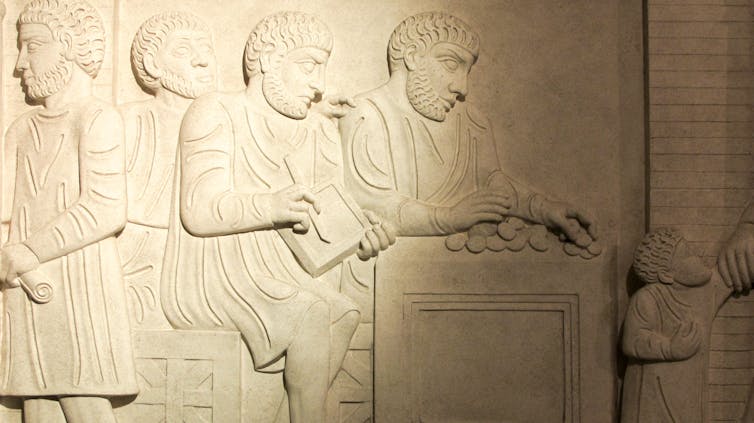
The Roman government charged a tariff of 25% (known as the tetarte) on imported goods.

The purpose of the tetarte was to raise revenue rather than protect local industry. These imports mostly could not be sourced in the Roman Empire. Many of them were in raw form and used in manufacturing items within the empire. Silk was mostly imported raw, as was cotton. Pearls and gemstones were used to manufacture jewellery.

With the volume and value of eastern imports at such high levels in imperial Rome, the tariffs collected were enormous.

One recent estimate suggests they could fund around one-third of the empire’s military budget.

Inflationary effects

Today, economic experts are warning Trump’s new tariffs – which he sees as a way to raise revenue and promote US-made goods – could end up hurting both the US and the broader global economy.

Today’s global economy has been deliberately engineered, while the global economy of antiquity was not. But warnings of the inflationary effects of tariffs are also echoed in ancient Rome too.

Pliny, for example, complained about the impact of tariffs on the street price of incense and pepper.

In modern economies, central banks fight inflation with higher interest rates, but this leads to reduced economic activity and, ultimately, less tax revenue. Reduced tax collection could cancel out increased tariff revenue.

It’s not clear if that happened in Rome, but we do know the emperors took inflation seriously because of its devastating impact on soldiers’ pay.

Black markets

Ancient traders soon became skilled at finding their way around paying tariffs to Roman authorities.

The empire’s borders were so long traders could sometimes avoid tariff check points, especially when travelling overland.

This helped strengthen black markets, which the Roman administration was still trying to deal with in the third century, when its economy hit the skids and inflation soared. This era became known as the Crisis of the Third Century.

I don’t subscribe to the view that you can draw a direct line between Rome’s high tariffs and the decline of the Roman Empire, but it’s certainly true that this inflation that tore through third century Rome weakened it considerably.

And just as it was for Rome, black markets loom as a potential challenge for the Trump administration too, given the length of its borders and the large volume of imports.

But the greatest danger of the new US tariffs is the resentment they will cause, especially among close allies such as Australia.

Rome’s tariffs were not directed at nations and were not tools of diplomatic revenge. Rome had other ways of achieving that.The Conversation

Peter Edwell, Associate Professor in Ancient History, Macquarie University

This article is republished from The Conversation under a Creative Commons license. Read the original article.

The Conversation: Life-size sculptures uncovered in Pompeii show that ancient women didn’t just have to be wives to make a difference

Emily Hauser, University of Exeter

Visitors to the site of Pompeii, the ancient Roman town buried (and so preserved for thousands of years) by the eruption of Mount Vesuvius in 79AD, don’t often think to look beyond the city walls. And it’s easy to understand why: there’s plenty on offer within this monumentally well-preserved town, from jewel-like wall paintings of myths and legends like Helen of Troy, to the majestic amphitheatre and sumptuously stuccoed baths.

But step outside the gates for a moment, and you’re in a very different – yet no less important – world.

For the ancient Romans, the roads and paths leading into and out of cities were crucial: not just for getting places, but as a very real kind of “memory lane”. Tombs lined these ancient byways – some simply bearing inscriptions to the memories of loved ones lost, others, more grand, accommodating space for friends and family to feast in remembrance of the dead.

Some of the tombs even address the passerby directly, as if its occupant could speak again, and pass on what they’ve learned. Take one Pompeiian example, set up by the freedman Publius Vesonius Phileros, which opens with ineffable politeness: “Stranger, wait a while if it’s no trouble, and learn what not to do.”

Going into Pompeii, and leaving it, was about being reminded of ways of living and ways of dying – as well as an invitation to tip your hat to those who trod the path before you, and to learn from their example.

Which is why the recent discovery of a monumental tomb crowned by life-size sculptures of a woman and man, just outside the gates on the east side of the town, isn’t just a fascinating find in and of itself. It’s also a reminder to stop, and to remember the people who once lived and died in this bustling Italian town.


Looking for something good? Cut through the noise with a carefully curated selection of the latest releases, live events and exhibitions, straight to your inbox every fortnight, on Fridays. Sign up here.


The tomb’s main feature is a large wall, peppered with niches where cremated remains would have been placed, and surmounted by the astonishing relief sculpture of the woman and man. They’re standing side by side, but not touching.

I rather like that she’s slightly taller than him, standing at 1.77m, while he’s 1.75m. She’s draped in a modest tunic, cloak and veil (symbols of Roman womanhood), and boasts a pronounced crescent-moon-shaped pendant at her neck called a lunula, that (through the age-old link with lunar cycles) tells a story about female fertility and birth. He, meanwhile, is dressed in the quintessentially Roman toga that instantly identifies him as a proud male citizen of Rome.

Who do the statues depict?

The status quo in archaeology, when a woman and a man are presented next to each other in tombs and burials like this, has always been to assume that she’s his wife. Yet here, there’s an unmissable clue that there’s more going on. That’s because, in her right hand, she’s holding a laurel branch – which was used by priestesses to waft the smoke of incense and herbs in religious rituals.

Priestesses, in the Roman world, held unusual levels of power for women – and it’s been suggested that this woman might have been a priestess of the goddess Ceres (Roman equivalent of Demeter).

So this high-status priestess is shown alongside a man. The inclusion of the symbols of her status (as priestess) alongside his (as a togatus, or “toga-wearing man”), shows that she’s there in her own right, as a contributing member of Pompeiian society. She might be his mother; she might even have been more important than him (which would explain why she’s taller). Without an inscription, we don’t know for sure. The point is: a woman doesn’t have to be a wife to be standing next to a man.

What’s fascinating is this isn’t unique to Pompeii. In my new book, Mythica, which looks at the women not of Rome but of Bronze age Greece, I’ve found that new discoveries in archaeology are overturning the assumptions that used to be made about a woman’s place in society, and the value of their roles, all the time.

One fascinating example is a royal burial in Late Bronze Age Mycenae: a woman and a man who’d been buried together in the royal necropolis, around 1700 years before the eruption of Mount Vesuvius decimated Pompeii. As is typical, this woman was immediately labelled, by the archaeologists who uncovered her, as the man’s wife. But then DNA analysis came into the picture.

As recently as 2008, both skeletons were sampled for DNA – and came up with the game-changing result that they were, in fact, brother and sister. She’d been buried here as a member of a royal family by birth, not by marriage, in other words. She was there on her own terms.

From golden Mycenae to the ash-blasted ruins of Pompeii: the remains from the ancient world are telling us a different story from the one we always thought. A woman didn’t have to be a wife to make a difference.

So I think it’s worth listening to the advice of our friend Publius. Let’s look at the burials of the past, and learn.The Conversation

Emily Hauser, Senior Lecturer in Classics, University of Exeter

This article is republished from The Conversation under a Creative Commons license. Read the original article.