Commodus’ Mini-Colosseum at Genzano

Interesting discovery getting some coverage in the English press but the fullest is from Il Messaggero:

Che l’imperatore Commodo, il controverso figlio di Marco Aurelio, avesse una passione per i giochi gladiatori e i combattimenti contro le bestie, era noto. Non a caso le fonti storiche raccontavano che l’erede dell’imperatore filosofo avesse un anfiteatro privato nella sua natia Lanuvio dove amava sfidare il destino, scendendo nell’arena e uccidendo vestito da gladiatore le belve feroci. Ma quello che finora sembrava solo un retroscena riportato dalla biografia della «Historia Augusta», ha ora le sue prove archeologiche. La conferma che Commodo avesse davvero il suo personale tempio dei ludi gladiatori, ribattezzato già dagli studiosi «il piccolo Colosseo».

L’ARENA
L’arena di oltre 35 metri per 24, una struttura esterna di oltre 50 metri per 40, una superficie della cavea di oltre 9mila metri quadrati, e una capienza di oltre 1300 posti, senza contare l’intero palco imperiale. Un monumento databile alla metà del II secolo d.C. Ma a colpire la suggestione sono i marmi decorativi provenienti da tutto il Mediterraneo. L’eccezionale scoperta è avvenuta a Genzano nel complesso archeologico della cosiddetta Villa degli Antonini, l’originaria residenza imperiale che si estendeva in età romana nell’«Ager Lanuvinus», l’antica Lanuvio, luogo di nascita di Marco Aurelio e, appunto, di Commodo.

I MARMI
È qui che dal 2010 l’équipe del Center for Heritage and Archaeological Studies della Montclair State University sta portando avanti il progetto di scavo didattico sulla Villa degli Antonini sotto la direzione scientifica di Deborah Chatr Aryamontri e Timothy Renner, grazie ad una convenzione rilasciata dal Ministero per i beni culturali in accordo con la Soprintendenza per i beni archeologici del Lazio, e in collaborazione col Comune di Genzano. Le campagne di scavo estive avevano finora indagato le strutture del vasto impianto termale degli Antonini, ma soprattutto avevano individuato una piccola porzione di strutture murarie curvilinee: «Ci sembrarono subito anomale perché apparivano disposte secondo una planimetria ellittica – racconta la Chatr Aryamontri – e oggi siamo ad una svolta. Le indagini col georadar hanno verificato l’intera disposizione planimetrica delle mura di fondazioni e gli scavi hanno riportato alla luce una nuova porzione di strutture curvilinee speculari».

Blocchi di roccia vulcanica alternati a laterizio, rivestiti di marmi pregiati. «Il repertorio dei marmi è eccezionale, il giallo antico, il pavonazzetto, il greco scritto, il granito rosa e il serpentino – avverte la Aryamontri – Pregevoli anche i rivestimenti pavimentali tra tessere di mosaico bianco-nero, pasta vitrea, incluso tessere di vetro trasparente ricoperte con foglia d’oro. Una produzione di qualità rivolta ad una committenza ricca». Tutto intorno all’arena corre un canale sotterraneo, largo oltre 50 centimetri: «L’ipotesi è che servisse anche per gli spettacoli di battaglie navali», azzarda la studiosa. Sempre sotto l’arena, spicca una scala elicoidale che scende per quasi tre metri. Forse anche il «piccolo Colosseo» di Commodo aveva i suoi ipogei per le macchine sceniche funzionali allo spettacolo. Privato, ma grandioso.

On the English side:

… the (much advertised) dig is being conducted at the Villa of the Antonines by the fine folks at Montclair State (who really should get a press release out there) … they have a page about the dig (aimed at prospective field schoolers), which notes that this amphitheatre was actually discovered last year: An Introduction to the “Villa of the Antonines” Archaeological Field Project in Italy.

Roman Vineyard from Leighton Buzzard

From the Leighton Buzzard Observer:

The remains of an ancient Roman vineyard have been discovered on a site being developed by a housebuilder in Leighton Buzzard.

Archaeologists found the 2,000-year-old vineyard at the new Persimmon Homes site at Grovebury Farm, Grovebury Road.

Archaeology and historic buildings consultant Duncan Hawkins, who led the investigations at the site, said the find was exciting because it ‘put another piece in the puzzle’ of the history of the area.

He said: “Although vineyards were fairly common, this is a significant find for the Leighton Buzzard region as it enables us to keep on building a picture of how the landscape used to be; in effect another piece in the jigsaw.

“We were unsure at first whether they were Roman or medieval remains, but because of the common practice of burials out in the fields we have been able to date it to the 2nd or 3rd Century.”

Duncan added that because the process of archaeology is in itself destructive, the site would be photographed, recorded and a 3d model created to keep the history alive.

Mark Gatehouse, Persimmon Homes Midlands technical manager, said the company called in the archaeologists as part of being granted planning permission to develop the site.

“We didn’t necessarily expect to find anything so to discover this old Roman vineyard was a real surprise. It has proved to be very exciting and significant, because not much is known of the Roman presence in the area.

“It will be particularly interesting for new homeowners to move onto a site with such a fascinating history. They will literally be walking in the footsteps of the Romans every time they step out of their front doors.

The site – scheduled for new homes by both Persimmon and sister company Charles Church – lies close to the ancient Watling Street – one of the Roman’s most important highways and now the basis for the modern A5.

Unplundered Sarmatian Burial

Brief item from RiA Novosti:

Archaeologists have found the intact burial chamber of a noble woman from a powerful tribe that roamed the Eurasian steppes 2,500 years ago in southern Russia, an official said Tuesday.

The Sarmatians were a group of Persian-speaking tribes that controlled what is now parts of southern Russia, Ukraine and Central Asia from around 500 BC until 400 AD. They were often mentioned by ancient Greek historians and left luxurious tombs with exquisite golden and bronze artifacts that were often looted by gravediggers.

But the burial site found near the the village of Filippovka in the Orenburg region has not been robbed – and contained a giant bronze kettle, jewelry, a silver mirror and what appears to be containers for cosmetics, said history professor Gulnara Obydennova who heads the Institute of History and Legal Education in the city of Ufa.

“The find is really sensational also because the burial vault was intact – the objects and jewelry in it were found the way they had been placed by the ancient nomads,” she told RIA Novosti.

The vault – located 4 meters (13 feet) underground – was found in the “Tsar Tumulus,” a group of two dozen mounds where hundreds of golden and silver figurines of deer, griffins and camels, vessels and weapons have been found since the 1980s.

The woman’s skeleton was still covered with jewelry and decorations, and her left hand held a silver mirror with an ornamented golden handle, Obydennova said.

The descendants of the Sarmatians include Ossetians, an ethnic group living in the Caucasus region, who speak a language related to Persian.

… there’s a couple of interesting photos with the original article

Mycenean Rock-cut Tombs from Bodrum

Interesting item from Hurriyet:

Rock tombs dating back to 3,500 years ago have been uncovered in Bodrum’s Ortakent district, which form part of the necropolis area.

Bodrum Underwater Archeology Museum manager Emel Özkan and archeologists Banu Mete Özler and Ece Benli Bağcı are leading the excavations. The experts are still not sure if there was a settlement or not.

The tombs are believed to belong to the early “Mycenaean Greece III A” era, which was a cultural period of Bronze Age Greece taking its name from the archaeological site of Mycenae in northeastern Argolis, in the Peloponnese of southern Greece. The tombs also revealed human and animal bones, bronze containers and many different kinds of pieces. The necropolis area has been taken under protection. The findings of the excavation may belong to the bronze age and also to the Akha Hellenistic era.

The tombs also reveal the culture and the lifestyle of the early Mycenaean Greek era, as well as the period’s artistic approach, according to experts.

Hurriyet has another version at Mycenaean artifacts found in Bodrum which has a different photo … there’s also some added detail from the Today’s Zaman coverage (inter alia):

[…] Speaking to the press, Professor Yusuf Boysal, the supervisor of the excavations, said his team so far has found the remains of several tombs, a canteen, a three-handled cup, a jug, a bronze razor, animals’ bones, many pieces of glass and beads with different shapes.

Boysal added: “Along with these new discoveries, now we will have more information regarding this ancient era. These tombs and other historical ruins are very important and they will give us information about the culture of the people who lived in that era.” […]

Antony + Cleopatra Coin from Bethsaida!

Interesting item from Ha’aretz, although it is behind a paywall. Here are some excerpts:

[…]

A few thousand years is a mere blink of an eye when it comes to the vital ties between this land and Egypt, as attested by a rare coin carrying historical weight far greater than its 7.59 grams, which depicts the notorious lovers – and which emerged last year from the ruins of a first-century house at Tel Bethsaida on the Sea of Galilee.

Tel Bethsaida rises from the northern coast of the Sea of Galilee, but the coin was minted in another city by another sea – the Mediterranean port of Akko – today better known as Acre. The coin, made of bronze, is about the size of a quarter, being 21–23 millimeters in diameter (it is not perfectly round, at least not any more). Its date shows that it was minted in the last half of the year 35 or the first half of 34 BCE.

Mark Antony, the most powerful man in the world at the time, is on one side of the coin and Cleopatra graces the other. On her side are the Greek words “of the people of Ptolemais.”

Ptolemais is the Greek name for ancient Akko, which was founded in the 3rd century BCE and named after Ptolemy II Philadelphus. The name appears in the New Testament (Acts 21:7) as the home of an early Christian community that Paul the apostle visited: “And when we had finished our course from Tyre, we came to Ptolemais, and saluted the brethren, and abode with them one day.”

The coin was minted some two and a half centuries after the city was founded, a time when both Mark Antony and his bitter rival Octavian were in their prime and no one knew who would prevail, Arav says.

Why depict them? The cities of the ancient Middle East had a habit of minting coins bearing the portraits of whoever was in power, says Dr. Donald T. Ariel, head of the Israel Antiquities Authority Coin Department.

And Marc Antony was most definitely powerful in the year stamped on the coin. Prof. Rami Arav, director of the Bethsaida Excavations Project, suggests that the minting of the coin may have had to do with Marc Antony’s victory over the Parthians, rulers of a land in what is now northeastern Iran and Armenia, in 35 BCE. He then granted Armenia to Cleopatra’s sons and gave Cyprus to her daughter Selene.

Cleopatra also appears on coins from the same period, found in cities further north up the Lebanese coast, that were among gifts Marc Antony gave his consort.

That same year Marc Antony, still deeply involved with Cleopatra, moved the capital of the empire from Rome to Alexandria, Egypt.

[…]

via: The ancient coin of Cleopatra: There could have been pyramids in Paris (Ha’aretz)

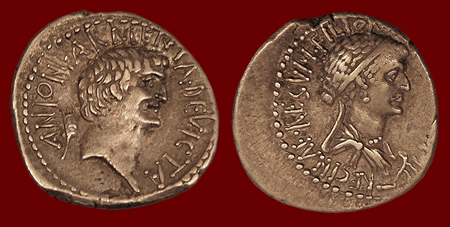
… Rami Arav is then pressed to speculate what might have happened if Tony and Cleo were victorious at Actium. There is no photo of the coin (which was found last year, by the way), alas, but presumably it was like this one from the VRoma site:

via VRoma

That said, I’m not sure if anyone would call Antony’s actions in Parthia a “victory” in anything but a ‘Parthian’ sense; he lost a major portion of his troops — Napoleon-like — to the cold and had to do some serious bribing of those that remained … it’s actually more interesting how little of substance there is about this campaign on the www. One can, of course, read Dio 49.22-33 on it and get a sense of the ‘failure’ (although Dio’s description of the testudo in action here is incredibly interesting)