Votive Relief of Zeus from Near Starosel

This one’s interesting primarily because of the ‘omen’ involved in the different coverage and how it is dealt with by the journalists. First, here’s the coverage from Focus-Fen:

Archaeological team of Dr Ivan Hristov discovered a big votive relief of the ancient Father of Gods and men Zeus close to the archaeological excavations of Bulgaria’s National Museum of History at the Kozi Gramadi peak in Severna Gora, close to the village of Starosel.
Director of the National Museum of History, Dr Bozhidar Dimitrov, announced the news for FOCUS News Agency.
“It is bigger than the votive slabs found so far and probably it is the central icon of the ancient temple,” Dimitrov said.
A strange event took archaeologists by surprise while the votive relief was taken out. A big imperial eagle started flying over them.
In antiquity Zeus was often portrayed as an imperial eagle and the younger women archaeologists started commenting that Zeus had come to see what they were doing in his temple.
The Kozi Gramadi stronghold, built in VI-V century before Christ, was a capital of a Thracian tribe, which used to live in this part of Bulgaria during the antiquity. The popular tombs close to Starosel are in fact the necropolis of the Thracian aristocrats living in the city.

Here’s the same site, with the same coverage (and sadly, the same, uniformative photo) via Novinite/Sofia News Agency:

A team of Bulgarian archeologists led by Dr. Ivan Hristov has discovered an unusually large votive relief of the ancient Greek God Zeus near the Bulgarian village of Starosel.

The news was announced by the National History Museum for the Bulgarian News Agency Focus.

The archeological team uncovered the votive relief which was much bigger than the ordinary ones and thus it was allegedly the center part of an ancient temple.

A large rock eagle appeared flying round when the archeological team was about to uncover the artifact. As the ancient Greek god Zeus was commonly featured as a rock eagle, some of the archeologists jokingly concluded that god Zeus should have come to look over his sanctuary.

The votive relief was uncovered while the archeologists were excavating the Kozi Gramadi mount in the Sredna Gora mountain, in the village of Starosel, close to the resort town of Hissar in central Bulgaria.

The fortress, located on the Kozi Gramadi mount , was built VI-V century BC and it used to be the capital of ancient Thracian tribe living in central Bulgaria.

The archaeologists believe that the region was the power center of Ancient Thrace in the 4th century BC. It was destroyed during the rise of the Macedonian state of Philip II in 342-341 BC.

… it’s interesting the different tone one gets comparing the use of “commented” to “jokingly concluded”. Not sure if that’s just an aspect of translation or sensation (c. e.g., all the claims this past weekend about a ‘True Cross’ find presented with incredible credulity by quite a few outlets …). That said, it would have been nice to have a photo of the relief itself …

Roman Burials from Gloucester

From the BBC:

About 40 skeletons have been uncovered by archaeologists at the site of a Roman cemetery in Gloucester.

The discovery was made during a dig at the former Gloscat site at Greyfriars in Brunswick Road, ahead of a housing development being built.

It has been described as one of the most significant archaeological finds in the city in the past 30 years.

The skeletons could end up in the care of Gloucester museum after scientific tests have been carried out.

Stuart Joyce from Cotswold Archaeology said: “We’re just outside the walls of the Roman city of Glevum and this would have been the Roman cemetery associated with the city.

“This is probably one of the most significant finds that has been made within Gloucester within the last 30 years. It will add greatly to the knowledge of the [city].”

Forty skeletons were uncovered nearby in the 1960s. These are now kept at Exeter University.

“The cemetery itself was known previously, but this is the first time that such an [archaeological dig] in this area has been conducted under modern excavation practice,” added Mr Joyce.

“Maybe another 20 to 30 will come up during subsequent excavations, but the number is very hard to say.”

Excavation work on the site is expected to last for at least another two years while a new housing development is built.

… I don’t think we’ve mentioned this dig before.

Major Finds at Hadrian’s Villa

This is another one of those things that didn’t really hit the mainstream English press for some unknown reason. Here’s the coverage from Il Messaggero (from back in June!):

La «grande bellezza» di Adriano si nascondeva in un giardino segreto. L’area più panoramica e sconosciuta della sua villa a Tivoli, che si erge sulla cresta del banco tufaceo, alle spalle della famosa Piazza d’Oro.È qui che sono riemersi in sequenza strategica cinque edifici monumentali di rara raffinatezza architettonica, decorati con statue colossali, progettati da Adriano per offrire percorsi privilegiati, creando sfondi paesaggistici dal carattere idilliaco. Sono le memorie «inedite» di Adriano che riemergono ora da una porzione della sua villa del tutto dimenticata, considerata per secoli di scarso interesse, tanto da essere esclusa dal percorso di visita negli anni ’60 del secolo scorso per ospitare un campeggio. La scoperta, frutto della lunga e complessa campagna di scavi condotta dall’università La Sapienza con la responsabilità scientifica di Patrizio Pensabene in stretta collaborazione con la Soprintendenza ai beni archeologici del Lazio e la direttrice di Villa Adriana Benedetta Adembri, è stata presentata al convegno internazionale di antichità classica di Merida in Spagna, appena conclusosi. «Quello che è stato rinvenuto è solo la punta di un iceberg perché queste strutture non sono state mai documentate prima neanche dagli studiosi antichi come Piranesi», racconta il direttore dello scavo Adalberto Ottati ricercatore de La Sapienza e dell’Istituto catalano di archeologia classica. L’unico monumento visibile era il cosiddetto mausoleo di epoca repubblicana, un edificio circolare che è stato completamente reinterpretato, datandolo come gli altri all’età di Adriano (123 d.C. dai laterizi bollati). «È un unicum, non ha confronti con strutture conservate – dice Ottati – Sicuramente era un padiglione-museo, che sfoggiava i suoi fasti all’interno e non all’esterno. Nella ricca decorazione architettonica di cui abbiamo trovato frammenti monumentali, spicca un colonnato dorico, scelta stilistica non casuale, ma significativa nel suo riferimento alla Grecia delle origini. Inoltre – aggiunge Ottati – doveva conteneva anche statue e opere d’arte come una sorta di luogo di contemplazione del bello».
TEMPLI E COLOSSI
Dal padiglione di Adriano le indagini (condotte da Patrizio Fileri, Francesca Stazzi, Luigi Tortella, Elisa Iori, Elisa Mancini, Vito Mazzurca) hanno svelato una inusuale sequenza di edifici: un tempietto rettangolare, seguito da un secondo padiglione circolare abbinato ad un altro tempietto rettangolare. Questi ultimi, coronati da un grande edificio porticato. Un complesso scenografico di forte suggestione: «La disposizione degli edifici crea un gioco di sfondi e punti di vista tra natura e architettura che testimoniano di voler ricreare paesaggi che si ritrovano nelle pitture pompeiane – riflette Ottati – Un affascinante confronto è proprio nelle Pitture di II e III stile ed in particolar modo nelle vedute di paesaggio idilliaco-sacrale di tradizione tardo-ellenistica». Non è tutto. Nei pressi del secondo padiglione, sono stati rinvenuti centinaia di frammenti marmorei di una statua colossale che oggi, dopo un attento e certosino lavoro di ricomposizione, ha riconquistato una sua identità: «Sembra una Nemesi, e per il suo carattere colossale può essere anche una statua ritratto di un’imperatrice», riflette Ottati. Forse la stessa Vibia Sabina, moglie di Adriano. Ma le ipotesi rimangono ancora aperte. Lo scavo riprenderà a settembre.

The original page includes a mini slideshow of reconstructions of the finds …

If you’re not into working through the Italian, Wanted in Rome had a brief summary this past weekend: Major discovery at Hadrian’s Villa

Hopefully, when the digging resumes in September, the English media will be a bit more on the ball …

Roman Necropolis from Jordan

I wonder if we’ll hear more about this … from Ammon:

The Department of Antiquities (DoA) has unearthed the remains of a Roman cemetery in Abdoun, it announced late on Monday.

Ahmad Al Shami, Amman antiquities inspector, said 12 burial sites were discovered in addition to artefacts and human bones dating back to the Roman era.

The site in Abdoun, which is one of Amman’s upscale neighbourhoods, includes numerous graves and skeletal remains of several individuals, according to Shami.

In addition, archaeologists have found pottery and a coin.

“We will study the pottery and the coin for more details about that era,” he told The Jordan Times over the phone on Tuesday.

Shami added that they did not find a complete skeleton, only remains, which experts will study to identify the age and gender of those who were buried at the site.

In addition to the 12 graves the DoA unearthed, there are two destroyed tombs and a small yard in front of them that was used to prepare the dead bodies, he noted.

“We also found symbols of Rosetta, the Roman flower, engraved in the stones,” Shami said.

The cemetery was discovered on private property by a contractor supervising a construction project, and the owner was requested to stop work at the site until studies by the DoA conclude.

via: ‘Roman cemetery unearthed in Abdoun’ (Ammon)

Dragon and Dolphin (nope) Mosaic From Monasterace

This one is potentially very interesting … most of the coverage comes from ANSA-related outlets in various languages, so here’s the English coverage from Gazzetta del Sud:

Students on an archaeological dig near the southern Italian town of Monasterace have uncovered an important and ancient mosaic, authorities said Tuesday. The large mosaic, likely of ancient Greek origins, was discovered near another major find announced last fall by archaeologist Francesco Cuteri. Cuteri says he is pleased that students from Argentina and Italy made the latest mosaic discovery, which he added is an important find. “The discovery is of extraordinary importance because it is the largest Hellenic mosaic of Magna Grecia (an area of southern Italy),” he said. The mosaic, depicting dragon and dolphins, may date from the Hellenistic period, which ran from about 323 BC to about 146 BC. Work on the excavation began in 1998 and last year had already led to the discovery of a mosaic depicting a dragon, a rosette and six panels with floral motifs. Cuteri said work is far from finished. “We are confident….we can find at least two other panels,” he said, adding the new area has been dubbed ‘the hall of dragons and dolphins’. “We have worked on this excavation for 15 years and now what emerges fills us with joy”.

That said, I don’t understand why all the ANSA coverage includes what isn’t exactly the greatest photo available, i.e.:

via Gazzetta del Sud

Corriere della Calabria includes one that’s a bit more clear:

via Corriere della Calabria

… which raises a question: does the ‘dragon’ interpretation come via the first photo, which has something on top of it which makes it look like there are two creatures? So we’ll track down another photo (actually, the whole set, it seems):

via Mondo Tempo Reale

Seems we ain’t dealing with dolphins or dragons. Those are good old-fashioned Hippocampi/oi, no?

UPDATE (an hour or so later): definitely an argument for the benefits of caffeine … when the caffeine hit, I remembered we mentioned an earlier phase of this back in September: Hellenistic Mosaic From Monasterace … check out the photo there. How are they getting dragons and dolphins from this????

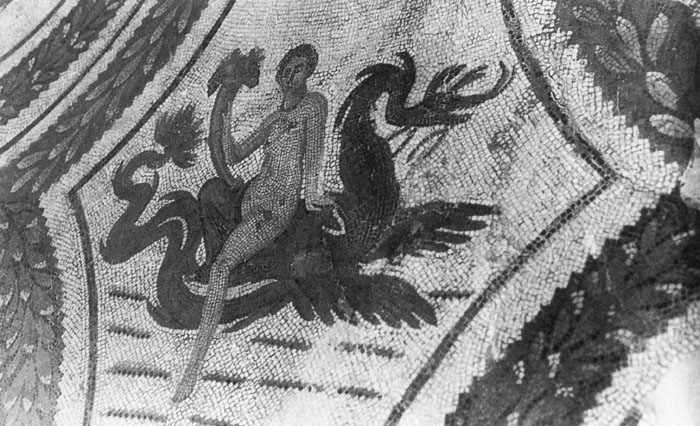
UPDATE II (a couple days later): tip o’ the pileus to the Random Classicist who wrote in to remind me of the beastie known as the Cetus, the foe of Perseus which I had totally forgotten about. Here’s an example of a Cetus image from the Classical Art Research Centre (a mosaic from Tunis) :

… so the thing I was calling a Hippocamp is clearly a Ketos/Cetus. Are they considered dragons? Or is that just something that happened during translation?

UPDATE III (the next day): Tip o’ the pileus to John Dillon, who also sent in some very useful comments:

_Ketos_ seems to be the contemporary term of choice among art historians for sea beasties of this form, though one still encounters _pistrix_ (and, in Italian, its derivative _pistrice_). Joseph Fontenrose (Python_, pp. 288-306) is helpful here, esp. pp. 288-89 and fig. 25 on p. 305; cf. also Barbette Stanley Spaeth, _The Goddess Ceres_, p. 135, and J. M. Blanquez, “Grifos y ketoi en mosaicos de Italia, Hispania, Africa y el Oriente”, in Nicole Blanc and André Buisson, edd., _Imago Antiquitatis_ (Paris, 1999), pp. 119-28; figs. 1-9. In Italian they’re conceived of as a sea serpent and thus as a sort of _drago_ and are popularly called by that latter term (_ketos_ and _pistrix_ both being far too specialized for a general audience). Since English _dragon_ tends to signify a four-legged, terrestrial creature, a better translation of _drago_ in this context would be _sea dragon_.

A few further ancient and medieval _ketoi_:
1) A red-figure vase in the Museo Jatta in Ruvo di Puglia [but how much of this is down to a modern restorer?]
http://www.flickr.com/photos/28433765@N07/3411670241/

2) The sea wind (at right) on the Ara Pacis Augustae:
https://upload.wikimedia.org/wikipedia/commons/8/8b/Tellus_-_Ara_Pacis.jpg

3) Jonah and the “whale” in mosaic on the epistle ambo (said to be earlier C12 but I’d check to see what Jill Caskey has to say before repeating this standard dating) in the cathedral of Ravello:
http://www.flickr.com/photos/28433765@N07/3415070638/

4) Detail of the later C12 mosaic floor of the cathedral of Otranto:
http://www.flickr.com/photos/28433765@N07/5319544904/

5) At far left, on the probably earlier C13 mosaic frieze on the cathedral of Terracina:
http://www.flickr.com/photos/ecormany/132384564/

–jd