This is presumably a followup to the reports from last week adding the Tauric Chersonese to the list of UNESCO Heritage sites. I’m hoping some newspaper will pick this up and have a reporter ask more questions, but nothing doing … from EurekAlert:
Chersonesos is an ancient city on the Crimean peninsula, which was founded by Greek colonists at the end of the 6th century BC in order to supply their homeland with grain and other strategic resources. The farmland in the Greek colonies was vital to the survival of the Greek city-states. The excavations by the Aarhus archaeologists are exploring the development of the rural area from its peak until its decline. One of the conclusions so far is that during a period of crisis in the early 3rd century BC a large proportion of the rural population was killed following a military invasion. The skeletons of these people can be found just 40 cm beneath the surface of the soil in a number of housing structures which the Aarhus archaeologists have excavated.
“We’ve learned things that have changed our view of what life was like in the Chersonesean countryside, which the Greeks called chora. The city’s rural territory, particularly on the Herakleian and Tarkhankut peninsulas, is incredibly well preserved. The houses of the rural population dating back to about 300 BC lie dotted around the untouched landscape in the form of ruins that are still visible. For instance, in one of the excavated ruins we have found the remains of a whole family. So we’re working on a murder scene dating back 2,300 years,” reports project director Vladimir Stolba, an archaeologist from Aarhus University.
Chersonesos and its rural area have just been added to UNESCO’s list of world heritage sites – the area is a unique example of the way the ancient Greek cities and surrounding landscape were organised.
“We’ve had several teams of students from Denmark and the host country Ukraine on our expeditions. It’s been a great experience and very fruitful collaboration. We are in a lucky and, in a sense, unique situation to work on short-lived rural sites which have never been re-inhabited since their destruction in the early 3rd century BC. The picture that emerges from the excavations is a snapshot of daily activities of the ancient peasantry, of its life and dramatic death. We’ve found answers to many of our research questions: for instance, who cultivated the Greek grain fields, how densely the area was settled and how it was organised, and how the ancient population adapted to changes in cultural and natural environment. The answers have given rise to new questions that we want to explore next. The world heritage status will hopefully help to preserve this unique area despite the increase in tourism and tourism infrastructure development, enabling us to continue our work,” concludes Vladimir Stolba.
All very interesting, but we really need to know more about these burials. The project website (Economic Models and Adaptation Strategies: The Northern Black Sea in the Late Bronze Age and Iron Age) has quite a bit of information, but nothing, really, on these in-house burials. What is the evidence for “murder” as opposed to epidemic? Are these people buried actually inside the structures? etc. … more details please!!!!
Sakarya Museum has launched excavations in Kaynarca district’s Uzunalan village after a 2,000-year-old damaged sculpture from Roman times was discovered in the area.
Archaeologists believe the sculpture is not the only work in the area and that there could be other artifacts in the vicinity, according to a written statement from the director of the museum, Murşit Yazıcı.
“Since the sculpture cannot be here alone, we are looking for a settled area,” said Yazıcı. “This sculpture that has a missing hand and no head is from the Roman era and probably belongs to a Roman aristocrat.”
The sculpture was delivered to Sakarya Museum, where examinations confirmed that it was a 2,000-year-old sculpture from the Roman era.
Archaeological studies and pre-excavations have started in the area with contributions from Süleyman Acar, an art historian at Sakarya Museum; archaeologist Gökhan Beyazcem and experts from Kaynarca Municipality.
Yazıcı said the studies that were being conducted in the area were not archeological excavations but that only the pre-excavations were being undertaken in an effort to determine whether or not to proceed with a more comprehensive dig.
We cannot know that without an examination. Now we are conducting pre-studies because we think that the sculpture cannot be alone here; we are looking for an ancient settlement,” said Yazıcı. “This is not an archaeological excavation yet. After the studies, we are going to make a decision.”
“They said that I have found a treasure,” Uzunalan village headman Saffet Tezer said.
There’s a typically not-great photo accompanying the article, which we’re going to include here:
via Hurriyet
The drapery is vaguely reminiscent of the Prima Porta Augustus, but clearly by a lesser artist. It would be nice to know more about the conditions of its discovery …
Not sure why this isn’t getting more attention, even in the Italian press. Rosella Lorenzi’s piece for Discovery News seems to be the only English coverage … some excerpts:
A key episode of the Punic Wars has emerged from the waters near the small Sicilian island of Pantelleria as archaeologists discovered a cluster of more than 30 ancient anchors.
Found at a depth between 160 and 270 feet in Cala Levante, one of the island’s most scenic spots, the anchors date to more than 2,000 years ago.
According to Leonardo Abelli, an archaeologist from the University of Sassari, the anchors are startling evidence of the Romans’ and Carthaginians’ struggle to conquer the Mediterranean during the First Punic War (264 to 241 B.C.).
“They were deliberately abandoned. The Carthaginian ships were hiding from the Romans and could not waste time trying to retrieve heavy anchors at such depths,” Abelli told Discovery News.
[…]
Following the first conquer in 255 B.C., Rome took control of the island with a fleet of over 300 ships.
“The Carthaginian ships that were stationing near Pantelleria had no other choice than hiding near the northern coast and trying to escape. To do so, they cut the anchors free and left them in the sea. They also abandoned part of their cargo to lighten the ships and gain speed,” Abelli said.
Indeed, Abelli’s team found many jars in clusters of 4-10 pieces near the spectacular Punta Tracino, not far from where the anchors were found.
Two years ago, the same team found 3,500 Punic coins about 68 feet down. Dating between 264 and 241 B.C., the bronze coins featured the same iconography, suggesting that the money served for an institutional payment, possibly to sustain anti-Roman troops.
Carried on a Carthaginian ship headed to Sicily, the money was deliberately left on the bottom of the sea, in relatively low waters, with the hope of recovering it later.
“Near the coins we found a large stone anchor with three holes and a tree trunk. We believe they were signaling the point where the treasure was hidden,” Abelli said.
For some reason last summer, I neglected to post the item on the coin find, which you can read here: Sunken Treasure Found in the Seas Of Sicily (Discovery News), but here’s an excerpt:
[…] Lying at depth of about 68 feet, the coins most likely represent an episode of the Romans and Carthaginians struggle.
Amazingly, all 3,422 coins feature the same iconography.
On one side, they show Kore/Tanit, the ancient goddess of fertility, whom Carthaginians worshipped on the island around 550 BC.
On the other, the coins display the head of a horse, surrounded by symbols such as stars, letters and a caduceus. A staff often surmounted by two wings and entwined with two snakes, the caduceus was the symbol of Hermes, the messenger of the gods in Greek mythology.
“Since all coins feature the same iconography, we believe that the money served for an institutional payment. Indeed, ordinary commercial transactions contain different kind of coins,” archaeologist Leonardo Abelli, director of the excavation, told Discovery News.
According to Abelli, the money, carried on a Carthaginian ship headed to Sicily, was destined to an anti-Roman movement.
But something might have gone wrong during the navigation.
“They decided to hide the treasure on the bottom of the sea, in relatively low waters, in the hope to recover it later. Indeed, near the coins we found a large stone anchor,” Abelli said. […]
Despite the good info above, I find the lack of press coverage on this one somewhat infuriating. As far as I can figure, cutting anchors is not what you if you’re faced when an enemy fleet (I might be wrong there) pops up on the horizon, but rather, when a storm blows in. I can’t help but wonder, therefore, given the apparent dating of all this, whether this might not be evidence of the (in)famous storm in the same area as described in Polybius 1.37 which trashed a major part of the Roman fleet in 255 or so. Here’s an excerpt (from Lacus Curtius … with a bit from 1.36 for context):
In the early summer the Romans, having launched three hundred and fifty ships, sent them off under the command of Marcus Aemilius and Servius Fulvius, who proceeded along the coast of Sicily making for Libya. Encountering the Carthaginian fleet near the Hermaeum they fell on them and easily routed them, capturing one hundred and fourteen ships with their crews. Then having taken on board at Aspis the lads who remained in Libya they set sail again for Sicily. They had crossed the strait in safety and were off the territory of Camarina when they were overtaken by so fierce a storm and so terrible a disaster that it is difficult adequately to describe it owing to its surpassing magnitude. For of their three hundred and sixty-four ships only eighty were saved; the rest either foundered or were dashed by the waves against the rocks and headlands and broken to pieces, covering the shore with corpses and wreckage. History tells of no greater catastrophe at sea taking place at one time. The blame must be laid not so much on ill-fortune as on the commanders; for the captains had repeatedly urged them not to sail along the outer coast of Sicily, that turned towards the Libyan sea, as it was very rugged and had few safe anchorages: they also warned them that one of the dangerous astral periods was not over and another just approaching (for it was between the rising of Orion and that of Sirius4 that they undertook the voyage). The commanders, however, paid no attention to a single word they said, they took the outer course and there they were in the open sea thinking to strike terror into some of the cities they passed by the brilliancy of their recent success and thus win them over. But now, all for the sake of such meagre expectations, they exposed themselves to this great disaster, and were obliged to acknowledge their lack of judgement.
… The Carthaginians, of course, would know how to respond to a sudden storm blowing up in the area (i.e. cut anchors); the Romans were still rookies. That said, we have to admit there’s no way to know with any degree of certainty, but it’s an interesting possibility.
Not sure why there isn’t anything about this at the IAA site … so far it’s only at Ha’aretz and for some reason they let me behind the paywall, so we’ll strike while the ‘Ferrata’ is hot, as it were:
Israeli archaeologists have found ruins they believe are the site of one of the two Roman legions based in the country between 120 and 300 C.E.
Israel Antiquities Authority archaeologist Yotam Tepper had long suspected that the site in the Galilee was the base of the Legio Sexta Ferrata, the 6th Roman Legion, also known as the Ironclad Legion. The other legion in the country was the 10th, based in Jerusalem.
Over the past week, an expedition led by Tepper and archaeologist Matthew Adams found the base of a battery or wall, a moat surrounding the camp, water pipes, a covered sewage channel, coins and tiles. The legion’s symbol adorned a broken shingle.
The site sits between two other historical gems: Tel Megiddo, the ancient fortified city that has been named a UNESCO World Heritage site, and the oldest known Christian house of worship, which was discovered around seven and a half years ago about a kilometer south.
Tepper uncovered the Christian site during antiquities authority digs at Megiddo Prison in 2005. Now the legion site is in focus; it’s why the area became known as Legio. In Arabic, it was known as Lajun before early Zionists restored the name Megiddo. “We’re very excited,” said Tepper, who has been excavating the Legio-Megiddo area for 15 years
The legion camp is comparable to the Defense Ministry’s Kirya headquarters in Tel Aviv, says Tepper. “That’s where the administrative-bureaucratic system dealt with the military government,” he says. “From here, around 3,500 soldiers in a hierarchical system ruled over the Galilee and part of Samaria.”
Excavations and surveys over the years found the locations of the Jewish village Othnai in the Megiddo Prison compound, and the Roman-Byzantine city of Maximianopolis near Kibbutz Megiddo. To find the legion camp, Tepper conducted field surveys and relied on surveys from the past.
“I even went to the homes of local people, who poured me out old coins from old tin cans,” he says. “In people’s gardens, we found archaeological artifacts bearing various inscriptions.”
Slowly he put together the puzzle: aqueducts, burial grounds and the ruins of a civilian settlement at the edge of the camp. There were also remnants of ancient roads and a milestone marking the two-mile mark from the camp. All this helped Tepper conclude that the legion’s camp lay under a hill.
Tepper and Adams analyzed an enhanced high-resolution satellite photo and could clearly make out the square marking the camp’s boundaries; each side was around 250 meters long. A ground-penetrating radar scan provided further evidence. Student volunteers from the United States, Europe and Australia helped out.
According to Hanan Erez, head of the Megiddo Regional Council, the plan is to build a tourism complex based around the ancient chapel and Tel Megiddo. Next week a senior official of the Catholic Church is scheduled to visit the sanctuary’s remains.
According to Tepper, the chapel offered evidence of an ancient Christian community whose members included Roman officers. This was the period before Christianity was recognized as a religion, and well before it became Rome’s official religion. The chapel was apparently abandoned at the end of the third century.
Tepper believes the legion camp was also abandoned around that time. “You can see that the camp wasn’t destroyed but was abandoned in an orderly way,” he says. “From here they moved east across the Jordan River.”
This one’s getting a pile of coverage in the British press, with a couple of different focuses. The best overall coverage is the Durham University Press release … with a bit of trimming:
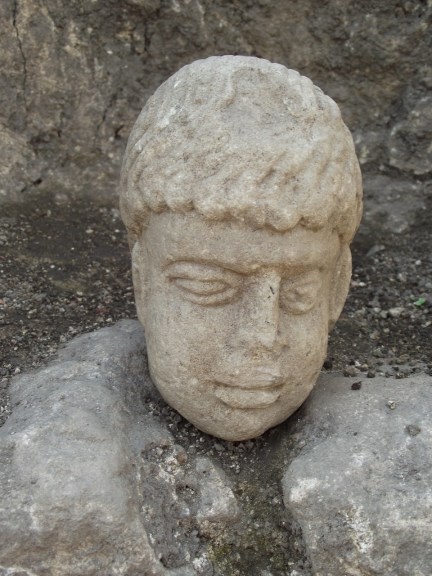
An 1,800-year-old carved stone head of what is believed to be a Roman god has been unearthed in an ancient rubbish dump.
Archaeologists made the discovery at Binchester Roman Fort, near Bishop Auckland, in County Durham.
First year Durham University archaeology student Alex Kirton found the artefact, which measures about 20cm by 10cm, in buried late Roman rubbish within what was probably a bath house.
The sandstone head, which dates from the 2nd or 3rd century AD, has been likened to the Celtic deity Antenociticus, thought to have been worshipped as a source of inspiration and intercession in military affairs.
A similar sandstone head, complete with an inscription identifying it as Antenociticus, was found at Benwell, in Newcastle upon Tyne, in 1862.
Dr David Petts, Lecturer in Archaeology at Durham University, said:
“We found the Binchester head close to where a small Roman altar was found two years ago. We think it may have been associated with a small shrine in the bath house and dumped after the building fell out of use, probably in the 4th century AD
“It is probably the head of a Roman god – we can’t be sure of his name, but it does have similarities to the head of Antenociticus found at Benwell in the 19th century.
“We may never know the true identity of this new head, but we are continuing to explore the building from which it came to help us improve our understanding of late Roman life at Binchester and the Roman Empire’s northern frontier in Northern England.
“Antenociticus is one of a number of gods known only from the northern frontier, a region which seems to have had a number of its own deities.
“It’s also an excellent insight into the life and beliefs of the civilians living close to the Roman fort. The style is a combination of classical Roman art and more regional Romano-British traditions. It shows the population of the settlement taking classical artistic traditions and making them their own.”
Alex, 19, from Bishop’s Stortford, in Hertfordshire, said:
“As an archaeology student this is one of the best things and most exciting things that could have happened.”
He added: “It was an incredible thing to find in a lump of soil in the middle
via the Roman Binchester Blog
of nowhere – I’ve never found anything remotely exciting as this.”
Dr David Mason, Principal Archaeologist with the site’s owner, Durham County Council, said:
“The head is a welcome addition to the collection of sculpture and inscriptions from Binchester. Previous religious dedications from the site feature deities from the classical pantheon of gods and goddesses such as the supreme god Jupiter and those associated with healing and good health such as Aesculapius, Salus and Hygeia.
“This one however appears to represent a local Romano-Celtic god of the type frequently found in the frontier regions of the Empire and probably representing the conflation of a classical deity with its local equivalent. The similarity with the head of Antenociticus is notable, but this could be a deity local to Binchester.”
The Binchester head is African in appearance, but Dr Petts, who is also Associate Director of Durham University’s Institute of Medieval and Early Modern Studies, said experts were unsure whether these features were deliberate or coincidental.
He explained: “This is something we need to consider deeply. If it is an image of an African, it could be extremely important, although this identification is not certain.”
Dr Mason added: “The African style comparison may be misleading as the form is typical of that produced by local craftsmen in the frontier region.”
The find was made as part of a five year project at Binchester Roman Fort which is shedding new light on the twilight years of the Roman Empire.
The Binchester dig is a joint project between Durham University’s Department of Archaeology, site owner Durham County Council, Stanford University’s Archaeology Centre and the Architectural and Archaeological Society of Durham and Northumberland.
[…]
About Binchester Fort
Binchester – known to the Romans as Vinovia – was established in the later 1st century AD and was once the largest Roman fort in County Durham.
Sited on the main Roman road between the legionary headquarters at York and Hadrian’s Wall, it controlled an important crossing point over the River Wear. It was also surrounded by the remains of a substantial settlement which would have housed the civilian population.
The major excavation fieldwork has been underway since 2009 and focuses on a section of the fort interior and a sample area of the nearby civilian settlement.
Previous finds at the site have included the remains of very late Roman activity at the fort, among them evidence for large-scale leather production dating to the very final years of Roman control in Britain in the late 4th and early 5th century AD.
Other evidence discovered at Binchester, including structures and artifacts, might also indicate continued occupation at the site into the early medieval period.
The archaeologists’ work at the site featured on BBC Two’s Digging for Britain in 2011 and on Channel Four’s Time Team in 2008.
About Antenociticus – a “Geordie” Roman god?
A carved stone head depicting Antenociticus was found in 1862 at a temple dedicated to the deity at Benwell, Newcastle upon Tyne. Fragments of a forearm and a lower leg were also found, suggesting that the head may have been part of a life-sized statue
The small temple of Antenociticus stands in the vicus (civilian settlement) outside Benwell (Condercum) Fort, one of 13 permanent forts added to the line of Hadrian’s Wall during its construction.
The temple was built in about AD 178-80, probably to mark the promotion of the Roman cavalry prefect who dedicated one of three altars in the temple to Antenociticus.
It is thought Antenociticus was possibly worshipped as a source of inspiration and intercession in military matters
Antenociticus is not mentioned at any other Romano-British site or on any inscriptions from the Continent, hence his identification as a local deity.
Quite a bit of the coverage mentions the student archaeologist who made the find. The Daily Mail’s coverage includes some comments from him:
Undergraduate Alex Kirton, 19, suddenly came across the carved stone head of a possibly Geordie Roman God at the site of an ancient settlement.
The stunning artefact, measuring 8in by 4in, is believed to have been dumped as rubbish when a Roman bath house fell out of use and remained hidden until now.
Alex, a first year student at Durham University, was helping to excavate the bath house site at Binchester Roman Fort, near Bishop Auckland, Co Durham, when he made the find.
The sandstone head, which dates from the 2nd or 3rd century AD, is likely to represent the war-like Antenociticus, a Celtic god worshipped as a way of inspiring troops about to go into battle.
Alex, who is studying Archaeology and Ancient Civilisations, said: ‘I know that I may be an archaeologist for the rest of my life and never find something this significant again, but it’s incredibly exciting to have been the person who uncovered it.
‘My trowel touched something and as I pulled away the soil I realised I was looking at the back of a head. I could clearly to see the impression of the hair carved into it.
‘I knew I may have found something of interest and I called over my supervisor as I thought I ought to let someone know what I’d discovered.
‘He came over and between us we carefully cleared away the soil that was surrounding it until all of a sudden the head rolled out face up and was just lying there staring up at us.’
The teenager said he knew his find was a rare one but he realised how special it was when he saw his supervisor’s stunned expression.
‘I was absolutely ecstatic, it seemed such an outrageous piece of luck to come across it on my second dig, but I’m delighted I did,’ he said.
Outside of the press coverage, Jonathan Eaton posted some photos of a temple to this deity at his Imperium Sine Fine blog a year and a half ago (Temple of Antenociticus and Vallum Crossing at Benwell). Folks will also definitely want to check out the dig blog which most recently includes a couple of posts on this item (Roman Binchester)


 rogueclassicism