Came across this one las week but couldn’t get it to post for some reason … it details the discovery via satellite imagery, off the shore of Baia, of what seems to be a Roman theatre:
Era il lontano 1956, quando Raimondo Bucher – ufficiale pilota da caccia – scoprì durante una ricognizione aerea, giacere a soli pochi metri dalla linea di costa, un’intera città romana collocata sui fondali del golfo di Pozzuoli. Come ebbe a dire poco dopo, durante un’intervista: «Era da poco passata la guerra, uscivo di pattuglia sul mare partendo dall’aeroporto di Capodichino. Dall’alto, in una giornata caratterizzata dalla straordinaria limpidezza del cielo e del mare, intravidi forme sottomarine simmetriche e regolari. Incuriosito, decisi pertanto di scattare dal cielo alcune fotografie, che ancora oggi restano per la loro limpidezza, testimonianza ineguagliata. Dopo lo sviluppo ebbi la sconcertante sorpresa: dalle stampe apparvero nella loro chiarezza quelle che inequivocabilmente erano mura, strade, e costruzioni di un’antica città sommersa. Erano i resti della antica città romana di Baia».
L’antico teatro: guarda le immagini
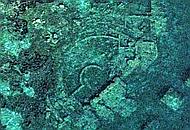
OPERA MURARIA – Oggi, a soli poco più di 50 anni di distanza, ritornando a “sorvolare” la zona interessata dai ritrovamenti è stato possibile osservare (grazie all’ausilio di moderni strumenti di telerilevamento satellitare), accanto a quelle antiche strutture d’età imperiale che giacciono in fondo al mare individuate dal Capitano Bucher, resti di un’opera muraria non ancora degnamente esplorata. Rilevati nei fondali della collina del Castello Aragonese, emergono per le loro caratteristiche essenziali, i resti di una particolare struttura dalla forma geometrica a semicerchio, che richiamano la pianta classica di un antico teatro romano d’età imperiale. La struttura, che si trova a pochi metri di profondità, è rivolta in direzione sud-est ed era capace di ospitare fino a 5.000 spettatori. Gli spalti, sfruttando la naturale conformazione del terreno, degradavano dolcemente dalla collina verso il mare. Stilisticamente il manufatto mostra una perfetta ed inalterata forma semicircolare interrotta da una murazione, forse utlizzata come fondale.
SPETTACOLO NELLO SPETTACOLO – Presumibilmente, ricalcando la linea di costa dell’antica «Baiae», offriva alle rappresentazioni del periodo uno scenario unico e inimitabile direttamente sul mare. Più elementi inducono a pensare che si tratti del famoso Teatro di Cesare in quanto la struttura risulta facente parte di un più ampio complesso residenziale definito Villa di Cesare (a conferma di quanto sostiene Tacito secondo il quale la villa di Cesare era posta su di un’altura dominante il golfo di Baia) successivamente inglobato nell’attuale fortezza Aragonese. Un grandiosa villa romana dunque i cui resti e il suo teatro si conservano inalterati ancora nelle profondità del nostro mare.
There is a slideshow of a dozen images of varying relevance at the original page …
Today I received a very interesting email from Ted O’Neill, who is one of the principals involved in the recent (re)discovery of what seems to be the source of the Aqua Traiana. Mr. O’Neill sent along a pile of interesting materials for me to share with y’all (thanks very much!||), so here goes … we’ll begin with some additional video footage (the text accompanying the videos is attached to them at the Vimeo site):
Descending under a ruined church in the Roman Countryside with the famous Archeologist Lorenzo Quilici, the Aqueduct Hunters discover the lost source of Trajan’s Aqueduct.
An extraordinary treasure has been discovered in a field north of Rome. But where is the river god displayed on a coin from 1900 years ago?And what will the archaeologists discover under 1900 years of mud? Music all included under Creative Commons Licence 3.0
Vodpod videos no longer available.
more about “The Emperor’s Sacred Spring – 7 minut…”, posted with vodpod
Scripsit Mr. O’Neill:
The site is the principal aquifer source of the Aqueduct, which was however stolen-off-with by the rogue Duke of Bracciano, Paolo Giordano Orsini in 1573. Paolo Giordano additionally had the distinction of Murdering the Pope’s nephew. So the source we discovered was not part of the Papal re-building of the same Aqueduct from the early 1600s.
The proof of this is in a document (letter from Arch. Luigi Bernini to Alessander VII) buried in the Chigi Archive in the Vatican. But an author called Carlo Fea saw that letter and published the attached pages in 1832.
… and here are the attached pages (the info is in the highlighted footnotes for those who wish to pursue it):
Carlo Fea, p. 41 (click for a larger view)Carlo Fea p. 42 (Click for a larger view)
Mr O’Neill continues:
In various times in history, it has been used to supply renewable energy, both to Trajan’s mills on the Janiculum Hill in Rome, and subsequently by the Orsini and
Odescalchi dukes for their industry in Bracciano (near lake Bracciano).
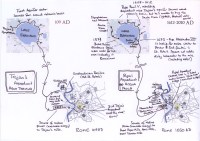
Also included was a very useful and interesting map:
Click for a larger view
… and the original press release:
Lost Aqueduct and beautiful nymphaeum REDISCOVERED near
ROME ON 1900th ANIVERSARY AFTER INAUGURATION
Rome, Italy, JANUARY 28, 2010: The primary source of the Emperor Trajan’s Aqueduct, the Aqua Traiana, has been identified north of Rome by British HD documentary team Michael and Edward O’Neill on the 1900th anniversary of the aqueduct’s inauguration. The significance of the site will be revealed at a press conference in Hotel Quirinale, via Nazionale 7, Rome, on Thursday, January 28th at 15:00.
On 24th June, precisely one thousand nine hundred years after the inauguration, worldwide aqueduct authority Prof. Lorenzo Quilici[1] visited the newly discovered springhouse-shrine and its labyrinth of underground water galleries.
“È TUTTO ROMANO!” – it’s ALL ROMAN! – he immediately exclaimed.
Documentary filmmakers Michael and Edward O’Neill discovered the site in extraordinary and adventurous circumstances, and are now raising money to film the ongoing preservation, excavation and opening to the public.
An ancient water source in Etruscan times, the web of springs was encapsulated by the Roman engineers in a vaulted, three-chambered semicircular ‘nymphaeum’, which served as a springhouse and probably contained the statue of a Roman river god or nymph. The ancient water source was commemorated by a sestertius coin minted by the Emperor Trajan when he inaugurated his aqueduct and his public baths in the centre of Rome, 1900 years ago.
For more than a thousand years, Trajan’s sacred water source was hidden under a Christian Church, now ruined and dismantled. The ancient aqueduct still emerges from under the church’s meagre remains. The water collection chamber of the Caput Aquae (headwaters) and 125 metres of the Roman Aqueduct gallery are still in pristine condition as compared with many crumbling ruins in the centre of Rome.
Ancient evidence and Papal records confirm that this shrine is almost certainly the primary water source of Trajan’s aqueduct:
The vaulted ceilings are all richly decorated with expensive Egyptian blue pigment, which strongly suggests that the great Emperor Trajan, proclaimed Optimus Princeps, almost certainly was here personally for his aqueduct’s inauguration.
Until recently, this water source was considered by some to be a local, regional aqueduct of eighteenth-century origin.
However, a descent below the chapel with powerful lights for filming of the underground galleries revealed that the brickwork and waterproof hydraulic cement lining the tunnels is absolutely characteristic of the Trajanic age.
Whilst filming the ancient roman Aqueducts in high definition, Michael O’Neill, Producer with MEON HDTV Productions, has descended below the chapel to explore into the stygian darkness of the ancient grottos and muddy tunnel, lined with classic Roman Opus Reticulatum brickwork.
“We are documenting a crumbling treasure,” he said. “The vaulted Roman concrete roofs with central oculus openings, thought originally to admit light like the Pantheon, are incredibly strong, but this unique Roman structure is being destroyed by neglect, and by aggressive fig tree roots.
Ted and Mike have invited two American scholars, Katherine Rinne (Institute of Advanced Technology in the Humanities, University of Virginia) and Rabun Taylor (University of Texas at Austin), to investigate the site further and to seek resources to undertake its survey, excavation, and publication.
Katherine Rinne, an expert on the hydraulic features of Rome in the Renaissance and Baroque periods, is drawn to the many extraordinary features of this site dating to the early modern period. The spring, which was still producing abundant water until quite recently, was commandeered in the seventeenth century to serve as a source of the Acqua Paola, one of the greatest of the Papal aqueducts of Rome. Some distance downhill from the grotto is a junction chamber where the Aqua Traiana and the Acqua Paola intersect.
Rabun Taylor wrote his dissertation on the ancient aqueducts of the city of Rome. He traced the course of the Aqua Traiana within the city, from its point of entry high on the Janiculum Hill to its crossing of the Tiber River near the modern Ponte Sublicio. “This is a discovery of almost unprecedented importance in the long history of aqueduct studies,” he said. “For all we know about the ancient city’s water supply—and we know quite a lot—it has to be understood that not a single architecturally defined spring source of any of ancient Rome’s eleven aqueducts has ever been discovered. And then Ted and Mike came along, put their amazing research and archival skills to work, and turned up one of the most spectacular—and pristine—Roman aqueduct sources in existence anywhere. The great aqueduct hunters of the twentieth century got within a couple of hundred meters of it, but never saw it.”
One of the most important features of this structure is the engineering of the water captivation chambers and galleries. “It’s like a gigantic upside-down coffee percolator built in stone,” said Mike. “This is a genre of Roman hydraulic engineering that has never been seen before. It is of unparalleled importance.”
… and a statement from Lorenzo Quilici of the University of Bologna:
STATEMENT BY Prof. Lorenzo Quilici,
UniversitÀ degli Studi DI Bologna
The Aqua Traiana was the penultimate of the eleven great aqueducts which supplied ancient Rome. It was inaugurated on June 24th, 109 A.D. to supply the urban zone of Trastevere and the city at large. It remained continuously functional, save a few interruptions, up to the period of the barbarian sieges, when Goths and Lombards seized and cut it. In the early 1600s, Pope Paul V undertook its restoration in order to guarantee the abundant provision of clean fresh water both to the Vatican and to the “Fontanone” Display Fountain on the Janiculum Hill, and it became known as the Acqua Paola.
The Aqua Paola was plagued with problems of hyigene and purity when it later took the water from Lake Bracciano at Anguillara. On the other hand, the original Roman aqueduct relied completely on fresh aquifers and captured all its water from clean springs along its route. The hills around the northern and eastern banks of the basin are rich with water: from Manziana to the Baths of Vicarello, to Trevignano and Anguillara where the channel proper begins. The water channel enters Rome at the ancient Aurelian Gate, today’s St. Pancras’ Gate.
The Roman aqueduct had the additional feature in Trastevere of the rapid drop in height offered by the Janiculum Hill. This was exploited to supply motor force to a chain of flour mills built in rows along its slopes: a real pre-industrial top-of-the-range facilty.
The Emperor Trajan minted coins to celebrate this work, which was constructed at his own expense. The sestertius coin shows a reclining figure of a river god under a great arch flanked by columns. This has previously been interpreted as the image of the ‘Display’ of water that Trajan must have built on the Janiculum, 1500 years before the great fountain of Pope Paul V.
The headwaters of the Roman aqueduct, constituting the first spring along the route around the lake, and the most important, remained forgotten in recent centuries until its re-discovery came about in extraordinary and adventurous circumstances.
Two British Citizens, Mike and Ted O’Neill, were preparing a series of documentaries regarding the ancient Roman Aqueducts for MEON HDTV Productions Ltd, researching the Trajanic conduit along the lake, when the Architect Giuseppe Curatolo, student of the Bracciano’s Odescalchi Aqueduct, directed their attention towards the springs which supply the local people of that city.
In a rough and wild patch alongside a stream, there is a spacious grotto that contained a chapel of the Virgin Mary. Today it’s an abandoned ruin, and at the bottom of the cavity, in her honour, there remains a beautiful molded baroque picture frame that would have contained her image. The cave is artificial and on each side of its great vault extend ancient crossed-vaulted rooms. These contained the springs. The rooms may have been reconfigured by the Odescalchi princes at the start of the 1700s when the the course of the waters was diverted to supply Bracciano, where they still arrive today. The water is currently collected by pumps in two adjacent bore-holes, which supply a good 50,000 cubic metres of water per day, an immense quantity.
Trajan’s Aqueduct, the ancient use of the springs, and the Christian chapel overhead were forgotten when the water was diverted to Bracciano. The ancient monument, however, would have taken the shape of a stunning nymphaeum, constructed at the primary source of the aqueduct: a central chapel dedicated to its god or nymphs, those on each side widened into two basins covered by extraordinary vaults still flecked with Egyptian blue paint. At the base of the side chambers can be seen an ingenious filtering system consisting of blocks laid with gaps between them. Water seeped in two basins, from which the aqueduct channel begins.
The structures are 8-9 metres high and perhaps more, given that they are partially buried and choked with vegetation that covers the site. They are built in very refined opus latericium brickwork and in opus reticulatum, a crosshatched pattern of stone facing for the underlying concrete. The chambers, with barrel and cross-vaults, the wells, the water-collection tunnels that converge there, the channel where the underground aqueduct gallery begins are all today, due to a lack of water, accessible by foot. Realistically, descending into the tunnels is not easy, because the place is overgrown, covered by a dense thicket of gigantic figs that threatens the concrete structures with roots that descend to the deepest level of the nymphaeum.
We can compare this partially subterranean nymphaeum with the Canopus of Hadrian’s Villa or with the Nymphaeum of Egeria in the Triopus of Herodes Atticus on the Appian Way!
The two Englishmen, excited about the discovery and wanting not only to document it but, with a true sense of community spirit, to achieve the stabilisation and restoration, excavation and evaluation of this monument, are attempting to involve in the initiative the local authorities, the Superintendents, Italian research organisations and foreign scholars.
It’s their inspired idea that Trajan’s famous coin does not represent his fountain on the Janiculum Hill, but the front of this nymphaeum-grotto, with the reclining god of the spring waters.
The research, restoration and stabilization of such an extraordinary monument requires funds, lots of funds: it is not, however, necessary to do everything immediately, but sufficent to start the work with the conscience and good will to prepare stage by stage the conditions for the future.
Something seems to be lost in translation (maybe not) in this item from the Barcelona Reporter:
The work that has lasted three weeks have also brought to light several tombs and a Roman Christian who, according to experts, could belong to some bishops or individuals from that epoch
An ancient Roman temple, discovered following the first excavations in the chancel of the church of Sant Feliu Girona.
The temple, with cross-shaped plan, apse, three naves and two side chapels, and several tombs from the sixth and seventh centuries, have appeared
This intervention is part of the European project “Sopra e sotto. Euopea La Città”, the culture program involving the City of Brindisi (Italy) as main organizer, with participation as members of L’Ecole Nationale Superiore d ‘ Architetture of Toulouse (France), the University and the city of Girona.
The work that has lasted three weeks have also brought to light several tombs and a Roman Christian who, according to experts, could belong to some bishops or individuals from that epoch. Professor Josep Maria Nolla, archaeologist and head of the excavations, said human remains have not been found, suggesting that the bodies were moved elsewhere.
“A number of graves, fairly well preserved, were discovered but not a single human fragment”. The expert stressed that they found wood and nails, so someone had been buried in a coffin, but when they dismantled the old church to build the new, it seems they picked up all these skeletal remains and bury them elsewhere”.
The European project has benefited Girona as it focuses on finding solutions to some of the problems faced by medium sized cities in finding their past history and town planning where the exploitation of archaeological sites of interest are in the midst of urban fabric.
Some Spanish coverage from La Vanguardia also mention this temple in the shape of a cross, but that doesn’t seem Roman, does it? Perhaps they mean Byzantine/Late Roman?
The incipit of a recently-dated piece from AdnKronos which seems to be being picked up by some other papers:
An international team of archaeologists claims to have unearthed the 2000-year-old birthplace of the Roman emperor, Vespasian, north of the Italian capital. Vespasian ruled the Roman empire in the first century A.D. and was behind the construction of the Colosseum, one of Italy’s most popular landmarks.
Archeologists believe they have located his birthplace in the Falacrinae valley near the hill town of Cittareale, 130 km northeast of Rome.
“Ancient Roman historian Suetonius says Vespasian was born in the Falacrinae valley area. Field surveys and information from locals have told us tell us this must be Vespasian’s birthplace,” one of the project’s directors, British archaeologist Helen Patterson told Adnkronos International (AKI).
Vespasian was the ninth Roman emperor, who reigned from 69-79 AD. He was believed to come from humble beginnings and founded the short-lived Flavian dynasty after the civil wars that followed Nero’s death in 68 AD.
During recent excavations, the archaeologists uncovered sumptuous marble floors and mosaics at the site of the 3,000-4,000 square metre Villa of Falacrinae, Patterson said.
The team of 30-60 archaeologists recovered pots, numerous coins, ceramic and metal artefacts from the site which is 820 metres above sea level, overlooking the surrounding Falacrinae valley.
The archeologists are hoping to recover more items in fresh excavations in July and August, Patterson said. [etc.]
Not positive about this, but I see nothing new here compared to reports (about which I expressed some skepticism) last summer …
The Fitzwilliam is certainly getting a lot of press attention, and each item revealed seems for interesting than the next. The Daily Mail, ferinstance, is highlighting the exhibition of a Roman precursor to the Swiss Army Knife:
The world’s first Swiss Army knife’ has been revealed – made 1,800 years before its modern counterpart.
An intricately designed Roman implement, which dates back to 200AD, it is made from silver but has an iron blade.
It features a spoon, fork as well as a retractable spike, spatula and small tooth-pick.
Experts believe the spike may have been used by the Romans to extract meat from snails.
It is thought the spatula would have offered a means of poking cooking sauce out of narrow-necked bottles.
The 3in x 6in (8cm x 15cm) knife was excavated from the Mediterranean area more than 20 years ago and was obtained by the museum in 1991.
The unique item is among dozens of artefacts exhibited in a newly refurbished Greek and Roman antiquities gallery at the Fitzwilliam Museum, in Cambridge.
Experts believe it may have been carried by a wealthy traveller, who will have had the item custom made.
A spokesman said: ‘This was probably made between AD 200 and AD 300, when the Roman empire was a great imperial power.
‘The expansion of Rome – which, before 500 BC, had just been a small central Italian state – made some individuals, perhaps like our knife-owner, personally very wealthy.
‘This could have been directly from the fruits of conquests, or indirectly, from the ‘business opportunities’ the empire offered.
‘We know almost nothing about the person who owned this ingenious knife, but perhaps he was one of those who profited from the vast expansion of Rome – he would have been wealthy to have such a real luxury item.
‘Perhaps he was a traveller, who required a practical compound utensil like this on his journeys.’
The spokesman added: ‘While many less elaborate folding knives survive in bronze, this one’s complexity and the fact that it is made of silver suggest it is a luxury item.
‘Perhaps a useful gadget for a wealthy traveller.’
Modern Swiss Army knives originated in Ibach Schwyz, Switzerland, in 1897 and were created by Karl Elsener.
The knives which provide soldiers with a ‘battlefield toolkit’ have since become standard issue for many modern day fighting forces thanks to their toughness and quality.
Nationalist Elsener decided to design the knives after he realised the Swiss army were being issued with blades manufactured in neighbouring Germany.
Other popular artefacts include an intricately designed Greek make-up box which was custom made almost 3000 years ago for a women of ‘wealth and status’.
… there follows a bit that seems to be an orphan description of some items mentioned before. In any event, lest folks think this is the only item of this sort know, the Armillum website has some photos of other examples (and there are, of course, some useful photos at the Daily Mail) …



 rogueclassicism