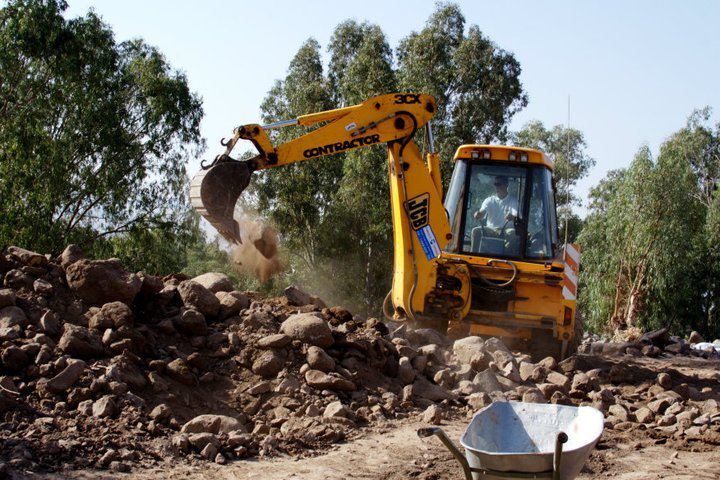
Alexander the Great Tomb in Amphipolis? Yeah … about that

This is another one of those mind bogglers which I don’t really understand … Back on August 21, a typically vague and brief item appeared in Greek Reporter:

A group of archaeologists in Amphipolis, a municipality in Serres, claim to have made one of the greatest archaeological discoveries ever, as they believe they have uncovered the tomb of Alexander the Great.

They said the tomb has a circumference of 498 meters, an artwork of perfection would only be built for a king.

Th masterpiece is externally covered with high quality exquisitely-carved marble, a remarkable feat given the tools available at the time.

The tomb once was covered with soil and topped with a lion, the one that has been reassembled further uphill and known as the Lion of Amphipolis which was found by Greek soldiers in 1912.

… which struck me as odd, especially given that none of the archaeologists involved were named, or even quoted. It struck me as odd especially because back in October, when this find was actually initially announced, there were plenty of names and quotes (see, e.g., Roxane’s Tomb?). In March, there were more developments and video coverage (Roxane’s Tomb Redux … click on the links therein as well for Dorothy King’s comments). In any event, because of this it wasn’t surprising to read an AP/Washington Post piece within a few hours suggesting it was ‘too early to tell’ … an excerpt:

[…] A Culture Ministry statement Thursday said the partly-excavated mound has yielded a “very remarkable” marble-faced wall from the late 4th century B.C. It is an impressive 500 meters (yards) long and three meters high.

But the ministry warned it would be “overbold” to link the site near ancient Amphipolis, 370 miles (600 kilometers) north of Athens, with “historic personages” before the excavation is completed. […]

It’s worth noting that the info in the Washington Post piece is essentially the same (in that it really adds nothing) to the info we read back in October (including the name of the archaeologist who seems to be heading the dig (Aikaterini Peristeri). Again, though, it’s probably not surprising that we had the Greek Reporter (via  a different author), trying to do some face saving:

On Aug. 22, the Greek Ministry of Culture and Sports published an announcement on its official website about the way the media handled the recent excavation of a big built precinct of the 4th century B.C. in Kasta near Amphipolis, in the Serres regional unit of Greece.

As many Greek websites rushed to link the monument that was discovered to the long-sought tomb of warrior-king Alexander the Great, the Culture Ministry and in particular the General Directorate of Antiquities and Cultural Heritage felt it had to calm things down.

“The finding of Amphipolis is certainly very important, but before the excavation proceeds, any interpretation and mainly any identification with historical figures lacks scientific justification and is too risky,” the Ministry announced.

However, the Ministry admitted that the discovery of the marble-faced wall from the late 4th century B.C., 500 meters long and three meters high, is indeed very remarkable and of high archaeological importance.

I really can’t tell, but one suspects Enet (another English-language Greek newspaper) took great joy in posting only: Mound fuels heady speculation about Alexander the Great. Ditto for Kathimerini: Ministry warns against speculation that Alexander the Great’s grave has been found. Turkish Weekly is probably in the same boat: Greece: too early to say whether grave of Alexander the Great found.

So you’d think that would be the end of it and most people who read this blog are shaking their collective heads muttering things about Ptolemy and Alexandria. But nooooo … we read the International Business Times, which includes this bit, inter alia:

Lead archaeologist Aikaterini Peristeri said the grave could contain a “significant individual” or individuals, hinting at the possibility that the remains of Alexander and his wife Roxanne, as well as his young successor, are inside the tomb. […]

“Hinting”? Really? Didn’t know ‘hinting’ was the equivalent of a journalistic source. The ‘significant individual’ thing was made back in October. Speculation about others (including Roxane) was being made by municipal politician types.

Meanwhile, the Daily Mailhas been even more creative in its cutting and pasting of things written elsewhere, again, inter alia:

Site archaeologist Aikaterini Peristeri has voiced hopes of finding ‘a significant individual or individuals’ within.

A Culture Ministry statement has enthused that the archaeologists have partly excavated a mound that has yielded a ‘very remarkable’ marble-faced wall from the late 4th century BC.

Experts believe the ancient artificial mound could contain the remains of the king, or is at least an important royal Macedonian grave. […]

MSN then takes things to their illogical conclusion and cites the Daily Mail as the source for its brief item:

If found, the tomb of Alexander the Great would be one of the world’s greatest treasures. Now, archaeologists think they may have found it — not in Egypt, as long believed, but in Greece, around 400 miles north of Athens in the ancient city of Amphipolis. There researchers discovered “an impressive wall,” lined with marble, that might shield a “royal grave” for the 4th-century BC warrior king, whose distinctions include creating one of the biggest empires the world has ever seen. Alexander died young, perhaps at 32, after becoming ill or being poisoned

In short (or TL:DR), no archaeologist has actually made any suggestion that Alexander the Great might be buried in this mound. The only coverage where archaeologists have actually said anything comes back in October and then in March. All this speculation seems to have been made by some reporter at Greek Reporter with too much time on his hands who probably was chatting with some business folks in Serres who are trying to get some tourist bucks while the Culture Ministry was quick to try to bring some sanity back. Sadly, however, other news outlets ran-with-scissors-like to make this into the silliness we’ve witnessed these past few days and, no doubt, will see more in the next few.

By the way, if you’re new to this Alexander Tomb business, you might want to check out some of our previous posts:

… I could give more, but you get the idea. I’ll just sit here and let my mind boggle a bit more …

On Egos and “Bulldozers” and Bull of Another Kind

As many folks know, besides filling my time with rogueclassicism, I also put out a weekly archaeology newsletter called Explorator which looks at coverage of archaeology in all parts of the world. I’ve been putting out that newsletter for at least sixteen years and one of the things I’ve long been aware of is that there is a certain ‘class’ of archaeologist (for want of a better term) who are very much into the ‘glory’ aspect of any coverage they get and/or create. That is to say, they are driven as much by their egos — and their desire to be seen as somehow ‘better’ than their counterparts — as much as they are by their research. One might even cynically suggest there are some  who are even more ego-driven than research driven. I’ll let you decide which applies in the following situation.

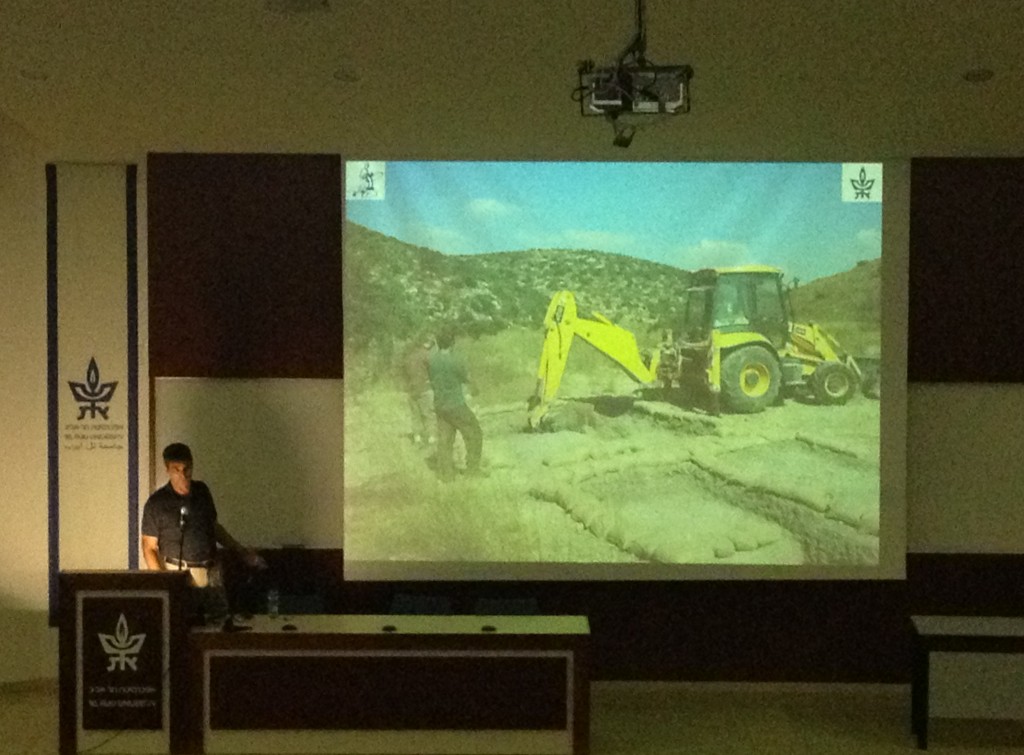
Biblical Archaeology Review unleashed a bit of a firestorm when, in its May/June 2013 issue it showed a photo which was subsequently picked up and commented on by Emmy Award Winning Professor Simcha Jacobovici, co director of the Bethsaida Dig and self-described ‘Naked Archaeologist’. Here’s the photo as posted by the Professor:

via Simchajtv.com

Back in April, Professor Jacobovici opened his blogpost containing the photo thusly:

Recently, Professor Yuval Goren shocked an audience at Tel Aviv University by proudly describing his method of archaeological excavation using a Caterpillar bulldozer.

You can read the post if you want a bit more context.  That particular post (and other coverage) resulted (more or less) in a response from the archaeologists which included the following:

1. There was no use of a mechanical excavator on Tel Socoh.

2. The slide shown in the ad illustrates work carried out in a wadi near the mound, as a sequel to a systematic manual excavation from surface to natural soil nearby. The sounding was aimed at detecting pottery and slag in the vicinity of the site. This method is authorized (and endorsed) by the Israel Antiquities Authority.

3. This is a common method in archaeology. Most seasoned archaeologists – regardless of period of research, location on the globe, and institutional affiliation – use mechanical excavators in certain, closely controlled circumstances.

… The professor dutifully noted it as well: Shocking Tel Aviv University Statement Defending Bulldozer Archaeology. Now it gets silli(er) as the Emmy Award Winning Professor has blogged the following at his own blog (I’ve left his links in):

An archaeological controversy has erupted in Israel which has serious implications for anyone interested in the history of the Holy land. At the center of the controversy is Professor Yuval Goren from Tel Aviv University. Goren has a PhD. in petrography, which is a branch of petrology that focuses on detailed descriptions of rocks. Though he doesn’t have a graduate degree in archaeology, he de facto works as an archaeologist. A few months ago, Goren shocked an audience at Tel Aviv University by proudly featuring his method of archaeological excavation using a Caterpillar bulldozer.

Biblical Archaeology Review (BAR) dubbed Professor Goren’s technique as “Cater-pillaging”. Archaeologists normally dig with spades and toothbrushes. The position of every coin is important for identifying strata and for dating. Every pottery shard and its location can influence the overall understanding of the site. But at Tel Socoh, where Goren is digging, the archaeology was going slowly and Goren decided to speed things up. That’s where the bulldozer came in. Clearly, bulldozers are not conventional archaeological tools, and Professor Goren came under severe criticism. Dr. Robert Deutsch took an uncompromising stance against the practice and I have been blogging against it as well (here and here). Now, in BAR’s latest issue, someone has once again anonymously published an ad featuring Professor Goren and his bulldozer. Goren has reacted with anger calling the ad “defamatory” and some colleagues at Tel Aviv University have posted a defense of the practice. […]

… an almost identical (if not actually identical) post is at the Times of Israel site as well: Bulldozer Archaeology

So now it’s time to comment … it ain’t a bulldozer. It’s a front end loader with a bucket scoop/backhoe on the back. No, you probably wouldn’t use a bulldozer for archaeology, because it has a big blade on the front and is used for grading and pushing large quantities of dirt (etc.), not digging. As for using bucket scoops in archaeology, anyone who has watched Time Team will know that use of such buckets are common enough and there are plenty of images on the web of same.  Heck, if you want to go to the AIA’s Ask the Experts page, you can read this:

What tools do archaeologists use for excavation?
Archaeologists use a great variety of tools for excavation, depending on the nature of the area in which they are working. The most common digging tools are picks, shovels, and trowels. In areas where there is a lot of sediment or dirt over the sites, archaeologists sometimes use heavy equipment like bulldozers and back hoes, but only to remove earth that shows no signs of human remains. If excavation will be a delicate operation, as during the careful cleaning away of soil from a damaged painting or human skull, archaeologists use dental picks, spoons, brushes, or anything that works. They often improvise based on the situation in which they find themselves.

For our purposes, however, it should suffice to link to this one from the BETHSAIDA EXCAVATIONS of which Professor Jacobovici is a co-director (although that was a recent gig … this photo is apparently from 2010):

429960_110205829107743_316896377_n
via the Bethsaida facebook group … here’s the url: https://fbcdn-sphotos-c-a.akamaihd.net/hphotos-ak-ash4/429960_110205829107743_316896377_n.jpg

Whaaaaaa?  Is that a front end loader with a bucket attached? Or maybe it’s just a bucket scoop on its own. Say it ain’t so! Perhaps Dr Rami Arav can school his co-director in the ways of archaeology …

Come on guys … in the right hands, a front end loader/bucket  is a perfectly legit archaeological tool … a massive ego isn’t.

… we now return to our regular programming.

UPDATE (the next day): Tip o’ the pileus to Joseph Lauer for drawing our attention to BAR’s most recent comment in this little saga: BAR Accused of Publishing “Defamatory” Ad

UPDATE II (A couple days later): See now Robert Cargill’s exceptionally thorough piece on this whole thing … very eye-opening: One Big Balagan: Robert Deutsch, Simcha Jacobovici, and their Campaign of Misinformation against Prof. Yuval Goren

Diagnostical Skepticism

Hot on the heels of the Odysseus in America post comes this item from Anesthesiology News:

Sing, O Muse, of the rage of Achilles, of Peleus’ son, murderous, man-killer, fated to die of massive hemorrhage secondary to an acute laceration of the calcaneal tendon, indicating the likely presence of an inherited coagulopathy such as hemophilia or von Willebrand disease. (Note: The patient’s parentage—half mortal, half immortal—could have predisposed him to yet-undescribed clotting disorders.)

Classicists who devote their lives to the analysis of ancient texts such as Homer’s Iliad tend to be skeptical of physician historians who examine these literary works for insight into ancient medical practices—and who, in the process, come up with post hoc diagnoses such as the mockery above. And they’re evidently right to be wary.

An anesthesiologist and a pair of classicists have identified numerous errors in the methods and conclusions drawn by several medical researchers about medicine during the time of The Iliad. The researchers, from Wake Forest University, in Winston-Salem, N.C., and Temple University, in Philadelphia, presented their findings at the 2012 annual meeting of the American Society of Anesthesiologists (abstract 1320).

Lead author and anesthesiologist Raymond C. Roy, MD, PhD, said that five of the six articles published from 2000 to 2010 discussing medical care in The Iliad fell into common traps. Mistakes included incorrect assumptions that Homer was an eyewitness reporter of actual events and real injuries, that accurate comparisons could be made to modern-day medical care based on limited descriptions, that there was a one-to-one relationship between ancient Greek and modern English medical terms, that medical care was organized then as it is now, and that physicians provided care to wounded heroes during the Trojan War.

Dr. Roy said his interest in the subject was stimulated by his daughter and her husband, both classicists at Temple University in Philadelphia. “We have engaged in some very interesting discussions over the coffee and drinks regarding ancient Greek medicine and current perceptions of it,” he said. “It has been fun to have this project with my children and to be ‘forced’ to read The Iliad … and a monograph by Salazar. Our thesis was that physicians who ‘dabble’ in history, like myself, frequently fall into traps that lead classicists to be critical of our conclusions.”

The epic poem about gods, heroes and heroic wounding and death near the end of the war stems from an oral tradition. Estimates of when it was composed (1184-675 B.C.) and first recorded (800-675 B.C.) range widely, and there are multiple versions of the work.

All accounts of Homer’s life place him centuries after the Trojan War. However, physician researchers have written: “We are amazed by Homer’s meticulous account of the wounds inflicted to combatants” and “it may therefore be inferred that Homer was a witness of the war and that he even participated in it: he may have been one of the people appointed to nurse wounds of the injured warriors.”

Other comments revealed a lack of knowledge about the practice of medicine in the period. Those included a reference to the likelihood that anesthetic procedure was already present in ancient Greece as well as the statement: “Numerous findings indicate that Greek physicians were present on the battlefield.”

Dr. Roy and his team point out that there were no field hospitals, and surgical instruments were rarely found at archeological digs of Bronze Age battles. With regard to anesthetics, salves were applied after, not during, an arrowhead extraction. Disease was left untreated because it was believed to be inflicted by the gods, and healing temples appeared after Homer. Healers took orders from heroes and could only treat non-heroes—only heroes had the status to treat other heroes. In fact, the primary function of the healers was to fight.

Medical terms that appear in modern translations present added red herrings, Dr. Roy said, “Classics like The Iliad are constantly evolving as each translator chooses more modern words, terms and concepts based on knowledge acquired since the previous translations, and this evolution has the effect of attributing more understanding by the ancients than they actually had.” For example, sinews, tendons, nerves, arteries and veins have all been used in place of the ancient term neuron, he said.

The authors conclude that for reasons ranging from national pride to the projecting of modern beliefs and knowledge onto the past, physicians who otherwise are rigorous in their scientific and medical endeavors tend to be naively positive in their analysis of the quality and efficacy of ancient treatments as encountered in classics. Although medical training can aid in the analysis of ancient healing practices, Dr. Roy warned, “Physicians writing historical articles about medicine in ancient times need to collaborate with classicists, archeologists and full-time historians to avoid drawing conclusions that are at odds with facts.”

That final paragraph should become some sort of mantra … you can substitute the non-classics profession of your choice for “Physician” as you desire …

Odysseus in America Redux

We’ve had this nuttiness before and once again, it comes from the Greek Reporter:

Dr. Enrico Mattievich, a retired Professor of Physics from the UFRJ, Brazil, suggested in 2011 that Odysseus’s journey to the Underworld took actually place in South America. The river Acheron was the Amazon, after a long voyage upstream Odysseus met the spirits of the dead at the confluence of the Rio Santiago and Rio Marañon.

In his book, Journey to the Mythological Inferno, which is a historical non-Fiction winners’ book, Mattievich exposes his thesis on ancient contacts between the Old World and America, based on Greek and Roman classical texts, leading to new ideas about America that many historians and geographers have been reluctant to consider until now.

Some time ago, the writer and archaeologist Henriette Mertz suggested that the legendary voyage of Odysseus and his ship’s crew, after the Trojan War – narrated in Homer’s Odyssey – would be a trip across the Atlantic, from the Gibraltar Straits to North America. She also suggested that the Argonauts could have navigated down to the South Atlantic Ocean, passed the mouth of the Amazon River to Rio de la Plata, and, following it upstream, reached Bolivian Altiplano and Thiaguanaco. Dr. Christine Pellech also suggested that Odyssey’s voyage to the Kingdom of the Dead was a real trip to America.

The thesis presented in the Journey to the Mythological Inferno claims that Greek and Roman myths related to the Underworld, the House of Hades, the Kingdom of the Dead or the Inferno, originated in South America, specifically in the Andean region of Peru, where the ruins of the Palace of Hades and Persephone, mentioned in Hesiod’s Theogony – written around 700 B.C. – still stand, known as Chavín de Huántar. This theory took form after Mattievich’s first visit to the archaeological site of Chavín de Huántar, in 1981.

In his book, Mattievich presents classical literature texts, such as Ovid’s Metamorphosis, that relate to the knowledge of America. The Cadmus myth, written by Ovid, for example, is estimated to be a myth immortalizing the heroic feat of the discovery and conquest of the Amazon River by the Phoenicians. The prehistoric presence of Phoenician navigators along the coast and rivers of Brazil, could be confirmed by hundreds of engraved inscriptions on rocks– called itacoatiaras – by natives of Brazil, where it’s often possible to recognize archaic Semitic and proto-Greek characters. The same name Brazil, according to Professor Cyrus Gordon, comes from the vocable brzl, used by Canaanites to denote iron.

… back in November, they gave the same basic story: Odysseus in America? … it’s genuinely difficult to take this news source seriously at times. And once again I marvel how an outsider (retired physics guy) seems to be taken seriously in a matter clearly outside his purview. Maybe I should write how I proved string theory or something …

Ancient Roman Hidden Under Fresco? Maybe … Maybe Not

As can be seen by the numerous posts from the Classical blogosphere, I’m in catchup mode after a hectic week and one item which has been bugging me big time is a report about a talk given at the American Chemical Society … we’ll deal with the press release version:

In the latest achievement in efforts to see what may lie underneath the surface of great works of art, scientists today described the first use of an imaging technology like that used in airport whole-body security scanners to detect the face of an ancient Roman man hidden below the surface of a wall painting in the Louvre Museum in Paris.

They described unveiling the image, which scientists and art historians say may be thousands of years old, during the 245th National Meeting & Exposition of the American Chemical Society, the world’s largest scientific society. The meeting, with almost 12,000 presentations, continues here through Thursday.

J. Bianca Jackson, Ph.D., who reported on the project, explained that it involved a fresco, which is a mural or painting done on a wall after application of fresh plaster. In a fresco, the artist’s paint seeps into the wet plaster and sets as the plaster dries. The painting becomes part of the wall. The earliest known frescoes date to about 1500 B.C. and were found on the island of Crete in Greece.

“No previous imaging technique, including almost half a dozen commonly used to detect hidden images below paintings, forged signatures of artists and other information not visible on the surface has revealed a lost image in this fresco,” Jackson said. “This opens to door to wider use of the technology in the world of art, and we also used the method to study a Russian religious icon and the walls of a mud hut in one of humanity’s first settlements in what was ancient Turkey.”

The technology is a new addition to the palette that art conservators and scientists use to see below the surface and detect changes, including fake signatures and other alterations in a painting. Termed terahertz spectroscopy, it uses beams of electromagnetic radiation that lie between microwaves, like those used in kitchen ovens, and the infrared rays used in TV remote controls. This radiation is relatively weak, does not damage paintings and does not involve exposure to harmful radiation.

“Terahertz technology has been in use for some time, especially in quality control in the pharmaceutical industry to assure the integrity of pills and capsules, in biomedical imaging and even in homeland security with those whole-body scanners that see beneath clothing at airport security check points,” said Jackson, who is now with the University of Rochester. “But its use in examining artifacts and artworks is relatively new.”

Artists, including some of the great masters, sometimes re-used canvases, wiping out the initial image or covered old paintings with new works. They often did this in order to avoid the expense of buying a new canvas or to enhance colors and shapes in a prior composition. Frescoes likewise got a refresh, especially when the originals faded, owners tired of the image on the wall or property changed hands

The scientists turned to terahertz technology when suspicions surfaced that a hidden image might lie beneath the brushstrokes of a precious 19th century fresco, Trois homes armés de lances, in the Louvre’s Campana collection. Giampietro Campana was an Italian art collector in the 1800s whose treasures are now on display in museums around the world. When Campana acquired a work of art, he sometimes restored damaged parts or reworked the original. Art historians believe that Campana painted Trois homes armés de lances after the fresco was removed from its original wall in Italy and entered his collection.

Jackson said that Campana’s painting in itself is valuable, and the terahertz revelations may have added value by showing that an authentic Roman fresco lies under it.

To search for a hidden image, Jackson and colleagues, including Gerard Mourou, Ph.D., of Ècole Polytechnique, and Michel Menu, Ph.D., of the Centre de Recherche et de Restauration des Musées de France, and Vincent Detalle, of the Laboratoire Recherche des Monuments Historiques, probed it with terahertz technology. The process is slow, requiring a few hours to analyze a section the size of a sheet of paper.

“We were amazed, and we were delighted,” said Jackson. “We could not believe our eyes as the image materialized on the screen. Underneath the top painting of the folds of a man’s tunic, we saw an eye, a nose and then a mouth appear. We were seeing what likely was part of an ancient Roman fresco, thousands of years old.”

Who is the man in the fresco? An imperial Roman senator? A patrician? A plebian? A great orator? A ruler who changed the course of history? Or just a wealthy, egotistical landowner who wanted to admire his image on the wall?

Jackson is leaving those questions to art historians. The team already has moved ahead and used terahertz technology to study a Russian religious icon and the walls of a mud hut in one of the earliest known human settlements in what now is the country of Turkey.

This research was funded by the European Commission’s 7th Framework Program project CHARISMA (grant agreement no. 228330) and in part by AHRC/EPSRC Science and Heritage Programme. Access was provided by the Louvre Museum and the Institute Nationale Patrimoine.

The original report includes a photo:

via the American Chemical Society

As might be expected, this is getting a pile of press attention and blog attention as well, but near as I can tell, it’s either a really badly written article and folks are overlooking that fact, or we’re just being dealt a bunch of hooey (more likely the former). As the article states, Giampietro Campana was a collector; what it doesn’t really tell us is that some of his collection was ‘restored’ in a way which was rather sketchy, from a preservation point of view. What is missing from this article are some details which are included in a rather interesting French article by Delphine Burot at CeroArt which was written, apparently, while the testing was being done. The relevant excerpt:

L’observation des œuvres précédemment citées et de la façon dont elles ont été restaurées au musée Campana laisse penser que les restaurateurs qui travaillaient pour le marquis avaient à leur disposition un grand nombre de fragments d’enduit romain antique, qui constituait une réserve dans laquelle ils pouvaient puiser pour combler une lacune dans une peinture, ou pour en fabriquer d’autres. Car les autres peintures de la collection, reconstruites elles aussi à partir de fragments, sont à la limite de la falsification tant la part de recréation par les restaurateurs de Campana est grande. Si l’on excepte deux ou trois œuvres, comme la Primavera, sur laquelle nous reviendrons, la plupart des peintures ont été fabriquées à partir de quelques fragments peints, dont le motif a été extrapolé de façon à réaliser une composition entière, donc présentable.

Ainsi, la peinture des Trois hommes armés de lances a été reconstruite à partir de trois fragments peints montrant des visages, et de quelques autres fragments portant une inscriptionLe reste de l’œuvre est constitué par la réunion de plusieurs fragments placés de façon aléatoire sur un support de plâtre, et sur lesquels a été peinte la composition imaginée par le restaurateur : trois hommes debout côte à côte, vêtus de longs manteaux colorés et tenant des lances. Le placement de l’inscription dans la partie supérieure de l’œuvre ajoute une part de mystère à la composition. L’étude attentive des fragments a permis de voir qu’ils appartenaient presque tous à un même ensemble. Le restaurateur n’a pas pu trouver, ou n’a pas pris le temps de chercher la composition d’origine, ni les jonctions entre les fragments. Il a préféré les disposer rapidement sur un lit de plâtre et n’en garder que les parties qui l’intéressaient le plus, à savoir les visages les mieux conservés et une partie de l’inscription. D’autres lettres, lacunaires, appartenant vraisemblablement à l’inscription ont été placées dans la partie inférieure, et, grâce à un examen au Terahertz, des motifs peints (peut-être des visages) ont été repérés sous les repeints qui constituent les vêtements des trois hommes.

I’m sure I’m not the only one who scratched his head at the claim, but as can be seen from the French article, all that Campana’s restorers were actually working with was three heads; they filled in the plaster randomly and painted/restored it as seemed right to them. That explains why there’s a weird sort of sideways “Roman” head revealed by the new technology. Even then, however, whether that is a face is open to question near as I can tell … facebook friends will know that I regularly criticize claims of finding pareidolia of this or that religious figure in this or that domestic object, fruit, tortilla, or whatever and we might be dealing with a similar situation here. If it is a face, I see a beard, and if there is a beard, we’re probably not dealing with a Roman. That said, and taking into account this sort of ‘random’ filling in of things which we are told about in the Burlot article, why did the scanning only detect that one little thing? Shouldn’t there (in theory) be a pile of random lines or whatever? Does anyone know if this presented paper has been published yet?