At the Getty: Roman Runway

Man .. I swear if I lived in LA I’d be at the Getty all the time … check out what began this weekend:

Get the scoop on the fashion trends of ancient Rome—from soldiers and senators to slaves and aristocrats—during live runway shows at the Getty Villa most weekends beginning Saturday, June 9 until Sunday, July 1. Members of Legio VI Victrix, a historical reenactment group, will demonstrate how garments reflected Roman values, socioeconomic class, and historical changes during the Roman Empire. After the show, visitors will have a chance to go “behind the seams” to visit a Roman ornatrix (hair dresser) and try on related costumes and props.

And, of course, Aphrodite and the Gods of Love is still there for a month or so …

Getty Gets Some Relief

From a Getty Press Release:

THe J Paul Getty Museum Logo taken from a carv...
THe J Paul Getty Museum Logo taken from a carving at the museum. Photo taken on November 24, 2006 by Brian Davis (Photo credit: Wikipedia)

The J. Paul Getty Museum today placed on view a Decree Relief with Antiochos and Herakles, the first Greek loan to arise from a 2011 framework for cultural cooperation between the Getty and the Hellenic Republic Ministry of Culture.

On loan from the National Archaeological Museum in Athens, the marble relief bears a historical decree, dated to 330 B.C., which honors Prokleides, a military officer (taxiarch) in the Athenian army. The relief will be on view at the Getty Villa for three years in a second-floor gallery devoted to Religious Offerings.

The relief takes the form of a stele, a stone slab decorated with images and text, crowned with the figures of Herakles and his son Antiochos, who was the mythical hero of the tribe Antiochis. Herakles is depicted as an athletic nude, holding a club and the pelt of the Nemean Lion he vanquished, referring to the first of the twelve labors he had to perform. Seemingly the elder, Antiochos wears a dignified mantle and holds a staff (no longer visible, but probably added in pigment). Both father and son heroes were the subject of cult worship, and are shown standing within a small temple framed by columns and a pediment.

Written in ancient Greek below the figures, an inscription describes the honors bestowed upon Prokleides by his soldiers and comrades, all members of an elite infantry corps known as the epilektoi. This is the earliest known inscription referencing the epilektoi, a group of men bound together by their military service, participation in sacrifices and theatrical performances, and membership in the Athenian Council. According to the decree, Kephisokles of the village of Alopeke proposed the resolution to praise Prokleides, who “has well and with distinction taken care of security,” and crown him with a gold diadem worth at least 1,000 drachmas (an enormous sum, considering the average worker in classical Athens could support a family of four on one drachma a day).

Soon after arriving at the Getty, the stele was photographed using a technique that captures the object numerous times with varying degrees of raking light. The resulting composed image reveals the shallow lettering with unprecedented depth and clarity and enables a more accurate reading of the inscription. A transcription of the ancient Greek text, translation, and detail photography of the historical inscription accompanies the installation.

“The Antiochos relief commemorates the affection and respect of troops for their commanding officer,” explains Claire Lyons, acting senior curator of antiquities at the Getty Villa. “We are delighted that it will be on view at the Getty Villa in time for Memorial Day, when we honor the contributions of fallen soldiers to their communities and country.”

This long-term loan results from the Framework for Cultural Cooperation signed in September 2011, which provides for joint scholarship, research projects, loans, and exhibitions between the Getty and the Hellenic Republic. “As part of this framework of cooperation between the Hellenic Republic Ministry of Culture and the Getty Museum, we are pleased to have the Antiochos relief on display at the Getty Villa,” said Maria Vlazaki-Andreadaki, director general of archaeology in Athens. “We believe that this collaboration will promote classical studies in the United States and will spread the values and the spirit of ancient Greek civilization.”

Historical Background

The relief was discovered in 1922 in the foundations of a house in the Athenian neighborhood of Dourgouti. In antiquity, the area was known as Kynosarges and was the site of a public gymnasium and a sanctuary of Herakles, the greatest of the Greek heroes. Believed to have stood in this sanctuary, where several other inscriptions mentioning the tribe Antiochis were found, the relief was a votive dedication erected in a prominent public location befitting a successful military leader.

The Antiochos relief is a primary document of democracy, and the language of its inscription shows that voting and public speech were deeply ingrained in civic life two centuries after the foundation of democratic political institutions in Athens.

The creation of the Attic tribes was the most important feature of the revolutionary reorganization of Athenian politics that followed the overthrow of the tyrants in 508 B.C. In this system, ten tribes composed of approximately 3,000 citizens and their families were created. Each tribe was assigned the name of a mythical Athenian hero: Antiochos was the eponymous hero of the tribe Antiochis.

Drawn from villages in three distinct zones of the Athenian territory—the coast, the inland farming region, and the urban/suburban zone—the tribes represented the entire citizenry of Athens. Josiah Ober, Professor of Political Science and Classics at Stanford University, observes: “Imagine a reorganization of the United States that would require citizens from Maine, Texas, and California to work, fight, and feast together on a regular basis. The communities constituting the tribe of Antiochis included Alopeke, the philosopher Socrates’ home village—so we might even imagine that a descendant of Socrates as among the signatories to the decree.” […]

… the original press release has a smallish image of the relief (the images link doesn’t work!). Art Daily has one that’s rather better:

… which made me think of this, for some reason:

Museo Parc Alesia

I could have sworn I mentioned this museum when it opened, but I guess not (it’s probably lurking way in the bottom of my email) … anyhoo, here’s a nice AFP video report:

Apollo Saettante at the Getty

Today I was sent a Getty Press Release of interest:

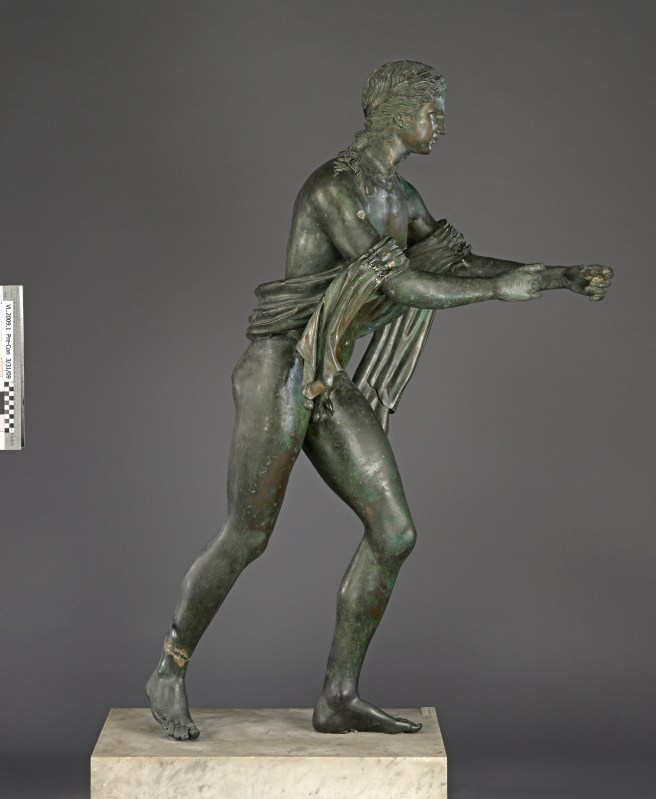
After eighteen months of analysis, conservation, and re-stabilization, the bronze statue of Apollo Saettante (Apollo as an Archer) from Pompeii will go on view at the Getty Villa from March 2 to September 12, 2011 in the exhibition Apollo from Pompeii: Investigating an Ancient Bronze. Providing a behind-the-scenes look at this rare treasure, the special six-month exhibition presents the results of the first full study of this ancient sculpture.

Originally located in the Temple of Apollo in Pompeii, the Apollo Saettante was discovered in fragments centuries after it was buried by the eruption of Mt. Vesuvius in AD 79. The bulk of the figure was unearthed in June 1817 just north of the Forum. A year later, in October 1818, veteran soldiers hunting a fox near the ancient city walls stumbled across some of the statue’s still-missing parts. The Apollo was one of the first major bronzes to be found at Pompeii, and was subsequently reassembled and displayed in the Real Museo Borbonico in Naples.

The conservation of the Apollo Saettante at the Getty Villa is the result of an important collaboration between the J. Paul Getty Museum and the Museo Archeologico Nazionale in Naples, as part of a broad cultural exchange agreement made in 2007 between the Italian Ministry of Culture and the Getty Museum. This exhibition marks the Apollo Saettante’s first showing in the United States, and complements the Villa’s collection of ancient works from Greece, Rome, and Etruria. Following its exhibition in Los Angeles, the statue will be returned to Naples, where the Getty’s conservation efforts will ensure its stability for generations.

The Apollo Saettante arrived in Los Angeles on loan for study and conservation treatment in 2009, together with the Statue of an Ephebe (Youth) as a Lampbearer, which is currently on view in the Basilica at the Getty Villa.

“This project has provided us an unprecedented opportunity,” said Erik Risser, an assistant conservator of antiquities at the J. Paul Getty Museum and co-curator of the exhibition. “Large bronzes rarely survive from antiquity, and the chance to conduct a thorough investigation into the Apollo Saettante has brought to light its rich and complex history.”

A variety of approaches, including archival research, X-radiography, ultra-violet photography, and endoscopic examination, have provided important new information regarding both the techniques used to make the statue in antiquity, and also the methods used to restore it in the nineteenth century. The investigations extended to analyses of the metal alloy composition, the pigments on the surface, and even of the types of bolts used in the re-assembly, all to answer questions about previous restoration efforts.

Apollo from Pompeii: Investigating an Ancient Bronze presents the results of these investigations, displaying art-historical, technical, and scientific evidence side by side in order to demonstrate the range of methods used during the study of the statue at the Getty Villa. Special features include the discovery of a large void in the statue’s back, which indicates that the method of its ancient manufacture was highly unusual, and the identification of two different phases of restoration. An interactive touch-screen display in the exhibition will provide visitors with the opportunity to explore the statue. This interactive feature will also be available on the Web at http://www.getty.edu.

Alongside select examples of ancient bronze sculpture from the Getty Museum’s Antiquities collection and a series of archival drawings and documents from the Getty Research Institute, the exhibition will also feature a bronze statue of Artemis, the sister piece to the Apollo Saettante. The two faced one another in the Temple of Apollo at Pompeii, and the inclusion of the Artemis, also on loan from the Museo Archeologico Nazionale in Naples, will provide a unique opportunity to develop and extend the discoveries that have been made in examining the Apollo.

This exhibition follows a series of Getty Villa exhibitions devoted to restoration and conservation, including The Hope Hygeia: Restoring a Statue’s History (2008), Fragment to Vase: Approaches to Ceramic Restoration (2008-2009), and Reconstructing Identity: A Statue of a God from Dresden (2009-2010), as well as early excavations in the Bay of Naples (The Herculaneum Women and the Origins of Archeology, 2007).

The exhibition is also one in a series of Italian collaborations that have brought important works of art to the Getty Museum, beginning in June 2009 with the display of the Chimaera of Arezzo in partnership with the Museo Archeologico Nazionale in Florence. The Getty also has long-term agreements with the Museo Archeologico Nazionale in Naples, and the Sicilian Ministry of Culture and Sicilian Identity, for exhibitions over the coming years.

Apollo from Pompeii: Investigating an Ancient Bronze is presented in collaboration with the Museo Archeologico Nazionale, Naples. It is curated by the Getty Museum’s Erik Risser, assistant conservator of antiquities, and David Saunders, assistant curator of antiquities. This exhibition runs concurrently with In Search of Biblical Lands: From Jerusalem to Jordan in Nineteenth-century Photography, March 2—September 12, 2011 at the Getty Villa.

Here are a couple of photos of interest:

Apollo as an Archer (The Apollo Saettante), Roman, 100 BC- AD79. Courtesy of the Soprintendenza Speciale per i Beni Archeologici di Napoli e Pompei.

The xray version is really neat:

2009 X-ray of Apollo as an Archer (The Apollo Saettante), Roman, 100 BC- AD79. Courtesy of the Soprintendenza Speciale per i Beni Archeologici di Napoli e Pompei.