I don’t think we covered the original discovery of this one (Adrian Murdoch did):
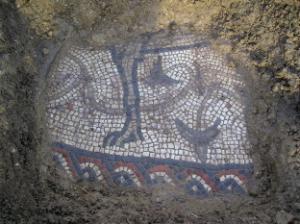
ARCHAEOLOGICAL work to determine the full extent of a massive Roman mosaic uncovered in a Cotswold field will resume shortly.
Metal detector enthusiasts Paul Ballinger and John Carter uncovered a section of the ancient mosaic in January last year in a field near Kemble.
It is believed to date back to the 4th Century and could be up to 40-foot in diameter which would make it the biggest Roman mosaic in north west Europe.
from the Standard
Archaeologists from Gloucestershire County Council say they will be performing further testing on the site, which is an agricultural field, throughout the summer with the permission of the landowner.
GCC county archaeologist Jan Wills told the Standard they would be using advanced surveying techniques to measure the electrical resistance and magnetic fields of the land.
“Soil affected by human occupancy will have higher magnetic values than regular soil,” she said.
“There’s some building debris over it so it’s not going to be possible to identify the extent of the mosaic using just these techniques.”
English Heritage may designate the site as Scheduled Monument once the full extent of the mosaic and buildings are determined.
Mrs Wills added: “From what we know it’s an important site and we have to tread carefully.”
Not sure if we’ve mentioned this one before; it seems to have been found a year or so ago:
Historians investigating a hoard of Roman coins unearthed in south Warwickshire are hoping to ensure they remain in the county – and to solve the mystery of who buried them.
The cache of 1,146 silver denarii dating from 209 BC to 64AD – the largest in the county – was found by metal detector enthusiast Keith Bennett and declared treasure trove last year.
The coins themselves shed light on the brutal and often corrupt machinations of the Roman Empire, but Warmington Heritage Group is trying to find out why they were buried and what they reveal about life in the area in the first century AD.
One theory has it that whoever buried the coins – then around five years’ pay for a Roman soldier – knew that the Emperor Nero was devaluing denarii by lowering the silver content.
Archaeologist David Freke, who has been involved in excavations nearby in 2008, believes whoever did so was a “financially astute” individual effectively gambling on the currency market.
Speaking to Warmington Heritage Group on Monday, Dr Stanley Ireland of Warwick University warned that the collection, currently being valued, should not be broken up and sold to private collectors.
Dr Ireland also explained how some coins’ rarity gave an insight into the political turmoil of the time.
Some, bearing the head of the Emperor Caligula, were recalled after he was murdered. Another double-headed coin shows the young Nero with his mother, whom he later tried to have killed in an ‘accident’, sending soldiers to finish the job when she escaped.
Others, known as ‘tribute’ coins, date from the reign of the Emperor Tiberius and are taken to be the money Jesus referred to when he told people to pay their taxes.
The hoard also contains counterfeits with a low silver content and a north African silver coin dating to the period of the Roman Republic and the Greek Empire.
Although Roman farms have recently been identified in nearby Tysoe, the hoard is the earliest Roman find in Warmington by some 300 years. The village group has applied to the Heritage Lottery Fund to pay for digs that may reveal why a wealthy person would have been there and why that spot – possibly a ditch or inside a building – was chosen.
Warwickshire Museum keeper of archaeology Sara Weir hopes to keep and display the hoard at Warwick Museum. She said: “The potential story behind who collected these coins and buried them is a tantalising clue to what happened here almost 2,000 years ago.”
A ROMAN quern stone discovered near Chaigley has sparked excitement in archaeological circles.
The stone was taken into Ribchester Roman Museum’s ‘Finds Day’ on Saturday by a local woman and Curator Patrick Tostevin says it was definitely “the highlight of the day.”
“It is the sort of object that would suggest there might be some sort of hitherto undiscovered Roman settlement in the area,” said Patrick. “It was an absolutely wonderful day and I was delighted with the response we had. A steady stream of people brought in a variety of different objects from coins to Chinese terracotta.
“The highlight of this was the Roman quern stone found near Chaigley, discovered in a ditch and which was in the possession of a woman who wanted to have it identified.”
He says the stone measures 370mm in diameter and is made of local millstone grit, adding: “We know that they used to import quern stones, but this a locally made one and is a very interesting find.”
The quern stone has now been loaned to the museum and Patrick says it will hopefully go on display in a couple of months time. The museum’s next ‘Finds Day’ is on Saturday, May 8.
ARCHAEOLOGISTS are surveying a newly-discovered Roman road.
The history of the road, which runs from Winchester to Chichester, is to be investigated and people are invited to get involved in a field visit.
People wanting to get a closer look at the ancient road should attend a workshop on Saturday March 20, held at the Milburys Pub in Beauworth, Hampshire.
The meeting starts at 11am with lunch at the pub. A field visit will follow in the afternoon.
Dr Richard Whaley, of North East Hants Archaeological Society, said: ‘The route to Chichester runs through this pub on to Exton and along the south face of Winchester Hill.
‘It is running through hilly country, and shows substantial engineering. Because of the hilly country, it runs in short straight lengths, which is probably the reason it has not been recognised before.
‘Indeed, for much of the way it is a well preserved terrace lying beside modern minor roads, tracks and footpaths.’
Some sections of the road are still to be discovered.

 rogueclassicism