About 40 skeletons have been uncovered by archaeologists at the site of a Roman cemetery in Gloucester.
The discovery was made during a dig at the former Gloscat site at Greyfriars in Brunswick Road, ahead of a housing development being built.
It has been described as one of the most significant archaeological finds in the city in the past 30 years.
The skeletons could end up in the care of Gloucester museum after scientific tests have been carried out.
Stuart Joyce from Cotswold Archaeology said: “We’re just outside the walls of the Roman city of Glevum and this would have been the Roman cemetery associated with the city.
“This is probably one of the most significant finds that has been made within Gloucester within the last 30 years. It will add greatly to the knowledge of the [city].”
Forty skeletons were uncovered nearby in the 1960s. These are now kept at Exeter University.
“The cemetery itself was known previously, but this is the first time that such an [archaeological dig] in this area has been conducted under modern excavation practice,” added Mr Joyce.
“Maybe another 20 to 30 will come up during subsequent excavations, but the number is very hard to say.”
Excavation work on the site is expected to last for at least another two years while a new housing development is built.
From a Newcastle/Hadrian’s Wall Heritage press release:
An archaeological excavation team, led by Newcastle University’s Professor Ian Haynes, has identified the most north western classical temple in the Roman world.
This is the third year of a five year programme of excavation commissioned by the Senhouse Museum Trust with in-kind support from Newcastle University and the permission of the landowners the Hadrian’s Wall Trust.
Remains of a building adjacent to the Roman fort and civilian settlement at the site were discovered in the 1880s by local amateur archaeologist Joseph Robinson. The excavation this year has confirmed the building was a Roman temple from the second century AD, and information from the position of fallen roof stones is allowing a reconstruction image to be drawn. The building is calculated to have been 8.4 metres high to the tip of the roof.
Professor Haynes (pictured) said: “We can confirm the stone building first uncovered in the 1880s was a temple from its shape, characteristically rectangular with an apse at the southern end. Foundations for columns at the entrance at the northern end of the building have also been identified.
“It is the north-western most classical temple in the Roman world.
“There is also what looks like a Roman military ditch beneath the temple which indicates an earlier phase of Roman presence at the site.
“In the area just outside the temple Joseph Robinson found material directly comparable to the cache of altars found by Humphrey Senhouse in the 1870s 100 metres further north. From our previous excavations here we know these altars were re-used in the foundations of a large timber building, having been moved from their original position. Part of the Temples project is establishing where they were placed originally and it’s something we’ll be looking at again when we come back next year.”
The site team includes fellow dig leader Tony Wilmott, supervisors Dan Garner and David Maron, community archaeologist Hannah Flint and environmental archaeologist Don O’Meara with a group of other experienced excavators, working alongside archaeology students and volunteers.
Rachel Newman of the Senhouse Museum Trust said: “We’d like to thank everyone for their commitment and hard work again this year, particularly our volunteers who have given so much of their time to the excavation and as guides to the site. We’d also like to thank the Hadrian’s Wall Trust for permission to dig here.
“Work certainly doesn’t stop when the excavation team leaves Maryport. Indeed, in many ways, the hard work begins then, as all the records made on site during the excavation need to be studied to understand in detail the way the site developed and individual structures were built. Finds also have to be cleaned and conserved, and then studied, and a report written.
“Lectures here at the Senhouse Roman Museum will be given throughout the year to allow both the public and other archaeologists to hear about the exciting findings.”
Nigel Mills, director of world heritage and access for the Hadrian’s Wall Trust said: “The fort and civilian settlement at Maryport were a significant element of the coastal defences lining the north western boundary of the Roman Empire for more than 300 years. They are also part of the world heritage site.
“As this year’s excavation season for the Roman Temples project closes, we’re preparing for a separate and complementary excavation exploring the civilian settlement adjacent to the fort and the temple area. The Roman Settlement project is due to start on site in August, subject to scheduled monument consent.”
The excavations are an important step towards the establishment of a long-term programme of archaeological research at Maryport, which is a key element in the development of the proposed Roman Maryport heritage and visitor attraction being taken forward in partnership by the Hadrian’s Wall Trust and the Senhouse Museum Trust.
The 23 Roman altars dedicated to Jupiter and other Roman gods by the commanders of the Maryport fort provide information of international importance for the study of the Roman army and its religious practices. In some cases the career histories of the commanders can be established from the inscriptions on the altars, tracing their movements across the Roman Empire as they moved from posting to posting. The altars are now part of the display in the Senhouse Roman Museum.
This one’s getting a pile of coverage in the British press, with a couple of different focuses. The best overall coverage is the Durham University Press release … with a bit of trimming:
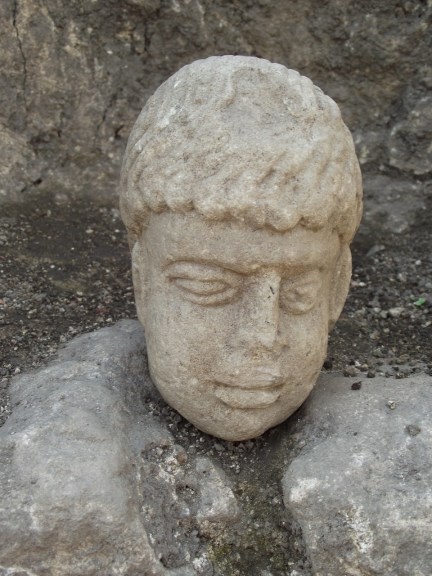
An 1,800-year-old carved stone head of what is believed to be a Roman god has been unearthed in an ancient rubbish dump.
Archaeologists made the discovery at Binchester Roman Fort, near Bishop Auckland, in County Durham.
First year Durham University archaeology student Alex Kirton found the artefact, which measures about 20cm by 10cm, in buried late Roman rubbish within what was probably a bath house.
The sandstone head, which dates from the 2nd or 3rd century AD, has been likened to the Celtic deity Antenociticus, thought to have been worshipped as a source of inspiration and intercession in military affairs.
A similar sandstone head, complete with an inscription identifying it as Antenociticus, was found at Benwell, in Newcastle upon Tyne, in 1862.
Dr David Petts, Lecturer in Archaeology at Durham University, said:
“We found the Binchester head close to where a small Roman altar was found two years ago. We think it may have been associated with a small shrine in the bath house and dumped after the building fell out of use, probably in the 4th century AD
“It is probably the head of a Roman god – we can’t be sure of his name, but it does have similarities to the head of Antenociticus found at Benwell in the 19th century.
“We may never know the true identity of this new head, but we are continuing to explore the building from which it came to help us improve our understanding of late Roman life at Binchester and the Roman Empire’s northern frontier in Northern England.
“Antenociticus is one of a number of gods known only from the northern frontier, a region which seems to have had a number of its own deities.
“It’s also an excellent insight into the life and beliefs of the civilians living close to the Roman fort. The style is a combination of classical Roman art and more regional Romano-British traditions. It shows the population of the settlement taking classical artistic traditions and making them their own.”
Alex, 19, from Bishop’s Stortford, in Hertfordshire, said:
“As an archaeology student this is one of the best things and most exciting things that could have happened.”
He added: “It was an incredible thing to find in a lump of soil in the middle
via the Roman Binchester Blog
of nowhere – I’ve never found anything remotely exciting as this.”
Dr David Mason, Principal Archaeologist with the site’s owner, Durham County Council, said:
“The head is a welcome addition to the collection of sculpture and inscriptions from Binchester. Previous religious dedications from the site feature deities from the classical pantheon of gods and goddesses such as the supreme god Jupiter and those associated with healing and good health such as Aesculapius, Salus and Hygeia.
“This one however appears to represent a local Romano-Celtic god of the type frequently found in the frontier regions of the Empire and probably representing the conflation of a classical deity with its local equivalent. The similarity with the head of Antenociticus is notable, but this could be a deity local to Binchester.”
The Binchester head is African in appearance, but Dr Petts, who is also Associate Director of Durham University’s Institute of Medieval and Early Modern Studies, said experts were unsure whether these features were deliberate or coincidental.
He explained: “This is something we need to consider deeply. If it is an image of an African, it could be extremely important, although this identification is not certain.”
Dr Mason added: “The African style comparison may be misleading as the form is typical of that produced by local craftsmen in the frontier region.”
The find was made as part of a five year project at Binchester Roman Fort which is shedding new light on the twilight years of the Roman Empire.
The Binchester dig is a joint project between Durham University’s Department of Archaeology, site owner Durham County Council, Stanford University’s Archaeology Centre and the Architectural and Archaeological Society of Durham and Northumberland.
[…]
About Binchester Fort
Binchester – known to the Romans as Vinovia – was established in the later 1st century AD and was once the largest Roman fort in County Durham.
Sited on the main Roman road between the legionary headquarters at York and Hadrian’s Wall, it controlled an important crossing point over the River Wear. It was also surrounded by the remains of a substantial settlement which would have housed the civilian population.
The major excavation fieldwork has been underway since 2009 and focuses on a section of the fort interior and a sample area of the nearby civilian settlement.
Previous finds at the site have included the remains of very late Roman activity at the fort, among them evidence for large-scale leather production dating to the very final years of Roman control in Britain in the late 4th and early 5th century AD.
Other evidence discovered at Binchester, including structures and artifacts, might also indicate continued occupation at the site into the early medieval period.
The archaeologists’ work at the site featured on BBC Two’s Digging for Britain in 2011 and on Channel Four’s Time Team in 2008.
About Antenociticus – a “Geordie” Roman god?
A carved stone head depicting Antenociticus was found in 1862 at a temple dedicated to the deity at Benwell, Newcastle upon Tyne. Fragments of a forearm and a lower leg were also found, suggesting that the head may have been part of a life-sized statue
The small temple of Antenociticus stands in the vicus (civilian settlement) outside Benwell (Condercum) Fort, one of 13 permanent forts added to the line of Hadrian’s Wall during its construction.
The temple was built in about AD 178-80, probably to mark the promotion of the Roman cavalry prefect who dedicated one of three altars in the temple to Antenociticus.
It is thought Antenociticus was possibly worshipped as a source of inspiration and intercession in military matters
Antenociticus is not mentioned at any other Romano-British site or on any inscriptions from the Continent, hence his identification as a local deity.
Quite a bit of the coverage mentions the student archaeologist who made the find. The Daily Mail’s coverage includes some comments from him:
Undergraduate Alex Kirton, 19, suddenly came across the carved stone head of a possibly Geordie Roman God at the site of an ancient settlement.
The stunning artefact, measuring 8in by 4in, is believed to have been dumped as rubbish when a Roman bath house fell out of use and remained hidden until now.
Alex, a first year student at Durham University, was helping to excavate the bath house site at Binchester Roman Fort, near Bishop Auckland, Co Durham, when he made the find.
The sandstone head, which dates from the 2nd or 3rd century AD, is likely to represent the war-like Antenociticus, a Celtic god worshipped as a way of inspiring troops about to go into battle.
Alex, who is studying Archaeology and Ancient Civilisations, said: ‘I know that I may be an archaeologist for the rest of my life and never find something this significant again, but it’s incredibly exciting to have been the person who uncovered it.
‘My trowel touched something and as I pulled away the soil I realised I was looking at the back of a head. I could clearly to see the impression of the hair carved into it.
‘I knew I may have found something of interest and I called over my supervisor as I thought I ought to let someone know what I’d discovered.
‘He came over and between us we carefully cleared away the soil that was surrounding it until all of a sudden the head rolled out face up and was just lying there staring up at us.’
The teenager said he knew his find was a rare one but he realised how special it was when he saw his supervisor’s stunned expression.
‘I was absolutely ecstatic, it seemed such an outrageous piece of luck to come across it on my second dig, but I’m delighted I did,’ he said.
Outside of the press coverage, Jonathan Eaton posted some photos of a temple to this deity at his Imperium Sine Fine blog a year and a half ago (Temple of Antenociticus and Vallum Crossing at Benwell). Folks will also definitely want to check out the dig blog which most recently includes a couple of posts on this item (Roman Binchester)
All the coverage I’ve found on this seems to derive from this BBC piece:
Archaeologists have uncovered a Roman shrine at Rutland Water nature reserve.
The team from Northamptonshire Archaeology investigated the site ahead of a 240-acre extension to the reserve by Anglian Water.
They found the remains of an Iron Age farmstead, and a shrine dating from about AD100.
Jo Everitt, Anglian Water’s environment and heritage assessor, said: “Finding Roman shrines is not the norm, so we were delighted.”
Ritual sacrifice
Roman sites had been found in the area at Collyweston Great Woods, 14km (eight miles) to the south-east of Rutland, and another to the north-west of Rutland Water, near Oakham.
However, nothing had previously been discovered near the lagoons along the western edge of the reservoir.
The team discovered a circular stone building, about 10.5m (34ft) wide, with decorated red and white painted walls.
They also found more than 200 Roman coins, pottery jars, part of a small bronze figurine and deposits of animal bone, probably from the ritual sacrifice of lambs and cattle.
A skeleton of a man, aged about 30, was buried in a grave in the centre of the shrine.
The archaeologists believe the shrine fell out of use in AD300.
Ms Everitt added: “We’ve recreated part of the foundation and wall of the shrine from the original stone on an area outside of the lagoons so visitors to Rutland can see what it looked like.”
The findings from the dig are currently being displayed at the Rutland Water visitor centre.
The BBC coverage includes a little slideshow of the “shrine”, the pottery and the burial. Other than the Roman coins, I’m not really sure what makes this Roman or a “shrine”. No enlightenment from the Northamptonshire Archaeology website.
A HISTORIAN is claiming to have found the site of one of Scotland’s most significant battles.
Archaeologist Mike Haseler believes he has evidence to suggest that the battle of Mons Graupius took place in Moray.
Mons Graupius was a key battle for British independence against the repressive hand of Rome almost 2000 years ago.
According to the Romans, 10,000 Britons died that day at the hands of this first European super-state, while many others fled the scene.
Despite stringent efforts by experts, the site of the battle between the Romans and the Caledonians – in either 83AD or 84AD – has never been conclusively identified.
However, Mr Haseler believes his research strongly points to the battle taking place near Elgin, at Quarrelwood Hill to the north-west of the town.
He is now asking that experts pay closer attention to the site and examine what he believes to be a possible Roman fort a short distance away.
From his research and examining the formation of aerial crop circles, Mr Haseler believes he has discovered the fort just south of Elgin.
“I knew the site was a really good candidate from looking at old maps, but I never thought I would find what appeared to be the ditches of a Roman fort staring out at me from the computer screen,” he said.
“I have looked and looked at the evidence, and everything fits.
“I have been to the site, and it is just as described by the Roman writer Tacitus and, barring going up with a metal detector, which is clearly illegal, there is nothing else I can do but present the evidence I have for the public to decide.”
Mr Haseler, who is based in Lenzie, East Dunbartonshire, found the location while completing his certificate of field archaeology at Glasgow University.
Key to his discovery was his reconstruction of a second century map to help him pinpoint the homeland of the Caledonian tribe.
Considerable debate and analysis has surrounded the site of the battle, which is known to have taken place on Scottish soil.
Touted locations include Perthshire, to the north of the River Dee, while other historians have suggested it may have taken place in Kincardineshire or even Bennachie in Aberdeenshire.
However, Mr Haseler’s research brought him to Moray.
“It is the right size and the only way to prove or disprove it is to go public and ask for experts to assess the site,” he added. “The general position of the site is an excellent fit for Mons Graupius.
“The Caledonian army of about 30,000 would be gathering on Quarrel Hill and were probably expecting the Romans to take two days to reach them.
“Instead, I think [Roman governor] Agricola pressed on with a surprise attack and took only one.
“The Romans, having sent out scouts to select a suitable site for a temporary camp, would have arrived to the surprise and consternation of the Caledonians very late in the day, and made camp a few miles from the Caledonian army.
“So, the main battle would have been fought on the south of Quarrelwood Hill, and perhaps on the immediate plain in front.
“Having looked at all the possible candidates, I am convinced that this site is the best fit to what we know about the battle, mainly because most other sites are just too far south even to consider.
“Historians have been gradually moving the assumed locations of tribes further north, so a lot of the potential sites are now located too far south, but we simply don’t know what is there until we start digging.”


 rogueclassicism