@Roman History Books and More
IO SATVRNALIA!
http://romanhistorybooks.typepad.com/roman_history_books_and_m/2013/12/io-satvrnalia.html
quidquid bene dictum est ab ullo, meum est

@Roman History Books and More
IO SATVRNALIA!
http://romanhistorybooks.typepad.com/roman_history_books_and_m/2013/12/io-satvrnalia.html
@APA Blog
APA Member to Be Interviewed on NPR
http://apaclassics.org/apa-blog/apa-member-be-interviewed-npr
@Bread & Circuses
Latest Archaeological News from Germany
http://feedproxy.google.com/~r/typepad/CGkB/~3/upXYJDYV440/latest-archaeological-news-from-germany.html
I’m sure many readers of rogueclassicism were saddened to read of the death of Peter O’Toole this past weekend, especially considering how many ‘classical’ roles he played. Indeed, I was one of many folks on Twitter retweeting obits and the like … all of which makes the following somewhat disturbing/uncomfortable. The Guardian has a thing wherein Malcolm McDowell (of Caligula fame, natch) is reminiscing about his experiences with O’Toole on the set. Inter alia we read:
[…]
I do recall one particular night shoot… We were called to the set at four o’clock in the afternoon. As usual, nothing was ready. They’d built a set of Tiberius’s grotto, on three acres, and were assembling all of the extras and background. The producers worriedly asked if I would go into Peter’s trailer (he was playing Tiberius) and go through the lines with him, which we did few times.And then he told me the most remarkable story – whether it is true or not I have no idea – about his grave-robbing Etruscan tombs. He said the best way to find Etruscan jewellery and artefacts was to find the drains in the tombs, and very gingerly sift through them with your fingers because, as the bodies decompose, all of the artifacts deposit themselves into the channels. The thought of Peter O’Toole on his hands and knees in an Etruscan catacomb makes for a lovely image. […]
A lovely image? It gets a bit more sinister … Sian Philips’ Public Places: My Life in the Theater, with Peter O’Toole and Beyond, which is available at Google Books. Check this excerpt (from Chapter 20) out:
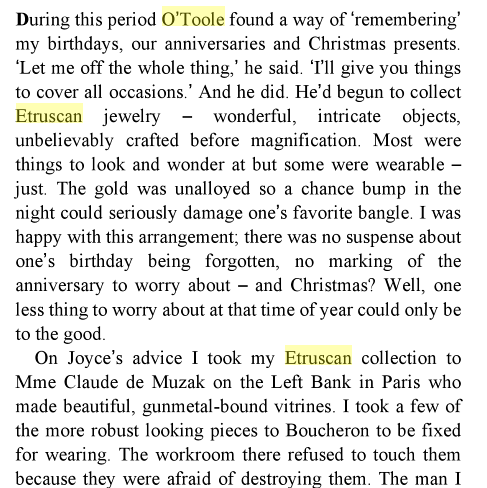
Is this something that Classicists were aware of? Should someone be looking into these Etruscan-associated activities?

From a Stanford News release:
Rap Genius is a popular lyric-annotating website that allows music lovers to upload lyrics and share comments about them.
Stanford classics students are using it too, but for a decidedly academic purpose.
Jacqueline Arthur-Montagne, a classics graduate student, began using Rap Genius to comment on and annotate Greek texts. Shortly after Arthur-Montagne started to work with Ancient Greek texts on the site, she got an email from Jeremy Dean, the “Education Czar” at Rap Genius, who wanted to talk to her about the potential of using Rap Genius in the classroom.
Twelve weeks later, Dean was interacting with 10 graduate students in a Classics Department workshop called Teaching Classics in the Digital Age .
“After we talked about the possibilities, I invited him to come to our workshop, and he came to present to the class. He did a great presentation, and it is clear that people – faculty, students, the university – are interested in this,” said Arthur-Montagne, the research assistant for the workshop.
Susan Stephens , a professor of classics, leads the workshop, which was offered for the first time this quarter.
Digital tools
A scholar of ancient Greek literature, Stephens says the ability to use digital tools is helpful for graduate students who are looking for teaching positions.
“Technology is here and here to stay. There is a lot of interest at Stanford in helping people do pedagogy better, and digital pedagogy is critical. This is where we are going and we have to embrace it,” she said.
Stephens saw a need to offer a formal workshop that would address the needs of graduate students as the next generation of teachers. “We wanted a workshop in which graduate students could experiment with different sorts of digital tools and resources.”
The result was a weekly workshop, offered to graduate students, which focused on harnessing the most useful digital resources in the classroom to enhance the undergraduate learning experience. A small grant from the Stanford Vice Provost for Undergraduate Education’s Center for Teaching and Learning supported the workshop.
Stephens cited graduate student Israel McMullin, who has already started to use Rap Genius in a class he teaches about Biblical Greek. “The students can comment and see comments on the passages they are working on in real time, and this live functionality and ease-of-use helps improve the learning experience,” Stephens said.
For Arthur-Montagne, the workshop was founded on a straightforward question: “Could I use pre-existing technology like Rap Genius for classics? They upload lyrics and comment on them, so how about doing the same with classical texts?”
She continued, “We are looking at practical applications, things that can be implemented in the classroom right now. We hope that the workshop can help us efficiently and succinctly incorporate technology as teachers, and therefore improve the learning experience for our students.”
Capturing the student imagination
Stephens, who has used many digital resources in her own research and teaching, said that she could not find any other workshops of its kind as a model that allowed hands-on experimentation with resources under expert guidance from professionals.
Each week a digital humanities specialist speaker presented on his or her field, and the task at home was to practice. The following week, students led discussions on their findings and their experience – whether they had filmed themselves teaching, set up a class blog or used Rap Genius.
For Stephens, the use of digital humanities allows for a more stimulated classroom. “You can approach a sophisticated scholarly question that through more traditional techniques you could not talk about and make it intriguing to the students,” she said.
The workshop also allowed graduate students to share projects they are working on that make use of digital tools.
One student, Scott Arcenas, presented the ORBIS project, an initiative headed by Classics Department chair Walter Scheidel. The digital mapping project aims to create a cohesive and interactive map of the Roman Empire by bringing together information from many different sources.
Another graduate student, Jon Weiland, presented on his work in geographic information systems and digital mapping.
Weiland uses interactive maps in his work on gladiators to bring together multiple sources to provide a more comprehensive picture of gladiatorial history, including the arenas where they fought and how they traveled.
Most important, he said, is that “all this technology is available and relatively easy to learn how to use.”
A unique moment of opportunity
Stephens sees the digital changes in education as marking the next step for, rather than the end of, the humanities.
As Arthur-Montagne said: “The humanities have been helping arrange, contextualize and organize masses of information forever, even before technology, which is more relevant than ever in this age of information.
“I am interested in digital tools not because there is a crisis, but rather because there are new avenues and opportunities for presenting the same sort of findings that we always have been finding.”
Stephens said the humanities are witnessing a unique moment of opportunity in an era of mass information, communication and digitization: “Being more on top of who the students are and what they use is vital. In this sense I think the humanities is really exciting right now.”
 rogueclassicism