
Readers of my Explorator newsletter will be familiar with the ongoing dispute in Ashkelon, where hospital expansion has uncovered a number of burials. The Israel Antiquities Authority has said for quite a while that it was a ‘pagan’ cemetery, and a recently-discovered altar seems to back up the claim. Here’s the IAA link (tip o’ the pileus to Joseph Lauer):
The development work for the construction of a fortified emergency room at Barzilai Hospital, which is being conducted by a contractor carefully supervised by the Israel Antiquities Authority, has unearthed a new and impressive find: a magnificent pagan altar dating to the Roman period (first-second centuries CE) made of granite and adorned with bulls’ heads and a laurel wreaths. The altar stood in the middle of the ancient burial field.
According to Dr. Yigal Israel, Ashkelon District Archaeologist of the Israel Antiquities Authority, “The discovery further corroborates the assertion that we are dealing with a pagan cemetery. It is an impressive find that has survived 2,000 years. The altar is c. 60 centimeters tall and it is decorated with bulls’ heads, from which dangle laurels wreaths. There is a strap in the middle of each floral wreath and bull’s head. The laurel wreaths are decorated with grape clusters and leaves. This kind of altar is known as an “incense altar”. Such altars usually stood in Roman temples and visitors to the temple used to burn incense in them, particularly myrrh and frankincense, while praying to their idols. We can still see the burnt marks on the altar that remain from the fire. The altar was probably donated by one of the families who brought it to the cemetery from the city of Ashkelon”.
Dr. Israel adds that during the archaeological supervision of the development work burial structures were discovered, which served as family tombs, and cist tombs that were used for interring individuals. In addition a large limestone sarcophagus (stone coffin) with a decorated lid was also found. The sarcophagus stands 80 centimeters high is 60 centimeters wide and is 2 meters long. Part of the stone in the sarcophagus was left rather high in the spot where the head of the deceased was placed and resembles a kind of pillow.
via Pagan Altar was Exposed while the IAA was Overseeing Development Work at the Barzilai Hospital. [article will move in the near future]
Here’s an image of the altar itself (provided by the IAA:
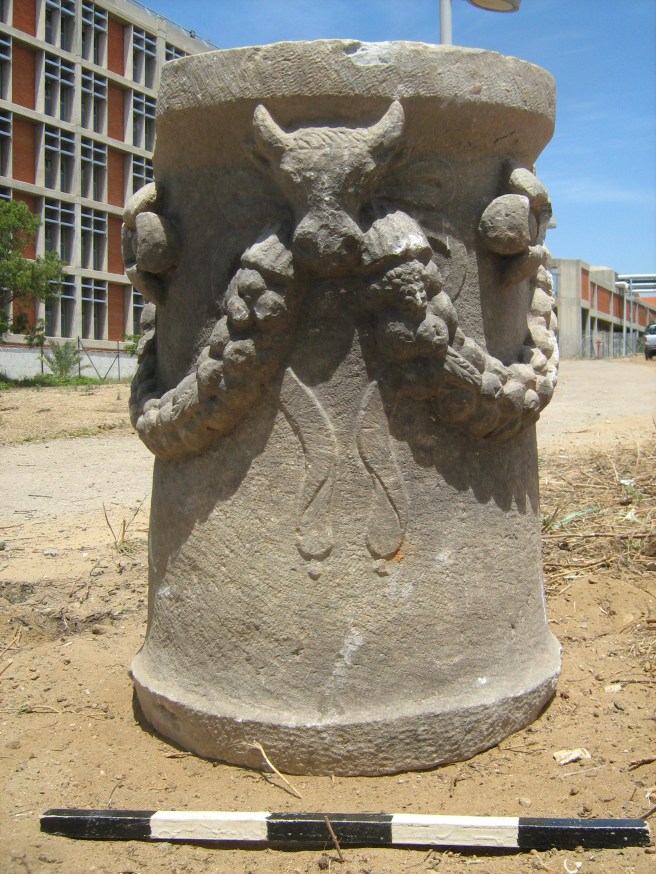
Interesting that it’s round … I’ve never seen a round Roman altar before; Ferrell’s Travel Blog provides some comparanda:
Useful comments on the dispute at Jim West’s blog:

 rogueclassicism