
In a word, no, but that doesn’t stop the Epoch Times for wasting electrons on a nutty theory … here are just enough exerpts to smack your gob:
The year 1492 is one of history’s most famous dates, when America was discovered by Europeans. However that “New World” may have been already known to the ancient Greeks, according to a book by Italian physicist and philologist Lucio Russo.
The translated title for Russo’s book would be “The Forgotten America: The Relationship Among Civilizations and an Error Made by Ptolemy.” But the author told the Epoch Times that the title for the English version, which isn’t ready yet, will probably be “When the World Shrunk.”
Some CluesAmong the many clues of contact between ancient Europeans and Native Americans are the few pre-Columbian texts to have survived the Spanish devastation.
In a book about the origins of the Maya-Quiché people there are many interesting points. The fathers of that civilization, according to the text, were “black people, white people, people of many faces, people of many languages,” and they came from the East. “And it isn’t clear how they crossed over the sea. They crossed over as if there were no sea,” says the text.
However, researchers later decided to translate the Mayan word usually meant for “sea” as “lake.”
There are also many Mayan depictions and texts about men with beards. But Native Americans do not grow beards.
Furthermore, some artworks of the ancient Romans show pineapples, a fruit that originated in South America.
Ways of Thought
Russo, who currently teaches probability at Tor Vergata University of Rome, says the main reason why researchers think America wasn’t known to ancient Greeks is not due to lack of proof, but to scientific dogma. […]
… now since they mentioned that old canard about pineapples in Roman art, we feel compelled to comment. We should make note of the photo that accompanies the original article:

I won’t go too much into detail about the background on this claim (which ultimately goes back to Ivan Van Sertima … see Jason Colavito’s excellent post from a year or so ago: The “Pineapple” of Pompeii), but there clearly is something wrong with people if they look at those things and see pineapples. Begin with the mosaic and you’re looking at something that looks like it’s smaller than most of the fruit there. Then look at the fresco and see that the things are only slightly larger than the snake’s head. Then you can argue with yourself about the statue and decide whether it’s a child or an adult. If you’ve been around Classics for a while, however, the thing is obviously a pinecone, not a pineapple, which are similarly-depicted on plenty of pots relating to Dionysus/Bacchus and usually brandished by a Maenad, and often by Dionysus himself E.g.:
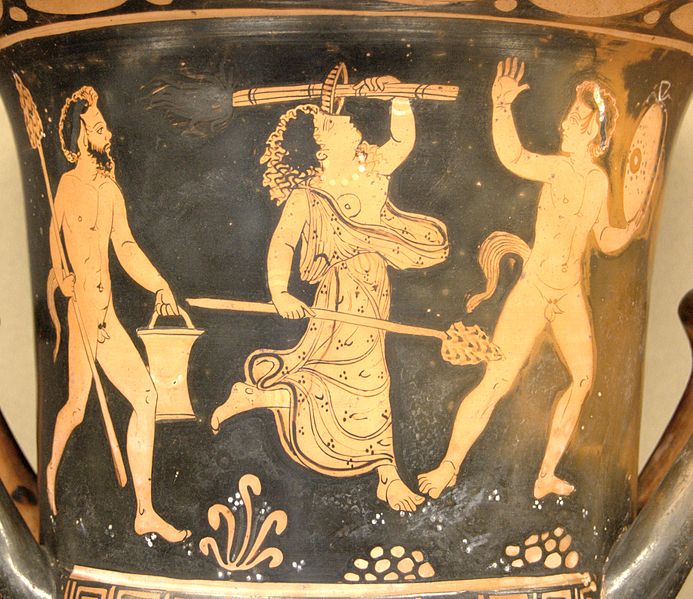
There are countless other examples, including architectural elements and the like. Once again we see the ‘danger’ of non-specialists building theories on rather common elements of ancient Greek and Roman life (more common than they want to believe) …

 rogueclassicism