Indian Artifacts from Berenike?

Interesting item from Frontline:

One way to understand the implications of the archaeological discoveries at Pattanam is to delve into the amazing wealth of data from the excavations at the lost Ptolemic-Roman port city of Berenike, on Egypt’s Red Sea coast. During the Ptolemic-Roman period (third century B.C. to sixth century A.D), Berenike served as a key transit port between ancient Egypt and Rome on one side and the Red Sea-Indian Ocean regions, including South Arabia, East Africa, India and Sri Lanka, on the other.

This ancient port city was well-connected by roads from the Nile that passed through the Eastern Desert of Egypt and also by sea routes from the Indian Ocean regions. Cargoes unloaded at Berenike and other Egyptian Red Sea ports (such as Myos Hormos, now lost) used to be taken along the desert roads to the Nile and from there through the river to the Mediterranean Sea and across, to the Roman trade centres.

Exotic goods from Rome and Egypt flowed into Berenike along the same desert road before being loaded into large ships bound for the Indian Ocean.

By the end of the second century B.C., the Egyptians and the Romans finally learnt the skill of sailing with the monsoon winds across the Indian Ocean (“from the Arabs and other Easterners”). Voyages from Berenike for the riches of the Malabar coast therefore became “faster, cheaper, but not less dangerous”.

According to most accounts, one of the major centres in India that ships from Berenike travelled to, along with the monsoon winds, was the emporium of Muziris, on the Malabar coast.

However, as the silting of the harbour, among other uncertain reasons, caused Berenike’s eventual abandonment before the middle of the sixth century A.D., Muziris, too, disappeared mysteriously from the itinerary of the later voyagers to the Malabar coast. For a long time since then, both these centres remained forgotten.

But while archaeological evidence about Muziris or the Indian Ocean trade remained elusive in the Malabar coast, it was Berenike that eventually offered invaluable proof of its links with the Yavanas.

In wide-ranging and ongoing excavations at Berenike launched from 1994 (and at many other places on the Eastern Desert), a team of dedicated archaeologists from the University of Delaware (United States) led by Prof. Steven E. Sidebotham, along with partners from several other institutions, has documented evidence of the cargo from the Malabar coast and people from South India being at the last outpost of the Roman Empire and of Indians on the Berenike-Nile road.

Among the unexpected discoveries at Berenike were a range of ancient Indian goods, including the largest single concentration (7.55 kg) of black peppercorns ever recovered in the classical Mediterranean world (“imported from southern India” and found inside a large vessel made of Nile silt in a temple courtyard); substantial quantities of Indian-made fine ware and kitchen cooking ware and Indian style pottery; Indian-made sail cloth, basketry, matting, etc. from trash dumps; a large quantity of teak wood, black pepper, coconuts, beads made of precious and semi-precious stones, cameo blanks; “a Tamil Brahmi graffito mentioning Korra, a South Indian chieftain”; evidence that “inhabitants from Tamil South India (which then included most of Kerala) were living in Berenike, at least in the early Roman period”; evidence that the Tamil population implied the probable presence of Buddhist worshippers; evidence of Indians at another Roman port 300 km north of Berenike; Indian-made ceramics on the Nile road; a rock inscription mentioning an Indian passing through en route; “abundant evidence for the use of ships built and rigged in India”; and proof “that teak wood (endemic to South India), found in buildings in Berenike, had clearly been reused”(from dismantled ships).

via South Indians in Roman Egypt? | Frontline.

The same magazine has a sort of ‘state of the finds’ article: Muziris, at last?

There was also a (annoyingly vague) report last week about Muziris in the Hindu:

… which mentioned the Roman connection, but only in passing (I’m not sure what date or origin many of the finds mentioned in that article would be).

Some of our previous coverage on Muziris:

Adrian Murdoch also covered the Muziris thing:

Unpublished Archaeological Data

The conclusion of an interesting piece in Nature about the flood of archaeological data found by commercial excavators which never seems to get ‘published’ in the academic sense of the word … fyi:

Michael Fulford, one of Bradley’s colleagues at the University of Reading, has been piloting a study of the grey literature about Roman Britain, with similarly exciting results. “We’ve almost found ‘another Roman Britain’,” he says, “one that we would have never seen without developer-funded archaeology.”

Previously British Roman archaeology had tended to be biased towards excavating high-status sites such as villas, as these were what researchers had chosen to investigate. But commercial excavations happen wherever developers are planning to break ground, and so provide a wider sampling of the past.

By embarking on a “massive photocopying campaign”, Fulford assimilated huge amounts of data, representing a massive increase in both the number and type of sites now known. His study revealed the other side of Roman society. The low-status rural settlements showed how indigenous communities coexisted with Roman invaders, by keeping much of their vernacular architecture, but furnishing their homes with Roman manufactured goods. “A lot of the best work is coming out of commercial units now — a lot of the worst is as well, but you can say that about universities, quite frankly,” says Fulford.

He advises PhD students who want to keep their hand in fieldwork that they might be better off working in commercial archaeology because it often involves large projects that are properly funded. “A lot of my contemporaries feel disenfranchised, but then that’s too bad,” says Fulford. “Despite the difficulties, we have to adapt to an archaeological record that is massively expanded and, at its best, of far better quality than has been achieved by academics, who are often very part-time fieldworkers.”

via Archaeology: Hidden treasure | Nature News.

I wonder if similar conditions prevail in other nations within our purview …

New Translation of Philae Victory Stele

I’m a bit late with this one … I first saw this story mentioned at Heritage-Key … here’s the coverage from the Independent:

Scholars translating a Roman victory stele, erected in the Temple of Isis at Philae in Egypt in 29 BC, have discovered the Roman Emperor Octavian Augustus’ name inscribed in a cartouche – an honour normally reserved for an Egyptian pharaoh

Octavian’s forces defeated Cleopatra VII and Mark Antony at the Battle of Actium in 31 BC, and captured Alexandria soon afterwards. Historians believe that although Octavian ruled Egypt after the death of Cleopatra in 30 BC, he was never actually crowned as an Egyptian pharaoh.

The stele was commissioned by Gaius Cornelius Gallus, a Roman soldier and poet who was appointed by Octavian to run Egypt as a province, and who administered Egypt until he was recalled to Rome in 27 BC. The stele celebrates the end of the Ptolemaic kings and the defeat of the “king of the Ethiopians”. It is written in three languages: Egyptian hieroglyphics, Latin and Greek. The stele has been known to scholars for around 100 years, but translation of the hieroglyphic text has been difficult as the inscription is no longer clear. Previous work had suggested that the name of Gaius Cornelius Gallus had been inscribed in the cartouche (an oblong frame).

Historians don’t believe that Octavian Augustus was ever crowned as the Pharaoh of Egypt. However, Professor Martina Minas-Nerpel, who was part of the team translating the stele, said that the inscription clearly indicated that Octavian Augustus was treated as a pharaoh by the Egyptians.

“The name of Octavian is written in a cartouche – he’s treated as any other Egyptian king,” she said.

Professor Minas-Nerpel believes that Egyptian priests had insisted on this honour, and that it was in Octavian’s interests to comply.

“(The priests) had to have an acting pharaoh, and the only acting pharaoh (possible) under Octavian was Octavian,” said Minas-Nerpel. “The priests needed to see him as a pharaoh otherwise their understanding of the world would have collapsed.”

For Octavian, pleasing the priests would have been vital in keeping the province in order.

“He needed to have a calm province and the key element to keeping the province calm were the priests – they were key to the population,” said Minas-Nerpel.

This stele would not be the only example of the names of Roman rulers being written in a cartouche. Similar instances dating up to the 3rd Century AD have also been discovered. Professor even Minas-Nerpel cites another example of Octavian’s name being written in a cartouche. His name is found on a gateway dating to 30 BC, on the island of Kalabsha in Southern Egypt.

via Stele names Roman Emperor Octavian Augustus as Egyptian Pharaoh | The Independent.

The tome which resulted from Dr. Minas-Nerpel’s study is partially available at Google Books:Friedhelm Hoffmann, Martina Minas-Nerpel, Stefan Pfeiffer, The Trilingual Stela of C. Cornelius Gallus from Philae. Translation, Commentary, and Analysis in Its Historical Context.
(Volume 9 of Archiv für Papyrusforschung und verwandte Gebiete)

Work on Kemble Mosaic Resumes

I don’t think we covered the original discovery of this one (Adrian Murdoch did):

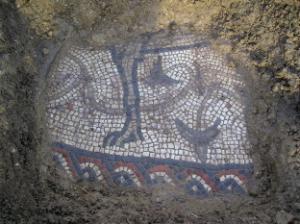
ARCHAEOLOGICAL work to determine the full extent of a massive Roman mosaic uncovered in a Cotswold field will resume shortly.

Metal detector enthusiasts Paul Ballinger and John Carter uncovered a section of the ancient mosaic in January last year in a field near Kemble.

It is believed to date back to the 4th Century and could be up to 40-foot in diameter which would make it the biggest Roman mosaic in north west Europe.

from the Standard

Archaeologists from Gloucestershire County Council say they will be performing further testing on the site, which is an agricultural field, throughout the summer with the permission of the landowner.

GCC county archaeologist Jan Wills told the Standard they would be using advanced surveying techniques to measure the electrical resistance and magnetic fields of the land.

“Soil affected by human occupancy will have higher magnetic values than regular soil,” she said.

“There’s some building debris over it so it’s not going to be possible to identify the extent of the mosaic using just these techniques.”

English Heritage may designate the site as Scheduled Monument once the full extent of the mosaic and buildings are determined.

Mrs Wills added: “From what we know it’s an important site and we have to tread carefully.”

via Archeological survey to resume on massive Roman mosaic in Kemble | Wilts and Gloucestershire Standard.

‘Forgotten’ Mithras Site ‘Reopens’

I wonder how many other sites are in similar circumstances …

An ancient sanctuary of the Roman god Mithras, located in the Rodopi Mountains border region between Greece and Bulgaria, was shown for the first time since its discovery in 1915.

The archaeological site is located 6 kilometres into Greece from the Greek-Bulgarian border, near the Greek town of Thermes. Discovered in 1915 by Bulgarian archaeologist Bogdan Filov, no archaeological research of the site was carried out since and knowledge of it was based only on his writings. Archaeologists suspect that at the foot of the rock complex, there is a large temple dating to Late Antiquity, but excavations will have to confirm this.

The Iron Curtain made it unthinkable for Bulgarian archaeologists to access the site, while their Greek counterparts showed no interest in it, so it was left forgotten for decades.

After the recent opening of the new border control point between Greece and Bulgaria and the road between the Bulgarian town of Zlatograd and the Greek Thermes, the rock sanctuary became accessible to visitors.

Being located in the forest near Thermes, the site until a month ago was concealed by trees and bushes. But then, according to Bulgarian media, enthusiasts from Zlatograd had local Greeks clean up the terrain, making Mithras’s bas-relief and the holy water spring visible and the site accessible.

Until the fourth century, Mithras was the most venerated god in the Roman Empire, archaeologists explained, before he was replaced by Christianity as the official religion. The bas-relief at the site, like all other images of Mithras in his temples, shows the god offering a bull as a sacrifice.

“This is the only sanctuary of Mithras, known thus far to exist in the Rodopi Mountains. Considering the fact that [what is apparent] is a veneration of the rock, we can see that the complex is a rock complex, and we can only connect the cult of Mithras, which dates to the third and fourth centuries, to earlier cults of the Thracians to the rocks,” Bulgarian archaeologist Professor Nikolay Ovcharov told media when the complex was presented.

“We hardly know anything about this region south of the border,” Professor Ovcharov said. “This area needs to be jointly researched together with Greek archaeologists,” he added.

In addition to joint excavations, the Mithras sanctuary will be included in a joint tourist route between the two countries.

The god Mithras, who became popular among the military in the Roman Empire from the first to the fourth centuries, was the center of a mystery religion known as the Mithraic Mysteries, information on which is based on surviving monuments. Besides showing Mithras as being born from a rock and sacrificing a bull, little else is known for certain.

via Greece and Bulgaria: Archaeologists Excavate Previously Inaccessible Site in Border Region | Balkan Travellers.