
ante diem xii kalendas maias
Month: April 2010
This Day in Ancient History: ante diem xiii kalendas maias
ante diem xiii kalendas maias
- ludi Cereri (day 8)– games in honour of the grain goddess Ceres, instituted by/before 202 B.C.
- Cerealia — the actual date of the Cerealia is uncertain, but it ‘reenacted’ Ceres’ search for her daughter Proserpina, with apparently all participants and spectators dressed in white.
- 69 A.D. — Vitellius is recognized as emperor by the senate in Rome
… we also note today is the commemoration of an (undated) Roman soldier saint Expeditus
Head of Augustus from Stobi?
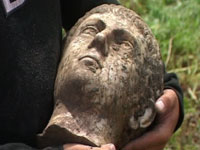
A well-preserved, priceless marble head of Octavius Augustus – part of a sculpture from the early Roman period – and a small torso were excavated Friday at Stobi archaeological site, which was visited by Prime Minister Nikola Gruevski together with Culture Minister Elizabeta Kanceska-Milevska and the director of the Department for Cultural Heritage Protection, Pasko Kuzman.
According to its features, the sculpture was intended to immortalize emperors and notable citizens from the first and second century A.D. It was housed in a temple, which was robbed soon after it was demolished in the classical era. […]
via MINA Breaking News – Priceless Roman sculpture excavated in Stobi.
Wish that photo was a bit better … it ‘sort of’ looks like a young Augustus …

Roman House from Crotone
The gist: a house with several phases of construction ranging from the 1st/2nd century A.D. down to the 4th/6th with the later phases including bathing facilities. I assume it is the early phases which are decorated in a ‘Pompeii style’ and I have no idea what coccio pesto is (but it sounds tasty). Here’s the salient descriptive bit:
‘E’ un edificio – ha continuato Marino – collocabile tra il I ed il II secolo dopo Cristo, quindi in piena età romana imperiale. Il suo abbandono, invece, è databile dal IV al VI secolo. L’importanza della struttura, si rileva dalla presenza delle terme, ma anche dai marmi rinvenuti, che erano di grande qualità. L’edificio romano – ha precisato ancora il responsabile degli scavi – si estendeva su più livelli, con annesse scale; un altro indice di antichità è dato dal rinvenimento di tratti di opere reticolate. Gli intonaci, poi, erano in stile pompeiano e i pavimenti in coccio pesto’. Per il direttore del museo, inoltre, interessante è anche il sito della struttura, ‘in zona panoramica, di fronte il mare; se fosse un edificio pubblico, le terme sarebbero certamente collegate all’attività del porto.
via A Crotone emerge una Domus Romana di assoluto valore archeologico | Tropea .
UPDATE (a few hours later)… ANSA just came through with some English coverage (although the dating seems rather different):
A luxury complex dating back 2,000 years has emerged from a building site in Crotone, which archaeologists say could cast new light on the southern city’s past.
The remains, discovered in a raised part of the city centre near the port, reveal a multi-storey building that once enjoyed a panoramic view and boasted its own thermal baths. The scale and facilities of the complex are a clear indication the Crotone was a far more sophisticated settlement in ancient times than previously realized, explained Archaeology Museum Director Domenico Marino.
A building of this nature would only have been possible if the surrounding town had extensive and fully functioning drainage, an aqueduct and a cistern, in order to transport the water required to and from the premises “This is a revolutionary discovery for Crotone,” said Marino. “These remains tell us we are dealing with a large-scale Roman city, with buildings and public facilities of a certain significance. “We have made several important finds from Ancient Crotone in the past but this is the first ever discovery of such importance”. Builders were first alerted to the possibility of a big archaeological breakthrough at the end of February, when they discovered some floor fragments, a silo, walls and a tank. They informed the city council, which brought in its own experts to investigate the area more thoroughly.
An initial 30-day search was extended by a further 20 days and it was only towards the end of this second period that archaeologists realized the full scale of the find. So far, they have uncovered sections of marble flooring, Pompeian-style red and black plastered walls, an interior staircase and corridors with mosaic artwork on the floor. They are not yet sure when the complex was built but believe it might have been developed over several centuries, with the oldest part dating back to the 6th century BC and more recent sections to the 1st or 2nd century BC. The building was probably a residential complex but may also have been some kind of public building, said Marino. For now, the construction project on the central city road has been put on hold while archaeologists continue their work, causing traffic hold-ups and chaos for local residents. But Crotone Mayor Peppino Vallone said the value of the discovery meant investigations would continue and, if necessary, the construction might be halted indefinitely. “According to the city’s archaeology department this is an extraordinary find, one that completely changes Crotone’s history,” he said.
via Ancient complex found in Crotone | ANSA
Citanda: Things I’ve Learned with Matt Roller
Interesting interview:
Things I’ve Learned with Matt Roller | Johns Hopkins Newsletter.
 rogueclassicism