New Translation of Philae Victory Stele

I’m a bit late with this one … I first saw this story mentioned at Heritage-Key … here’s the coverage from the Independent:

Scholars translating a Roman victory stele, erected in the Temple of Isis at Philae in Egypt in 29 BC, have discovered the Roman Emperor Octavian Augustus’ name inscribed in a cartouche – an honour normally reserved for an Egyptian pharaoh

Octavian’s forces defeated Cleopatra VII and Mark Antony at the Battle of Actium in 31 BC, and captured Alexandria soon afterwards. Historians believe that although Octavian ruled Egypt after the death of Cleopatra in 30 BC, he was never actually crowned as an Egyptian pharaoh.

The stele was commissioned by Gaius Cornelius Gallus, a Roman soldier and poet who was appointed by Octavian to run Egypt as a province, and who administered Egypt until he was recalled to Rome in 27 BC. The stele celebrates the end of the Ptolemaic kings and the defeat of the “king of the Ethiopians”. It is written in three languages: Egyptian hieroglyphics, Latin and Greek. The stele has been known to scholars for around 100 years, but translation of the hieroglyphic text has been difficult as the inscription is no longer clear. Previous work had suggested that the name of Gaius Cornelius Gallus had been inscribed in the cartouche (an oblong frame).

Historians don’t believe that Octavian Augustus was ever crowned as the Pharaoh of Egypt. However, Professor Martina Minas-Nerpel, who was part of the team translating the stele, said that the inscription clearly indicated that Octavian Augustus was treated as a pharaoh by the Egyptians.

“The name of Octavian is written in a cartouche – he’s treated as any other Egyptian king,” she said.

Professor Minas-Nerpel believes that Egyptian priests had insisted on this honour, and that it was in Octavian’s interests to comply.

“(The priests) had to have an acting pharaoh, and the only acting pharaoh (possible) under Octavian was Octavian,” said Minas-Nerpel. “The priests needed to see him as a pharaoh otherwise their understanding of the world would have collapsed.”

For Octavian, pleasing the priests would have been vital in keeping the province in order.

“He needed to have a calm province and the key element to keeping the province calm were the priests – they were key to the population,” said Minas-Nerpel.

This stele would not be the only example of the names of Roman rulers being written in a cartouche. Similar instances dating up to the 3rd Century AD have also been discovered. Professor even Minas-Nerpel cites another example of Octavian’s name being written in a cartouche. His name is found on a gateway dating to 30 BC, on the island of Kalabsha in Southern Egypt.

via Stele names Roman Emperor Octavian Augustus as Egyptian Pharaoh | The Independent.

The tome which resulted from Dr. Minas-Nerpel’s study is partially available at Google Books:Friedhelm Hoffmann, Martina Minas-Nerpel, Stefan Pfeiffer, The Trilingual Stela of C. Cornelius Gallus from Philae. Translation, Commentary, and Analysis in Its Historical Context.
(Volume 9 of Archiv für Papyrusforschung und verwandte Gebiete)
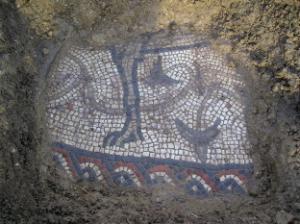
Work on Kemble Mosaic Resumes

I don’t think we covered the original discovery of this one (Adrian Murdoch did):

ARCHAEOLOGICAL work to determine the full extent of a massive Roman mosaic uncovered in a Cotswold field will resume shortly.

Metal detector enthusiasts Paul Ballinger and John Carter uncovered a section of the ancient mosaic in January last year in a field near Kemble.

It is believed to date back to the 4th Century and could be up to 40-foot in diameter which would make it the biggest Roman mosaic in north west Europe.

from the Standard

Archaeologists from Gloucestershire County Council say they will be performing further testing on the site, which is an agricultural field, throughout the summer with the permission of the landowner.

GCC county archaeologist Jan Wills told the Standard they would be using advanced surveying techniques to measure the electrical resistance and magnetic fields of the land.

“Soil affected by human occupancy will have higher magnetic values than regular soil,” she said.

“There’s some building debris over it so it’s not going to be possible to identify the extent of the mosaic using just these techniques.”

English Heritage may designate the site as Scheduled Monument once the full extent of the mosaic and buildings are determined.

Mrs Wills added: “From what we know it’s an important site and we have to tread carefully.”

via Archeological survey to resume on massive Roman mosaic in Kemble | Wilts and Gloucestershire Standard.

‘Forgotten’ Mithras Site ‘Reopens’

I wonder how many other sites are in similar circumstances …

An ancient sanctuary of the Roman god Mithras, located in the Rodopi Mountains border region between Greece and Bulgaria, was shown for the first time since its discovery in 1915.

The archaeological site is located 6 kilometres into Greece from the Greek-Bulgarian border, near the Greek town of Thermes. Discovered in 1915 by Bulgarian archaeologist Bogdan Filov, no archaeological research of the site was carried out since and knowledge of it was based only on his writings. Archaeologists suspect that at the foot of the rock complex, there is a large temple dating to Late Antiquity, but excavations will have to confirm this.

The Iron Curtain made it unthinkable for Bulgarian archaeologists to access the site, while their Greek counterparts showed no interest in it, so it was left forgotten for decades.

After the recent opening of the new border control point between Greece and Bulgaria and the road between the Bulgarian town of Zlatograd and the Greek Thermes, the rock sanctuary became accessible to visitors.

Being located in the forest near Thermes, the site until a month ago was concealed by trees and bushes. But then, according to Bulgarian media, enthusiasts from Zlatograd had local Greeks clean up the terrain, making Mithras’s bas-relief and the holy water spring visible and the site accessible.

Until the fourth century, Mithras was the most venerated god in the Roman Empire, archaeologists explained, before he was replaced by Christianity as the official religion. The bas-relief at the site, like all other images of Mithras in his temples, shows the god offering a bull as a sacrifice.

“This is the only sanctuary of Mithras, known thus far to exist in the Rodopi Mountains. Considering the fact that [what is apparent] is a veneration of the rock, we can see that the complex is a rock complex, and we can only connect the cult of Mithras, which dates to the third and fourth centuries, to earlier cults of the Thracians to the rocks,” Bulgarian archaeologist Professor Nikolay Ovcharov told media when the complex was presented.

“We hardly know anything about this region south of the border,” Professor Ovcharov said. “This area needs to be jointly researched together with Greek archaeologists,” he added.

In addition to joint excavations, the Mithras sanctuary will be included in a joint tourist route between the two countries.

The god Mithras, who became popular among the military in the Roman Empire from the first to the fourth centuries, was the center of a mystery religion known as the Mithraic Mysteries, information on which is based on surviving monuments. Besides showing Mithras as being born from a rock and sacrificing a bull, little else is known for certain.

via Greece and Bulgaria: Archaeologists Excavate Previously Inaccessible Site in Border Region | Balkan Travellers.

Paul Christesen on Matters Gymnasial

Greek society was not much more accepting of public nudity than modern societies are today, Paul Christesen said.

The Dartmouth College classics associate professor said this may come as a surprise because of the numerous depictions of nudes in Greek art and the ancient Greek practice of participating nude in sports competitions.

But in his lecture “Competition, Violence and Nudity: Sport in Ancient Greek Society,” Christesen explained why nudity in sports competition was the exception that proved the rule. The lecture was presented Monday by the History Honor Society and the Barksdale Lecture Series in collaboration with the Classics Club and the Honors College.

He said the practice of exercising and competing in the nude was one method of keeping working-class men, who because of democracy could not be excluded by law, from competing with upperclassmen. Instead of bullying the working-class men, the upper-class men chose to embarrass them.

The upperclassmen were able to devote more time to their private training in the gymnasiums, where they were free to be nude outside without fear of public display thanks to high enclosure walls. By being able to exercise nude in the sun, they were able to tan evenly, unlike the working-class men, who had what is commonly called farmer’s tans.

This uneven tanning was a point of deep embarrassment for the working-class men, who were referred to by the upperclassmen as “white-rumps.”

Alumnus Jim Perry said he enjoyed the topic.

“The premise was interesting and the evidence given was well supported,” he said. “It was interesting that even the Greeks thought farmer’s tans were funny.”

Christesen said before the earliest stages of democracy, the city-states of Greece were run by aristocratic families, and people not born into these bloodlines were excluded from politics completely.

History senior Karra O’Connell helped organize the event.

“I think it’s important for people to understand different aspects of history,” she said. “We do a wide range of talks because it’s good for students to have an extra intellectual stimulant.”

Before democracy was instituted, only about 5 percent of men were able to compete in sports. That number rose to between 35 and 40 percent when democracy was introduced. In the political and sports arenas, it became necessary for people to learn to deal with the changes.

“Societies need to find a balance between order, which is insisting that people obey the rules, and autonomy, allowing the people certain freedoms,” Christesen said.

He made the point that sports was and remains a solid means of helping people learn to obey the rules, function in groups, and deal with losing as well as winning. Christesen said all the schools that were cutting their sports programs might unknowingly be contributing to future societal problems.

“It was pertinent that he emphasized the budget cuts on sports right now and how they could effect our society on a greater scale than we think,” nursing senior Erin Santos said.

via Lecture focuses on reasoning behind nudity in ancient Greek sports | The Shorthorn.

Carandini Concerned for Hadrian’s Villa

In the wake of the collapse at the Domus Aurea a week or so ago, Andrea Carandini has voiced his concerns that something similar/worse lies in store for Hadrian’s Villa … here’s the incipit of a piece at Il Messaggero:

«Temo che quello che è accaduto martedì alla Domus Aurea possa capitare anche a Villa Adriana». Sono le parole di Andrea Carandini, presidente del Consiglio superiore dei Beni Culturali, dopo il crollo che ha interessato ieri parte del soffitto dell’edificio. «A Villa Adriana per non arrivare al disastro – ha detto Carandini – sarebbe fondamentale operare un monitoraggio continuo, ma l’idea prevalente è che se cade un muro lo si può sempre ricostruire. Invece quella struttura, con il crollo, non ci sarà più e sarà sostituita solo da un surrogato. Anche Villa Adriana rientra nell’allarme già lanciato. Dopo l’attenzione generata dal crollo alla Domus Aurea, bisogna evitare il ritorno alla sonnolenza. La prevenzione non è entrata bene nel nostro modo di pensare ma è una strada che costa meno dei restauri».

The article goes on to mention one of the folks in charge of safety at the Domus Aurea suggesting it will take more than a year and a half to restore the collapsed portion and make it safe again. There is also some criticism (by  (former minister of culture?)  Giovanna Melandri) of budgetary cuts to archaeological protection of close to 15% compared to last year. In contrast, another voice praises the minister Bondi for his willingness to listen to and cooperate with archaeologists. I still can’t figure out heritage issues in Italy …

via Crollo Domus Aurea, Carandini: «Si teme anche per Villa Adriana» – Il Messaggero.