Sinclair Bell on Chariot Fans

Winner of a Roman chariot race
Image via Wikipedia

Here’s another one from the Toledo Museum of Art … here’s the official description of an interesting talk on the fanaticism of fans ar Roman chariot races:

Dr. Sinclair Bell, Professor in the Department of Art History at Northern Illinois University, DeKalb, IL, presented his program “Fans and Fame in the Roman Circus”.

In the first century CE, the funeral for Felix, a charioteer of the Red team, made headlines in Rome’s daily gazette when one of his fans immolated himself on his favorite’s funeral pyre. While an extreme example, fan behavior in ancient Rome is not unknown. Yet where charioteers assumed a highly visible presence in Roman society and have been much studied, the fans whom they inspired remain largely overlooked and poorly understood. This talk drew upon a wide range of literary, artistic, and archaeological evidence in reconstructing and reclaiming the interactive experience of the sport’s various followers.

Sinclair Bell is a specialist in the archaeology of ancient Italy and the history of ancient art. He has excavated in Italy and Tunisia, and worked as a curatorial assistant at museums in Germany and Greece. He studied Classical Art & Archaeology at the universities of Oxford, Edinburgh, and Cologne, receiving his Ph.D. in 2004. Currently an Assistant Professor of Art History at Northern Illinois University, he has taught previously in the School of Art & Art History at the University of Iowa and in the Department of Classics at the University of Winnipeg. Dr. Bell’s research is broadly concerned with Etruscan and Roman material culture and art, especially its social history, Renaissance reception, and contemporary theorization. He has published numerous articles, book chapters, and reviews on these and related topics. In addition, he has co-edited five books, including Role Models in the Roman World: Identity and Assimilation (Ann Arbor 2008) and New Perspectives on Etruria and Early Rome (Madison 2009). He is currently completing a monograph about the role of circus spectacles in Roman imperial culture.

via Dr. Sinclair Bell | “Fans and Fame in the Roman Circus” | March 20, 2010 | Toledo Museum of Art.

CFP: Call for papers: Ceramics, Cuisine and Culture: the Archaeology and Science of Kitchen Pottery in the Ancient Mediterranean World

Seen on Classicists (please send any responses to the folks mentioned in the quoted text, not to rogueclassicism!):

Ceramics, Cuisine and Culture: the Archaeology and Science of Kitchen Pottery in the Ancient Mediterranean World

British Museum, 16 – 17 December 2010

The British Museum’s Department of Greece and Rome is pleased to announce its 2010 Classical Colloquium on Ceramics, Cuisine and Culture: the Archaeology and Science of Kitchen Pottery in the Ancient Mediterranean World, organized jointly with the British Museum’s Department of Conservation and Scientific Research and the ‘Tracing Networks’ Research Programme (Universities of Leicester, Exeter and Glasgow), funded by the Leverhulme Trust, and to be held at the British Museum in London 16-17th December 2010.

This conference is dedicated to the cross-disciplinary interpretation of ancient ‘kitchen pottery’, i.e. utilitarian wares used as food containers or for food processing in a broad sense. By bringing together established scholars and young researchers from a wide range of academic backgrounds, including archaeologists, material scientists, historians, and ethnoarchaeologists, Ceramics, Cuisine and Culture will stimulate an international and interdisciplinary exchange of ideas and approaches.

Themes will include:

science, archaeology and society – how scientific techniques can reveal technological choices, cultural preferences and knowledge transfer
production, consumption and the social biographies of utilitarian pottery – debates on the interplay of social and technological factors, social networks of production and consumption, development of specialist technologies (e.g. resistance to thermal shock), lifespan, re-use and recycling of kitchen pottery
cuisine, culture and social hierarchies – the impact of context and status on food processing and storage, the significance of ritual, feasting, funerary and other ‘special’ contexts
changing habits: cuisine on the move – innovations and adaptations in food processing and cooking in new or changing cultural settings, food and cultural identity, the impact of trade and migration

The conference aims to set this ubiquitous category of artefacts in its wider social, political and economic contexts, in order to exploit it more effectively for understanding ancient societies. The proceedings will be published in a peer-reviewed volume.

Abstracts for 20 minute papers and posters are invited for submission by 30 May 2010.

For further information and submission of abstracts, please contact the organizing committee at kitchenpottery AT googlemail.com

The organizing committee: Alexandra Villing (BM), Michela Spataro (BM), Lin Foxhall (Leicester)


Citanda: Rufus @ The League of Ordinary Gentlemen

For reasons unknown I seem to have lost my rss feed to the LoOG in the past weeks and in the non-process missed out on mentioning a number of Rufus’ posts … this link will take you to the page of his stuff:

Rufus F. | The League of Ordinary Gentlemen.

… I seem to have missed a pile of Plato and a touch of Euripides …

Warmongers v Senators in the Third Century

I think this is something many folks suspected …

Military warmongers took over the Roman Empire in the third century. The senate, the administrative elite of the Roman empire watched from the sidelines. Dutch researcher Inge Mennen investigated the balance of power in Imperium Romanum during the ‘crisis of the third century‘. Conclusion: senators lost their military power but retained their status. Meanwhile military emperors pulled the strings.

Inge Mennen studied biographies of the most prominent men from the turbulent third century to gain an impression of the shifts in the balance of power.

For decades power in ancient Rome was in the hands of the senators who traditionally came from a small group of wealthy aristocratic families. Status and network paved the way to the top. Military experience assumed second place. The senate was also the rearing ground for future emperors: only the ordo senatorius could cultivate emperors. At least that was the case until the third century AD. Then senators had to make room for men of an utterly different class: military emperors from the equestrians. Within just 100 years the Roman Empire changed almost beyond recognition: emperor Diocletianus realised large-scale reforms. He reorganised the army and shared the power with his most important general. The Roman Empire was then effectively split in two. How could that have happened within such a relatively short space of time? Inge Mennen attempted to answer this question.

Elite

In the third century the border areas of the immeasurably large empire came under pressure. Emperors had to spend increasing amounts of time dealing with the far corners of the empire and the increasing threat of war. Senators, with their limited military experience, were overshadowed by military leaders. Yet Inge Mennen’s research also reveals that some of the senators managed to use the new situation to their advantage. They retained their high social position but at the same time quietly expanded their power in the more peaceful parts of the empire. They relinquished some of their military might but flourished in legal, administrative and financial positions. Appointments up to the level of the senate were made via the emperor who in this way honoured the elite of Rome and at the same time could consolidate his own power.
Equestrians

Meanwhile the ‘new era’ at the start of the tumultuous crisis century ensured the expulsion of the equestrians from Rome. For a long time equestrians had occupied mainly advisory positions in the emperor’s palace. Yet with the absence of the emperor in times of war and the increasing power of cunning senators, this group became superfluous. That left the equestrians with just one option: defending the empire. Professional soldiers also saw an opportunity to climb up to the equestrians via a career in the army. Gradually the composition and culture of this social class changed. The Roman Empire at war made grateful use of this growing group of warmongers: they now advised the emperor and controlled the border areas. Equestrians who had won their spurs in the Roman army even rose to the rank of emperor, an honour which up until that time had been the exclusive privilege of the senators.
Emperors

The senators continued to control Rome, the empire’s old seat of power, whereas the equestrians gained increasing control of the periphery of the empire. The focus came to lie on the peripheral provinces, in the regions of the empire where wars had to be fought. In order to retain control of these areas the emperors needed a military background. They also devoted an increasing proportion of their time to military matters and so they frequently felt obliged to put off other tasks. At the worst of times, the emperors were even forced to give up parts of their empire.

The old imperial dynasties were not reinstated in the third century. Instead military emperors emerged: powerful generals who, with the support of their troops, gained the emperorship for a short period of time. They reigned until the next coup by an ambitious general. Military and civil affairs came into the hands of two completely different groups until these issues were formally separated by emperor Diocletianus. According to Inge Mennen, the reforms implemented by this emperor are not as radical as they might initially appear. The biographies of the powerful men of the third century reveal that many changes had already been set in motion a good century previously. Although Diocletianus put these ideas in writing, they were not entirely new.

via Warmongers pushed ‘intellectual’ politicians aside | AlphaGalileo.

Roman Family Tomb from Syria

Not quite enough details in this one for my liking:

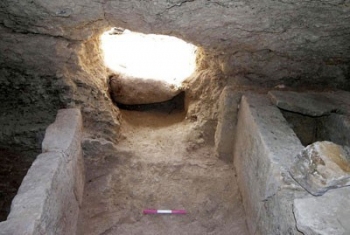
Idleb Antiquities Department has unearthed a Roman-era cemetery dating back to the 3rd century AD in al-Massasia Valley, north of Darkoush town, in the northern Province of Idleb (Northern Syria).

Head of the Syrian Archaeological Excavations Department Musstafa Kaddour said that the cemetery consists of three sarcophaguses, two of them are two-meter long by half a meter wide and another smaller.

All were covered with stone slabs inside the cemetery.

Excavations indicate that the cemetery belongs to one family as many clay and glass jars and some precious stones were discovered.

A flat seal which belongs to the cemetery’s owner was also found.

Darkoush is a very important tourist site in Idleb Province. It contains a number of archaeological monuments in addition to a Roman bridge over River Orontes.

via Roman Tomb Unearthed in Northern Syria | Global Arab Network .