Angelika Franz sports a very nice ivy of Dionysus around her arm:
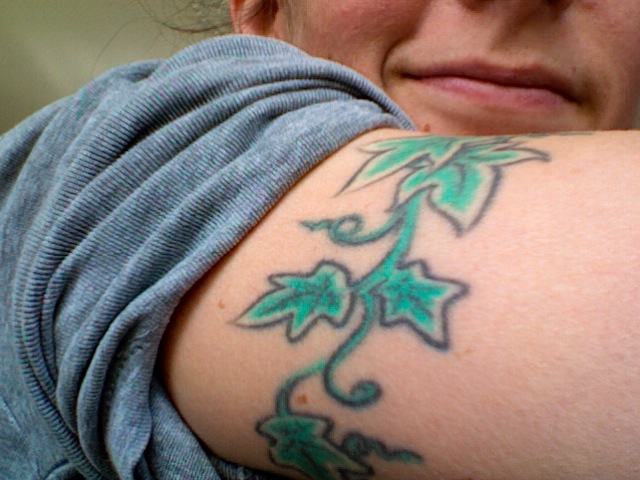
As Dr Franz notes, she got her ink before she was aware of the ‘ptolemaic context’ of ivy tattoos (i.e. that Ptolemy IV had an ivy-leaf tattoo as well) …
quidquid bene dictum est ab ullo, meum est

Angelika Franz sports a very nice ivy of Dionysus around her arm:
As Dr Franz notes, she got her ink before she was aware of the ‘ptolemaic context’ of ivy tattoos (i.e. that Ptolemy IV had an ivy-leaf tattoo as well) …
From Caroline Lawrence’s Roman Mysteries blog:
Are you a budding young writer?
Could you create the next Flavia Gemina or Falco?
Well, here’s your chance.
Burgess Hill School presents an annual writing competition now in its third year: THE GOLDEN SPONGE-STICK COMPETITION.
This global competition is now open to all UK and International school & college students. [more]
Here’s one Tim Parkin (and others) and I have been chatting about on Facebook … AFP via PhysOrg:
Archaeologists unearthed a Roman bust from the 2nd century AD hailed as the most important archaeological find of the last 50 years in Albania, experts said Friday.
“It is an exceptional discovery, the most important in the last 50 years in Albania because the bust is still intact,” French professor Jean-Luc Lamboley, who led the dig at Apollonia with Albanian archaeologists, told AFP.
Experts say the bust of an unknown athlete found at the Apollonia site, some 120 kilometers (75 miles) from Tirana, was of a remarkable quality.
Apollonia is one of the biggest archaeological sites in Albania and the fact that no modern town was built on its ruins makes for excellent excavating conditions.
The team of French and Albanian archaeologists digging at the scene are studying how Apollonia evolved from a Greek colony founded in the 7th century BC to a Roman settlement in the 3rd century AD.
“This spans a thousand years of history and we can study here how the classic Greek civilisation was transmitted, evolved and enriched in Roman times,” Lamboley said.
“For security reasons the bust was moved Friday to the Tirana archaeological museum as the Apollonia museum still has no security system in place,” the French expert added.
After the fall of communism in the early 1990s and following public unrest in 1997 several art works were stolen from Albanian museums probably to be sold to foreign art lovers at very high prices.
… the original AFP item (via Google and likely short-lived; no photo):
In any event, the PhysOrg piece is accompanied by a photo:
I tracked down another photo at Balkan Insight:
… which is interesting, because that second one doesn’t seem to be the same as the first one at all (perhaps this is a case where an indefinite article became definite in translation; maybe it’s just the angle of the photo). In any event, assuming that the first photo is the one that is being ‘hailed’, what Dr Parkin (and others) and I have been struck by is how ‘perfect’ this bust seems to be, despite having been buried for however many years. The nose, hair, and everything else seems undamaged and really isn’t typical of what tends to emerge from archaeological sites.
That said, I believe this must be the same site where Jack L. Davis and the University of Cincinnati was digging a few years ago (see also this earlier post) At one point, road construction threatened it … not sure how long the French have been involved there.
ADDENDUM (an hour or so later): Dorothy King notes the similarity to an item in the Shelby-White Collection which graced an exhibition catalog a while back (the image is via the Looting Matters blog):


ante diem xiii kalendas septembres
Remember that claimed brothel site with the 97 infant burials from the Yewden Villa in Hambleden? Here’s an incredibly interesting followup:
ARCHAEOLOGISTS investigating a mass burial of 97 infants were ‘horrified’ to find what they believe to be the skeleton of a dismembered child.
Chiltern Archaeologists suspect the site in Hambleden could have been a Roman brothel – where unwanted babies were systematically killed.
Dr Jill Eyers, who lives in Lane End, said the group has discovered cut marks on the bones of one of the babies.
She added: “These were knife marks and would represent a dismembering of this infant. We are horrified to say the least and are now about to closely check all other infant skeletons.
“If dismembered this could be signs of a ritual activity at this site. This is turning more sinister by the minute.”
Dr Eyers said ritual activity was not unusual for Roman Britain, citing a ‘head cult’ which was present in St Albans in Hertfordshire.
The group has been carrying out tests on excavation finds from 1912 at the Yewden villa.
An examination of the remains, which were rediscovered in boxes kept at Buckinghamshire County Museum, revealed the babies died at 40 weeks gestation.
A BBC documentary set to air on August 19, called ‘Digging for Britain’, will feature the Hambleden discoveries.
Presenter Alice Roberts was so enthused by the project that she has volunteered to join the Chiltern Archaeology team.
via: Skeleton of ‘dismembered’ child discovered by Chiltern Arcaeologists | Bucks Free Press
It’s unfortunate that we’re not given more details about where these purported cut marks were. It’s worth pointing out in this context that child sacrifice was not unknown in Roman Britain, e.g.:
In a few cases, evidence seems to point towards child sacrifice. At the temple at Springfield, Kent, excavated in the 1960s, foundation sacrifices of paired babies were found at all four corners of the temple. The burials took place at different times, indicating that the practice was repeated as the temple was extended. Similarly, excavations in the 1970s in the centre of Cambridge included a subterranean shrine and ritual shafts, of which no fewer than 12 contained newborn babies in baskets, several of them buried with small dogs. The shafts seem to have been left open for about 200-300 years.
via: Allison Taylor, “Burial with the Romans”, British Archaeology
Clearly this is still a developing story … we’ll see if they still cling to the ‘brothel’ theory …

 rogueclassicism