
Not sure the two ancient folks who made this list (Pythagoras and Empedocles) cross that line, really, but that’s a philosophical discussion more appropriate for a discussion over coffee and/or wine:
Month: September 2011
Classical Ink VI (I think)
We haven’t had an installment of Classical Ink for a while, but Angelika Franz (who sports her own Classical Ink), spotted some Horace-inspired body art on a lifeguard and got his permission to post the photos:

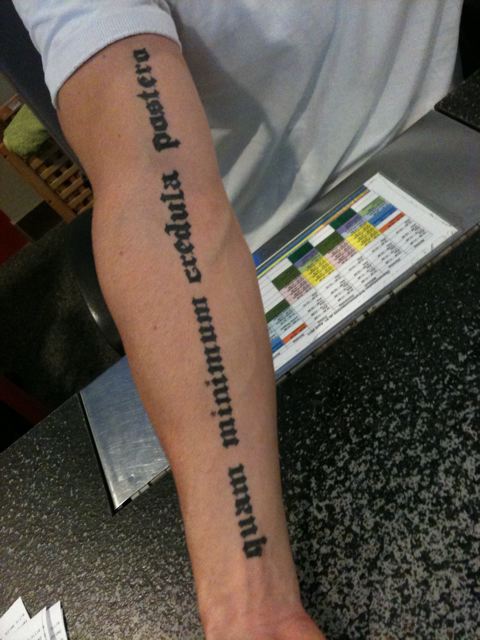
As always, feel free to send along your own photos of Classically-inspired body art … if they are, er, appropriate we’ll help you show them off to the world!
Idiots Damage Roman Monuments
Not sure if the headline which accompanies most versions of this is a remember-455-pun, but here`s the BBC version:
Three historic monuments have been attacked by vandals in the Italian capital, Rome.
In the first attack, a man was caught on security cameras chipping two pieces off a marble statue on a fountain in the Piazza Navona.
Hours later tourists watched as a man threw a rock at the famous Trevi Fountain in the centre of the city.
Police then said they caught an American student scaling a wall of the Colosseum to chip off pieces of marble.
SouvenirsThe fountain in the Piazza Navona is a 19th Century reproduction of a much earlier group of statues – now in a museum for safekeeping. It was not seriously damaged.
Police say the attacker could be the same individual who threw the rock at the Trevi monument – of Three Coins in the Fountain movie fame.
He missed, but his image was also captured on a security camera.
Police said the American student caught scaling the wall of the ancient Roman amphitheatre had been trying to chip away pieces of travertine marble to take home as souvenirs.
Rome’s fragile art heritage is under attack by a new army of vandals – the name originally given to the invaders who first sacked the city and destroyed many of its monuments 15 centuries ago.
Part of an Egyptian obelisk brought to Rome 2,000 years ago has just been covered in graffiti.
Despite the installation of 1,200 security cameras in central Rome and more frequent police patrols, protecting the Italian capital’s artistic treasures is proving an increasingly difficult task in an age of mass tourism and government budget cuts.
We won`t get into a discussion of how much/little damage the Vandals did back in 455, but, taking this to an entirely different level, if native Italians are involved, I wonder if a certain politician`s recent statements have finally caused some of them to be totally ashamed of their heritage …
Major Punic War Find Off Sicily!!
… and where is the major media coverage? Not sure … this comes from the relatively ‘local’ Keysnews (Florida):
For thousands of years the remnants of the final battle of the first Punic War lay undisturbed off the coast of Sicily, until last week when a Stock Island-based research firm raised artifacts from the seafloor that historians say provide clues as to how the largest conflicts in antiquity were waged.
Historians, divers, scientists and archaeologists with the nonprofit RPM Nautical Foundation raised helmets and vessel-battering rams used during a battle between Roman and Carthaginian forces in 241 B.C., a sea battle that contributed to the Romans achieving empire status and dominion over the then-known world.
It is considered the first-ever such find, and the discovery off the Egadi Islands is propelling the Shrimp Road nonprofit to major league status among academics worldwide. The organization was set up to operate exclusively for charitable, scientific, literary and educational purposes, not treasure hunting.
The excitement of the find was not lost on RPM Nautical archaeologist Jeff Royal, who spoke to The Citizen via phone Thursday aboard the foundation’s multimillion-dollar research vessel Hercules, ported in Malta. The 120-foot boat and its $1 million-plus remote operating submersible is fitted with some of the latest computer, mapping and sonar technology that provides three-dimensional analysis for detecting wrecks and artifacts.
“Sea battles at that time were infrequent and we know the battle took place on March 22, 241 B.C.,” Royal said. “The rams have Roman and Punic writing. Going into this, there were five other known warship rams in existence from this era.”
RPM Nautical has doubled that figure by its recent find, but perhaps more importantly, the discovery puts events in context, which is rare, Royal said. Typically, helmets, tools, weapons and other such artifacts from ancient times are found by fishermen or exist alone in private collections, so it’s difficult for historians and archaeologists to glean fuller understanding of ancient events in a broad sense.
Thus far, researchers are still going over the artifacts and studying them, but Royal hopes the find will help historians to understand how supplies were shipped during wartime thousands of years ago.
“Nothing is definite yet; we just raised the latest ram this week,” Royal said. “But based on the timbers that fit into these rams, we believe the ships were much smaller than have been previously hypothesized. They were not these large, multi-deck vessels, but much more moderate in size.”
Researchers also are finding that the helmets they’ve found are similar to those used by Celtic armies, which apparently were being adapted by the Romans and Carthaginian forces, Royal said. That makes sense, because although the Carthaginians were the premier naval power of their time, their land armies were made up mostly of mercenaries, often from Celtic areas, Royal said.
Some of the artifacts already are at museums, and historians believe they can teach us not only about ancient warfare, but about the technology that went into building the ships and how trade routes, war and society all fit together more than 200 years before the birth of Christ.
More often than not in ancient times, the victors of battles would plunder their foes’ supplies and then dump or leave what they could not carry, sometimes offering them to the gods, Royal explained. Others would then scavenge the items over the years, but not so in marine battles.
“The site has gone undetected from scavengers, other than fishing nets, so we have a much better context of all these items and what the ship was carrying,” Royal said.
The news of the find comes just weeks after the foundation discovered a well-preserved wreck of a Roman cargo ship off the coast of Albania dating to the 1st century B.C. That site contained some 300 wine jars, known by their Greek name of amphoras, that are providing insight into trade routes between western and eastern Mediterranean Sea-based civilizations.
As of Friday, researchers were still working on retrieving items from the Egadi Islands site and more news could be on the way, Royal said.
“I’m fortunate in the fact that our hard work paid off and that we’ve been able to experience the discovery and to publish the find,” Royal said. “It’s unique and one of the most significant finds in archaeology in quite some time.”
As noted in the article, this is the same firm that reported finding a shipwreck off Albania a week or so ago: Roman Shipwreck in Albanian Waters … and as can be seen from our coverage, it first appeared in an Iranian source, likely culled from from some European news agency, but it took almost a week to hit the rest of press (with more info … I really should update that post). As of this a.m., I don’t see this particular story anywhere except this local source. Perhaps the RPM folks need better channels getting the word out?
Emperors of Rome: Aemilian
Adrian Murdoch continues the series with a guy the Senate of Rome ended up hating just as much as Domitian:
 rogueclassicism