#Thelxinoe ~ Classics News for February 18, 2021

Hodie est a.d. XII Kal. Mart. 2774 AUC ~ 6 Anthesterion in the fourth year of the 699th Olympiad

In the News

In Case You Missed It

Classicists and Classics in the News

Public Facing Classics

Fresh Bloggery

Blog-like Publications

Fresh Podcasts

This rant was inspired by an unfortunately and timely experience in my own teaching. Have a listen, and a think. I only hope I’ve done this topic justice. (There’s a lengthy reading list for this episode on the website, to continue discussion of the topic.)

In this episode, we discuss Troy: Fall of a City episodes 4, 5, and 6, and how they handled THE ENTIRE PLOT OF THE ILIAD. Yes, in only three episodes of television. Spoilers: it was pretty bad. Feat. translation theory, Julia’s continued strong opinions about Achilles, and Allison’s favourite piece of pottery!

Dramatically placed on a plateau with drops of 400m to the east and 90m to the west, Masada translates from Hebrew as fortress. It became just that when Herod the Great built a magnificent palace complex upon it between 37 and 31 BC, the remains of which are in fantastic shape today. But the site isn’t only notable for its connection to the bible-famed King of Judaea. Masada was also the stronghold of some of the survivors of a Jewish revolt and, in response, the locus of a Roman siege in the early 70s AD. For this first of two parts, Tristan, from our sibling podcast The Ancients, spoke to Jodi Magness from the University of North Carolina. Jodi co-directed the 1995 excavations of the Roman siege works at Masada, and in this episode, she tells Tristan about the archaeological findings at the site, many of which are still visible to the untrained eye.

Palmyra features in headlines today as a casualty of IS destruction, but during its heyday it was a monumental city set on an oasis in the Syrian desert. First mentioned in the second millennium BC, it gained wealth from the caravan trade which moved goods across the desert. What makes it unique, however, is not its wealth but its multicultural, multilingual nature. Buildings in Palmyra featured inscriptions in Greek and Palmyrene and, after becoming a subject of the Roman Empire in the first century AD, Latin. To find out more about this beautiful site, Tristan spoke to Ted Kaizer from Durham University. Ted is Senior Lecturer in Roman Culture and History, and takes us through the growth of Palmyra, its position on the crossroads of cultures and whether or not it was really subject to Roman rule.

The living at Hadrian’s Wall wasn’t as austere as you might think for those stationed there–especially in the beginning. Merchants flocked from all over the Empire to sell their wares to soldiers with regular paychecks. But conditions changed drastically in the decades and centuries after Hadrian died. New Emperors–Antoninus Pius, Diocletian, Septimius Severus, and others–would all leave their mark on the Wall and its territory. This week, we’re going to talk about what became of the Wall—and those who lived there—after Hadrian’s death.

The First Decemvirate was a big success, so much so that Rome opts for a Second Decemvirate! The decemvirs were popular figures in Rome and during 451 BCE they produced the Ten Tables. This initial set of law codes was positively received by the population, but there was something missing… MORE LAWS! But it isn’t too long before some red flags appear… Episode 110 – The Mask Comes Off Wait a Second… Decemvirate Appius Claudius campaigns hard to get himself re-elected, along with some of his patrician buddies. There are also some new and unusual names that appear in the list for the Second Decemvirate – we might have some plebeian magistrates on the team. Gasp! As soon as they are confirmed in their positions, the charismatic, approachable and charming Appius reveals his true self and his real intentions. Tyranny! Life in Rome quickly becomes extremely unpleasant for everyone as the decemvirs and their thugs flex their muscles, but it’s especially tough if you are one of the less privileged persons in the populace. This a dark time for Rome. Join us to find out how they deal with the infamous Second Decemvirate!

Fresh Youtubery

Book Reviews

Dramatic Receptions

Online Talks and Professional Matters

Alia

‘Sorting’ Out Your Day:

Today on the Etruscan Brontoscopic Calendar:

If it thunders today, it portends a heavy wind and the appearance of boils on humans.

… adapted from the text and translation of:

Jean MacIntosh Turfa, The Etruscan Brontoscopic Calendar, in Nancy Thomson de Grummond and Erika Simon (eds.), The Religion of the Etruscans. University of Texas Press, 2006. (Kindle edition)

#Thelxinoe ~ Classics News for February 17, 2021

Hodie est a.d. XIII Kal. Mart. 2774 AUC ~ 5 Anthesterion in the fourth year of the 699th Olympiad

In the News

In Case You Missed It

Classicists and Classics in the News

Public Facing Classics

Fresh Bloggery

Blog-like Publications

Fresh Podcasts

Peter Reavill joins us to talk all about metal-detecting, the Treasure Act and the British Library’s Portable Antiquity Scheme.

In this week’s episode Zeus sends Hermes to demand that the fair-tressed Calypso release weeping Odysseus (still with us?) after seven years of island imprisonment. No amount of organic oat hair milk can cheer her, the added shine, volume, and bounce notwithstanding. We look at books 5-8, with Odysseus and Nausicaa having a go at jarts, while Demodocus (Homer himself in disguise?) plucks out the hottest hits of the Mycenaean Era. Odysseus weeps (again!) and drops some layered metanarratives, but not before the white goddess offers him a magic, life-saving pair of trousers in the middle of a shipwreck. 

Dion was born in Syracuse and became a trusted advisor to the city’s tyrant. But Dion’s relationship with the next tyrant was no so hot, and after falling out, Dion became a reformer. As a student of Plato, he saw an opportunity to implement the philosopher’s ideal Republic, and he seized the moment to try.

Xiaoli introduces us to silver in the Sumerian city of Umma. She explains where it came from and how people got hold of it. Who was able to use it and what for? She tells us how we might understand whether it could be called money. And explains the…

You are probably familiar with the term decimation. The word is usually used in English to mean “to cause great destruction or harm”. However, to ancient Rome, the word had a very different and very specific meaning. It was one of the most devastating and brutal forms of punishment that the military could inflict.

Fresh Youtubery

Book Reviews

Online Talks and Professional Matters

Alia

‘Sorting’ Out Your Day:

Today on the Etruscan Brontoscopic Calendar:

If it thunders today, it portends a very fruitful summer.

… adapted from the text and translation of:

Jean MacIntosh Turfa, The Etruscan Brontoscopic Calendar, in Nancy Thomson de Grummond and Erika Simon (eds.), The Religion of the Etruscans. University of Texas Press, 2006. (Kindle edition)
Conversation Classics: Joel Christensen on Athenian Politics and the U.S.

Ancient Greek desire to resolve civil strife resonates today – but Athenian justice would be a ‘bitter pill’ in modern America

[originally published December 15, 2020]

Increasingly, Americans seem to have irreconcilable differences over the pandemic, the economy – even the result of the 2020 election.
Caroline Brehman/CQ-Roll Call, Inc via Getty Images

Joel Christensen, Brandeis University

America’s divisions are old. Politically and socially, they are rooted in grudges and ideological vengeance that goes back generations, to the New Deal era, when government vastly expanded its role in people’s lives. Economically and morally, the nation was founded on the sins of slavery and Indigenous genocide.

The consequences of this past are still present: The COVID-19 pandemic has been far harder on Native populations, Black communities and the poor.

Long-lasting civil strife isn’t new. Greek mythology, my field of academic scholarship, is rife with cycles of vengeance that threaten to obliterate society. Two of the most famous works of Greek literature, “The Odyssey” and the “Oresteia,” are stories of seemingly eternal divisions that end with opposing factions coming together.

In the anxiety of the postelection period, I am turning to these stories in hopes that the ancient Greeks have wisdom to share, as they have on plagues, mourning the dead and “alternative facts.”

How did the conflict-filled Greek society find its way forward?

Forgetting and forgiving?

One of the poems I looked to is Homer’s “Odyssey.” This epic poem, composed before the fifth century B.C., tells the story of a Trojan War veteran, Odysseus, whose return home takes 10 years. When his journey finally ends, he finds his wife, Penelope, besieged by suitors hoping to wed her and take over his position as ruler of the city of Ithaca.

Most people who read the “Odyssey” usually remember it as ending with the joyous reunion of Odysseus and Penelope, but the epic’s final book actually ends with bloodshed: Odysseus kills his wife’s suitors.

Oil panting of a shirtless man in armed battle with other men
Odysseus and his son Telemachus kill the suitors, as painted by Thomas Degeorge in 1812.
Thomas Degeorge via Wikimedia Commons

After the slaughter, their survivors gather to debate whether they should kill Odysseus in return. Slightly more than half the family members decide not to pursue vengeance, but the rest arm to face Odysseus.

Just as the sides are about to clash, Zeus sends the goddess Athena to stop them. She declares they should forget the slaughter, recognize Odysseus as king, and “let wealth and peace be enough.”

No one in this scene questions the ancient custom of vengeance; people expect that the murder of a loved one must be paid back with murder. The poem’s ending implies the only way to stop cyclical violence is for those on one side to simply forget how they’ve been wronged in exchange for the promise of peace and prosperity.

A split vote

The Greek playwright Aeschylus also recognizes vengeance as a human institution in “Eumenides,” the final play of his three-part “Oresteia” – but sees a different way to resolve it.

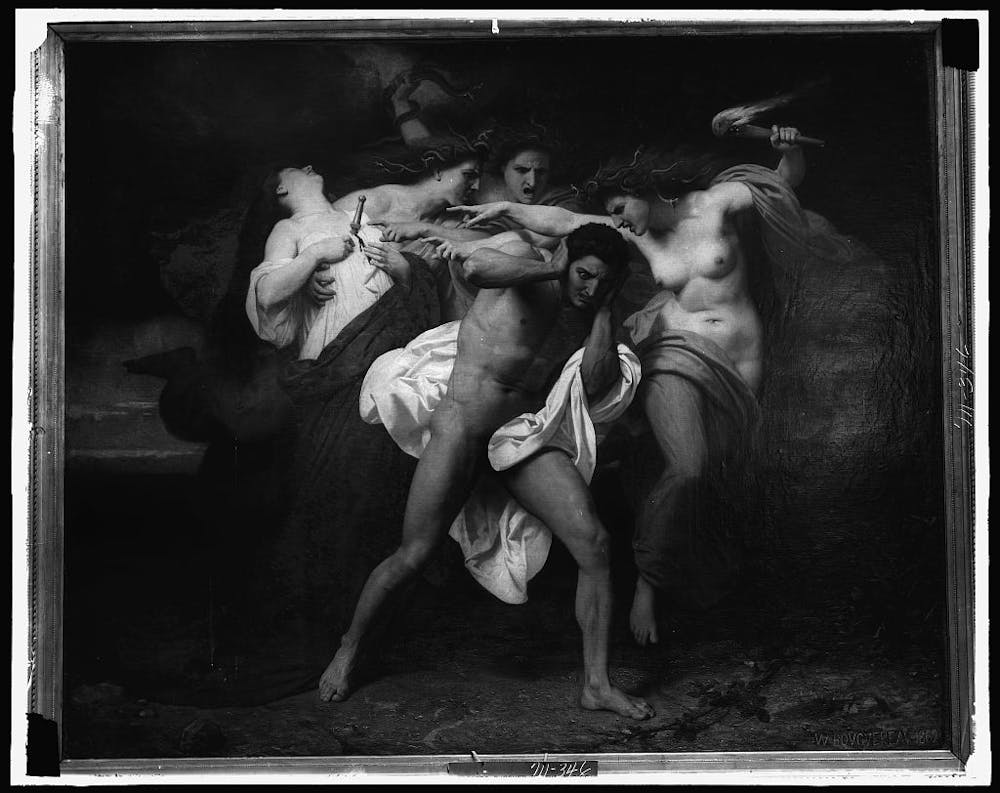
The “Oresteia” tells the story of Orestes, whose father, Agamemnon, returned home after the Trojan War and was murdered by his mother and her lover. The god Apollo orders Orestes to avenge his father’s death by killing his mother. He does this, but the Furies – earthbound goddesses of vengeance – curse him with madness for the murder. They pursue him until he takes sanctuary in Athens.

Painting of a man assaulted by flying beings
Orestes pursued by the Furies, as painted by artist William Adolphe Bouguereau in 1900.
PICRYL/Detroit Publishing Co.

This is where Aeschylus’ “Eumenides” picks up Orestes’ story. In Athens, in an effort to resolve this cycle of vengeance, Athena establishes a trial by jury. After both the Furies and Apollo make their cases about whether or not Orestes should be punished, the 12-member jury comes up deadlocked – a split representing the divided opinions of the Athenian people.

Again it is Athena who resolves this strife. She casts a tie-breaking vote for Orestes’ acquittal.

The play finishes with Athena negotiating with the angry Furies. The Furies will be allowed ritual worship and a home within the boundaries of the city, Athena decides, but they can no longer enforce vengeance. That job belongs to the state, not its citizens.

Athena finds a place for the Furies, even if what they represent is no longer welcome. Today that compromise might be called restorative justice, a process aimed at bringing perpetrators* back into the fold but ensuring they respect the prevailing values of that society.

Stasis

Aeschylus’ “Oresteia” anticipated a real-world challenge Athens would face a century later, after war with Sparta and the restoration of democracy in 403 B.C.

The year before, Sparta had conquered Athens and instituted an oligarchy – literally, the “reign of the thirty” – during which many citizens harmed one another. When the Sparta-supported tyrants were expelled, Athenians swore an oath “not to speak ill to anyone of the things that had happened.”

Bad memories were not erased, of course, but the losers were granted amnesty and the public airing of past grievances was forbidden. For Athens’ leaders, stability depended on integrating formerly warring factions back into the same society. They demanded that residents prize peace over vengeance, and perhaps even over justice.

That’s a bitter pill to swallow. So is Homer’s solution to cyclical violence: One side overpowers the other, then demands the survivors forget the harms they suffered.

A god and a man wearing a mask speak in front of a columned building
Orestes seeks Apollo’s help in the 2014 MacMillan Films production of the ‘Oresteia.’
MacMillan Films

These are two different strategies for resolving conflict, but in the ancient Greek language, the same word describes the endings to both the “Eumenides” and the “Odyssey”: stasis.

In English translation this noun is commonly used to mean “standing still” or “balance,” but in ancient texts – not just the “Odyssey” and the “Oresteia” but also in Plato, Thucydides and beyond – the most common meaning of “stasis” is “civil strife.”

The modern United States, like ancient Greece, is defined by stasis. On issue after issue, a stubborn subsistence of equal and opposite factions arises: the pandemic, climate change, the result of the 2020 election.

Greek myth and history teach that societal divisions such as these perpetuate themselves, and will continue, violently, unless something dramatic happens. This, I finally understand after a half-century of studying Greek, is why stasis means both “balance” and “strife.”

It’s a revelation that brings no solace. Homer and Aeschylus have the divine Athena to write their endings for them. No gods are conspiring above to free American society from its painful paralysis.The Conversation

Joel Christensen, Associate Professor of Classical Studies, Brandeis University

This article is republished from The Conversation under a Creative Commons license. Read the original article.

Conversation Classics: C. Michael Sampson on P. Sapph. Obbink

Lovers of Sappho thrilled by ‘new’ poetry find, but its backstory may have been fabricated

[originally published February 11, 2021]

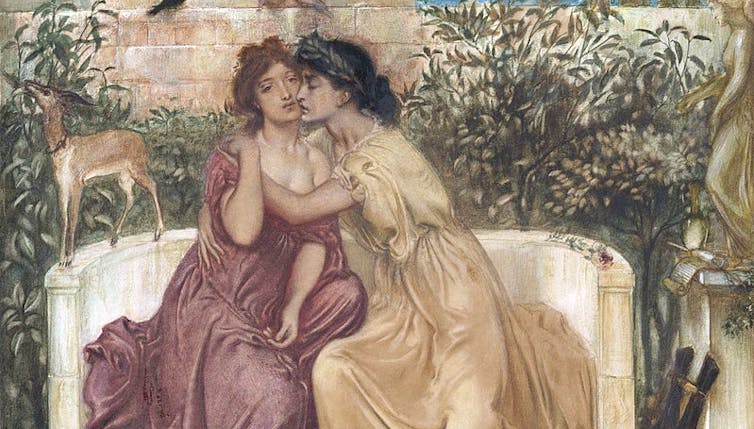
Fragments of Sappho? The 2014 discovery was of five stanzas of one poem and portions of a second.
(‘Sappho and Erinna in a Garden at Mytilene,’1864, by Simeon Solomon)

C. Michael Sampson, University of Manitoba

The Museum of the Bible in Washington recently announced it has returned 5,000 fragments of ancient papyrus to Egypt. Among them are fragments of poetry by the ancient Greek poet Sappho the museum had acquired in 2012.

The announcement follows years of questions about the origins of the fragments, and the origins of a fragment from the same papyrus roll that came to public attention in 2014.
Scholars and literary critics were abuzz after The Daily Beast reported on Jan. 28, 2014, that papyrologist Dirk Obbink of the University of Oxford had identified two new poems by Sappho.

Sappho of Lesbos is one of the earliest Greek lyric poets, famed in antiquity for the polish and elegance of her verse.

Today, Sappho’s legacy extends beyond poetry. Her expressions of female same-sex desire (“… sweat pours down me / a tremor shakes me …”) have made her an icon for some LGBTQ+ communities.

Little of Sappho’s poetry survives, and what does is fragmentary. Obbink’s discovery was remarkable because it preserved the final five stanzas of one poem and portions of a second, making it one of the longest continuous sequences of Sapphic verse.

News of the discovery made international headlines, but serious questions about the papyrus’s origins, acquisition and ownership history — its provenance — did not. Provenance is important for establishing the authenticity and legal status of antiquities.

In the fall, I published new research into a digital sales brochure produced by the auction house Christie’s. My research calls into question the published accounts of the papyrus’s provenance. I believe the accounts of the Sappho papyrus’s origins that Obbink published were fabricated, and that its owner had access to Obbink’s unpublished research and sought to capitalize upon it.

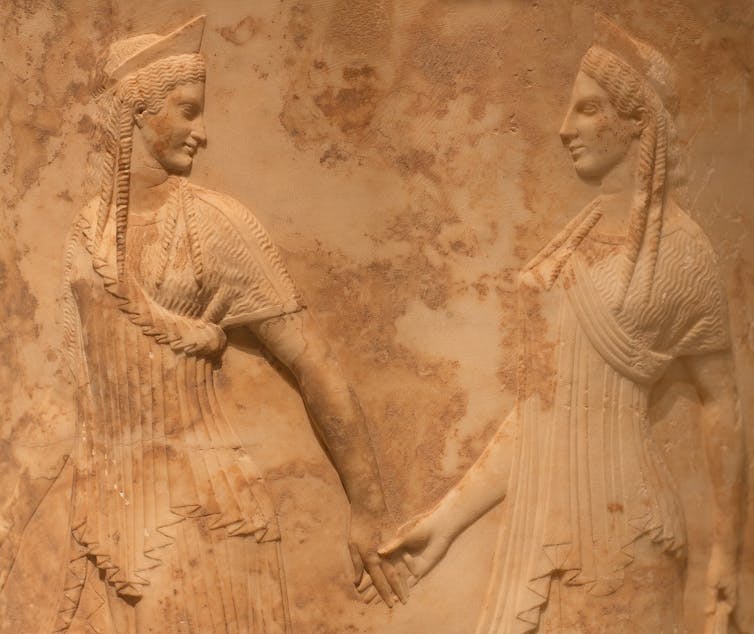
One woman leading another by the hand.
Little of Sappho’s oeuvre has survived, but the poet continues to stir people’s imagination.
(Shutterstock)

Legal, ethical concerns

Papyri originate almost without exception in Egypt. In 1983, the Egyptian government passed legislation prohibiting the domestic trade in antiquities, establishing definitively that the country’s archeological heritage is state property.

To combat looting and the illegal antiquities trade, more than one scholarly association’s ethical guidelines cite the 1970 UNESCO Convention on Cultural Property in condemning the study of newly surfaced antiquities. According to those guidelines, scholars shouldn’t authenticate or publish objects that left their country of origin illegally or prior to the 1970 convention.

How and when the Sappho papyrus left Egypt are pressing legal and ethical questions.

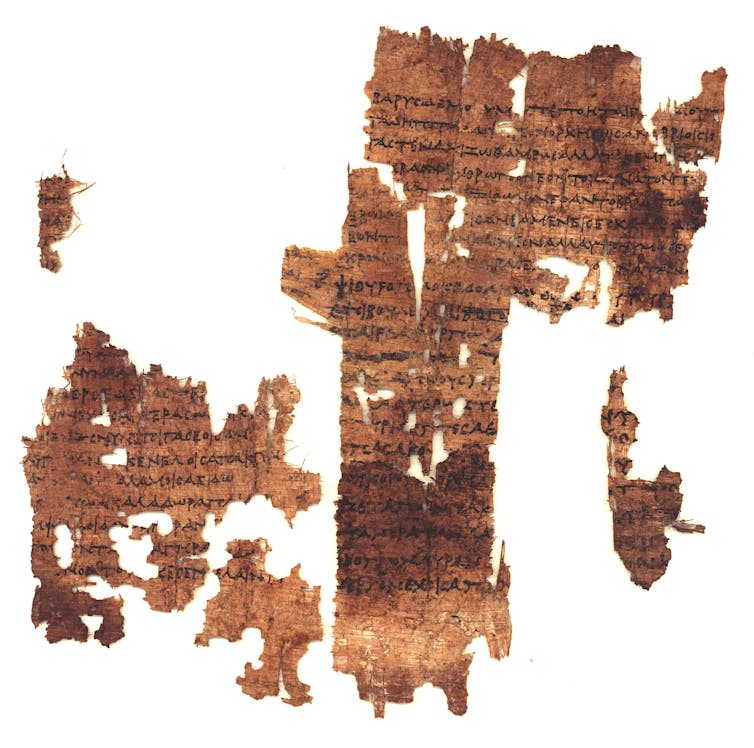
Fragment containing Sappho poetry discovered in 2004.
P.Köln 11.429, containing poetry by Sappho discovered in 2004.
(Institut für Altertumskunde an der Universität zu Köln), CC BY

The Daily Beast linked to an unpublished, draft article Obbink briefly made available on a blog.

Regarding the papyrus’s origins, it said only that it was newly uncovered and in the private collection of an anonymous owner.

Scholarly questions

Historian and broadcaster Bettany Hughes soon reported in London’s Sunday Times that Obbink discovered the papyrus after prising it from mummy cartonnage — the casing of an Egyptian burial similar to papier-mâché.

Obbink corroborated its origin in mummy cartonnage in a Times Literary Supplement article. Hughes stated that the papyrus’s “provenance was obscure” and that it “was originally owned, it seems, by a high-ranking German officer.” Obbink said only that its provenance was both documented and legal.

Scholars questioned the mummy cartonnage narrative because the practice of recycling papyri in the manufacture of cartonnage ceased long before the papyrus was copied.

When Obbink’s scholarly paper was finally published on April 10, 2014, it didn’t discuss provenance.

A year later, Obbink revised the papyrus’s origin story at a scholarly conference on Jan. 9, 2015. He said it was recovered from an unpainted fragment of papyrus cartonnage that was purchased at a 2011 Christie’s auction. He did not specify when the recovery took place.

The Christie’s brochure

After Obbink’s presentation, Christie’s produced a 26-page brochure advertising the new Sappho papyrus for private sale. It circulated exclusively among Christie’s clientele, and was unknown to scholars. I received a digital copy from Ute Wartenberg Kagan, a scholar of ancient Greek coinage, which she obtained from a client of Christie’s. The brochure contained photographs captioned as “the recovery of the Sappho papyrus.” When I inquired about the brochure, Christie’s responded: “We cannot discuss private sales activities unless authorized to do so.”

I hoped to learn when the files had been created and modified, and to scrutinize what the images depicted more closely. I ran a computer program that examined the brochure and its JPG files, and was able to extract the metadata associated with them.

I concluded that the photos presented in the Christie’s brochure were staged and don’t depict the extraction of the Sappho papyrus. In my view, the photos document the story about mummy cartonnage that Hughes and Obbink wrote about.

One photo includes a panel of cartonnage I have identified as previously belonging to a high-ranking German officer, as was mentioned in Hughes’s report. The story was never plausible — scholars questioned it and Obbink subsequently revised it. But the brochure, I believe, bears witness to the original narrative.

I also concluded that the anonymous owner of the papyrus had access to Obbink’s unpublished research, and undertook to propose the papyrus for private sale almost immediately after Obbink presented the revised story at the scholarly conference Jan. 9, 2015.

The brochure’s “Provenance” section cited not Obbink’s January presentation but a scholarly article that wasn’t published until June 15, nearly four months after the creation of the brochure.

In response to an article in The Guardian that reported on my research, Christie’s said it: “… would never knowingly offer any works of art without good title or incorrectly catalogued or authenticated. We take our name and reputation very seriously and would take all necessary steps available to address any situation of inappropriate use.”

Scholarly ethics and antiquities

Scholars are wary of the antiquities market because academic appraisals add to objects’ commercial value, which can incentivize looting and the illegal trade in antiquities. Scholarship also offers legitimacy.

For this reason, scholars must scrutinize new discoveries carefully before conducting or publishing research, and present their findings transparently. When the media reports on preliminary research, it is important to convey its preliminary nature.

Last April, an Oxford student newspaper reported that Obbink had been arrested Mar. 2, 2020, for “for alleged theft of ancient papyrus from the Sackler Classics Library in Oxford.” Obbink has denied those allegations.

Questions remain about the 2014 Sappho papyrus. The Museum of the Bible’s recent announcement acknowledges the “insufficient reliable provenance information” of its papyri — including its Sappho fragments. The chapter about the museum’s Sappho papyri has concluded, but the status of the Sappho papyrus Obbink discovered is uncertain. The papyrus’s present owner is anonymous and its location is unknown.The Conversation

C. Michael Sampson, Associate Professor of Classics, University of Manitoba

This article is republished from The Conversation under a Creative Commons license. Read the original article.

#Thelxinoe ~ Classics News for February 16, 2021

Hodie est a.d. XIV Kal. Mart. 2774 AUC ~ 4 Anthesterion in the fourth year of the 699th Olympiad

In the News

Classicists and Classics in the News

Greek/Latin News

Public Facing Classics

Fresh Bloggery

Blog-like Publications

Fresh Podcasts

We talk about the etymology of “Etymology” itself, and then discuss the basics of historical linguistics, including Grimm’s Law, Verner’s Law, and more. We also talk about Isidore of Seville, the etymological puns of Latin poets, and the way Mark does his research for his videos.

Sodales de ingenio vel de indole aut intro aut ‘extro’ versa loquuntur.

Hermes flies Perseus to the Island of Cisthene, where the Gray Sisters live. They’re three very old ladies — how hard could it be for Perseus to get what he needs? Plenty hard, as he quickly finds out.

Cleopatra was a boss lady who loomed large during her lifetime as one of the most successful monarchs of the East. But there were other royal women in the countries around her, suffering the same trials. Two of them – Alexandra and Mariamne of Judea – became friends with Cleopatra. This is the story of that friendship, and these women’s lives. It’s also the story of one of Cleopatra’s greatest rivals and one of the hottest messes in the ancient world: Herod the Great.

Fresh Youtubery

Book Reviews

Online Talks and Professional Matters

Alia

‘Sorting’ Out Your Day:

Today on the Etruscan Brontoscopic Calendar:

If it thunders today, it portends good things for the common people but discord for those in power.

… adapted from the text and translation of:

Jean MacIntosh Turfa, The Etruscan Brontoscopic Calendar, in Nancy Thomson de Grummond and Erika Simon (eds.), The Religion of the Etruscans. University of Texas Press, 2006. (Kindle edition)