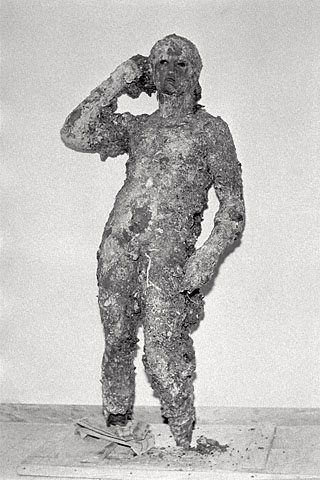
A statue, believed to be the ancient Greek goddess Demeter, has been unearthed at an illegal excavation in Simav, western Turkey. The statue, weighing in at 610kg and standing 2.8 meters tall, was discovered by two Turks, Ramazan C. And Ismail G, 26 and 62 years old respectively, who are alleged to have been conducting illegal excavations in the wider area where the statue was found. The two men were taken into custody by the Turkish police and sent to court.
The head of the statue and the altar, missing during the raid, were later found in a house in the city centre.
In Greek mythology, Demeter, one of Zeus’ sisters, so the story goes, was the goddess of agriculture, nature, abundance and seasons, and mother of Persephone, wife of Hades.
In our previous installment(s) on the so-called “Apollo” of Gaza, we primarily questioned the apparently ever-developing story of the find as told by the fisherman of many names as reported by various news outlets. Now it is time to look at the statue itself and see if it’s possible, from the information we have been given, to discern whether this thing is a genuine antiquity or a fake.
At the outset, though, we should deal with another question related to provenance, specifically whether it was actually found in the sea or not. Despite the engaging story told by the fisherman, opinions on this seem to be divided. Our first opinion comes from the oft-quoted Jean-Michel de Tarragon of the French Biblical and Archaeological School of Jerusalem, who seems to be one of the few academics consulted on the issue by the press:
The apparently pristine condition of the god suggested it was uncovered on land and not in the sea, he said, speculating that the true location of where it was unearthed was not revealed to avoid arguments over ownership.
“This wasn’t found on the seashore or in the sea … it is very clean. No, it was [found] inland and dry,” he said, adding that there were no signs of metal disfigurement or barnacles that one normally sees on items plucked from water.
The Tourism Ministry folks are totally buying into the found-in-the-sea story (which can be spun in numerous ways, depending on how conspiracy-minded one is):
“We are not denying that the statue was found in the sea — as a matter of fact, that is a very authentic and real story,” Al-Burch said.
Jawdat Khoudary, who was one of the first ‘knowledgeable’ folks to observe the statue provides an interesting argument for it being found in the sea:
There’s no doubt the statue came from the sea, Khoudary says. Sitting in the lobby of his hotel on a December evening, he wraps his portly frame in a wool robe and warms his neck with a black-and-white keffiyeh, the emblem of late Palestinian leader Yasser Arafat. In his left hand he works a silver coin purchased minutes earlier from two beachcombing treasure hunters. One side of the coin, encrusted with black sand, bears the outline of a face. Khoudary says it’s Alexander the Great, who conquered Gaza in 332 B.C. en route to taking Egypt.
Khoudary lays out his grim reasoning as the lights go off and on, a result of Gaza’s fuel shortage. “I know how they excavate in Gaza, it’s by shoveling,” he says, making the motions of a mechanical backhoe with his hand. In his collection’s catalog, an entry for clay wine jars even lists “bulldozer trenches” as the method of discovery. Clandestine hunters usually dig until they hit something, a process that’s speedy but damages the finds. In the case of the bronze, however, “It’s not damaged,” he says. “It’s 100 percent from the sea.”
Not sure if we need to (cynically?) point out that the same logic could be used to suggest that the statue was never underground in the first place (i.e. It’s a fake).
The second ‘knowledgeable’ observer Bauzou disagreed, however (I’m still not sure of Bauzou’s first name):
Neither Humbert nor Bauzou believes Ghurab discovered the bronze underwater. “It does not come from the sea. It’s obvious,” Bauzou says. The giveaway, they say, is the lack of any sea encrustation or damage from hundreds of years underwater. Instead, they suspect the bronze came from a clandestine excavation somewhere on land. “This story has been fabricated to hide the real place where the statue was found so they can continue digging.”
To its credit, the lengthy Businessweek article (referenced above, of course) does try to weigh the apparent evidence for it not being found in the sea somewhat objectively:
It’s possible the fisherman’s story is an elaborate hoax. It is true the Apollo isn’t encrusted with barnacles, but not all submerged bronzes get crusty. Photos of the 1996 Croatian find and the 1964 Getty bronze show thick layers of sea growth, but the Riace bronzes from 1972 appear to have come ashore with skin as smooth as that of the Gaza bronze. It might be no coincidence they were found under similar conditions: in shallow water, partly buried in sand, by a swimmer.
Here’s the Croatian Athlete at the time of discovery(I have another post mentioning this one in another context … stay tuned; Sam Hardy’s article above has a different photo):
Department of Underwater Archaeology of Croatia, via UNESCO
… Here’s the Getty’s ‘Victorious Youth”
via the Getty
… Finally, one of the famous photos of one of the Riace Bronzes:
This one was all over the internet a short while ago; this copy comes from oldhistoricalphotos.com
This is possibly an important detail … if the “Apollo” of Gaza did actually come from the sea and came out looking, patina-wise, like the Riace Bronzes, then the frequently-mentioned concerns about its current condition probably are even more concerning now (given that we haven’t had any news reports of any conservation help actually being given). The CNN coverage of February 15 mysteriously downplayed the deterioration:
A green spot — a sign of decay — has formed on the leg of the statue, which is exposed to the air.
A (single?) green spot? Anyone who has seen any of the photos has seen a statue that seems to be suffering from the early states of ‘bronze disease’ (or something similar), which can be the result of emerging from the sea and being exposed to air, or it can be the result of highly humid conditions (which does appear to be the case in Gaza … check the weather network for today’s humidity there). It’s difficult to tell whether there has been any change as seen from the two previously-mentioned photos (taken perhaps two weeks apart):
A picture taken in Gaza on Sept. 19, 2013 shows a 2,500-year-old bronze statue of the Greek god Apollo discovered by Palestinian fishermen in August (Gaza’s Ministry of Tourism/AFP)
… but it seems noteworthy that the more recent one seems to come from a place which is likely air-conditioned, which would, in theory, slow down the progress of deterioration. Then again, the Businessweek article concluded thusly:
The Apollo is in a Hamas Interior Ministry office, somewhere in Gaza, being kept away from sources of humidity, he says. It is propped up in a corner.
In regards to condition, we should also draw attention to another photo that was making the rounds from the ‘Smurf blanket’ phase:
Rear view of the statue, via the BBC
What’s interesting in this photo is that the back of the statue (including the head)— which was, of course, in contact with the blanket/mattress and not really exposed to air — is largely free from any signs of the green patina. Does this give us an indication of the original condition? Or did moving it on and off the mattress do something to the patina (unlikely). If it does indicate the original condition, according to our timeline, all that green patina would have accumulated in less than a month and we can only hope that something more than ‘propping it up in a corner of an office’ is being done about it.
Outside of conservation issues, the statue itself raises a number of questions. A photo from the Palestinian Tourism folks which accompanied the Businessweek article (and appeared elsewhere) seems to touch on many of them:
Palestinian Ministry of Tourism and Antiquities via Businessweek, but it is also available elsewhere
A major item that has been bugging me from the outset is the reported weight of this thing: 450 kg/1000 pounds. Why does it weigh so much? Although it is roughly the same size (possibly a bit smaller), it is almost double what each of the Riace Bronzes weighs, and if it is the actual weight, it probably suggests a rather massive core, which certainly wouldn’t be in line with traditional statue construction methods of the time (as far as I’m aware).
The graphic marvels that the feet are intact, but what seems to be more interesting is that they are not only intact, but are attached to their original base. I’m sure someone can correct me on this, but finding bronzes of this size still attached to their base is pretty rare. I’d be very interested to know whether the base was cast with the feet or whether it was later attached.
Two other items on the graphic raise other questions. We are told that three fingers are missing — we know the fisherman had one, his “cousin” (or jeweller) had one too. How did the third go missing? And what happened to the thumb? We also wonder about the eye and are unsure whether it was always missing or was gouged out/fell out later (more on the surviving eye in a bit). In one of the news reports, it “sounds” like it was something that happened later, but that might be just one of those things that comes during the translation of an interview:
Ahmed Elburch, an official at the Hamas-run Ministry of Tourism and Antiquities in Gaza, says he last saw the statue in October. He was concerned about its condition, he says, as the colour appeared to be changing, and one of the eyes had been cut out.
That said, over the past few weeks a number of us (namely, Sam Hardy, Vernon Silver, Justin Walsh, and myself) have engaged in an on-again, off-again discussion of the statue on Twitter and much of what follows is the result of those discussions. Stylistically, as several, including Sam Hardy have noted the head of the statue seems to have great affinities with a head from Herculaneum, which includes the very interesting ‘dreadlocks’ hair treatment, although they seem a bit more ‘orderly’ along the brow (the photo, by the way, comes from an article by Carol Mattusch on early bronze statuary which is definitely an appropriate read for this: Changing Approaches to Classical Bronze Statuary)
via INAH … in the above-referenced article
The twisty curls also appear in another head from Herculaneum, albeit flatter and in a clearly non-Apolline context (as Vernon Silver reminded me). Here’s Ptolemy Apion in the Naples Museum:
via Wikimedia Commons
In passing, we should note that the condition of the ‘free’ curls on the Gaza example is probably one of the best bits of evidence that the fisherman’s story of the recovery of the statue (by the ‘cartwheel technique’) is less-than-truthful. I have a very difficult time believing that those curls would have survived recovery according to his description.
As long as we’re looking at the head, I’m wondering if I’m the only one who finds the face of the statue to be somewhat strange. In some of the photos, depending on the angle, it does seem to be a reasonable ‘Greek’ visage, but in others (especially straight on) it does not and is certainly not the ‘idealizing’ sort of thing one might expect. The aforementioned ‘bronze disease’ also has almost ‘outlined’ a certain part of the face, which makes it look like it was somehow attached to a faceless head. I’m honestly not sure if that is the case or if that’s just an illusion caused by the deterioration, but clearly it would be an oddity. Indeed, when I first saw the outline, it struck me that this looked more like the face of a Roman cavalry mask than anything else. Here are the “headshots” from the BBC:
via the BBC Magazine
Also worth noting about the head is that it really isn’t unusual that a bronze might have lost its inlaid eyes (which were usually made from glass paste or other materials). What is interesting here, however, is the one eye that remains in the head is apparently blue and made from some sort of stone (maybe; not sure if a trained ‘eye’ determined that or not).
The pose of the statue is one which comes close to many statue styled an “Apollo” or “Kouros” or “Ephebe” but the closest analog seems to be the so-called ephebe of Selinunte, now in the Palermo Museum (tip of the pileus to Justin Walsh and Adrian Murdoch for helping me track this one down, there’s a huge version of the photo if you click on it):
via trapani tourism
The Ephebe from the ‘House of the Ephebe” in Pompeii also seems to have affinities both in terms of height and pose, sort of (and we might wonder if the Gaza statue carried something in its now largely broken left hand, but seems to be the product of a more-talented artist:
via the Getty
Another stylistic analog, but again the product of a better artist, would be the somewhat smaller (1.15 m) Piombino Kouros, originally from Etruria but now in the Louvre (this is a cast from Cambridge’s archive):
from the Cambridge Casts Archive
Perhaps related to this notion that the Gaza “Apollo” is the product of a less-talented artist is an observation which came up just last week: a photo which clearly shows a square hole on the back of one of the legs or upper arms (Sam Hardy has recently dealt with the confusion many of us had trying to figure out where this ‘hole’ is: Is it an arm? Is it a leg? What the hell is that hole?). Similar squares on other ancient bronzes usually indicate the site of a repair done in ancient times. Depending on where it is, however, it might also indicate where a statue attached to something else for stability purposes. If it is on the upper arm, it seems to be a patch. If it’s on a leg, it could be a patch or an attachment spot. Until some genuine conservationist/art historian gets an in-person look at the statue, I doubt we’ll know for sure.
I’m also not sure how much should/can be read into the above observations (I can’t really call them evidence) that all of the analogs for the Gaza “Apollo” seem to come from southern Italy/Sicily. As far as I’m aware, most of the bronzes which have survived to this point come from that part of the world. At the same time, Herculaneum for a long time was the site of numerous thefts, including a spectacular break in in the early 1990s, although no large scale statuary seems to have gone missing in that one (tip o’ the pileus to Dorothy King for help with that reference). Whatever the case, it’s obviously highly improbable that a statue might have been taken from southern Italy to Gaza to create a provenance, and then suddenly be subject to deterioration.
Which brings us to the bigger question: is the Gaza “Apollo” genuine or is it a clever fake? It’s interesting, I think, to note that the head from Herculaneum and the Piombino Kouros are considered in the category of ‘ancient fakes’ (I.e. Fakes/replicas made in antiquity to appeal to a contemporary market). Even so, I keep hemming and hawing on this issue and I still can’t come down firmly on one side or the other. The provenance strikes me (and most critical observers, it appears) as obviously manufactured. The weight, the face, and the survival of the base of the statue also combine to lead me to think there’s something very much amiss with this one. I’m still not too sure about the hair treatment either. Why Hamas (or whoever is in possession of it) is not giving scholars access to it to do some basic conservation and examination is puzzling and doesn’t lend any confidence to claims of authenticity. Despite all those considerations, it still seems possible that it is genuine and perhaps an archaizing sort of thing like the head from Herculaneum or possibly simply the product of a crappy artist. The whole situation is clearly being mishandled and I wouldn’t be surprised if we don’t hear anything more about this one for a year or two, if at all.
A ritual deposit, found intact beneath a first century Roman house in Sardis. The deposit, found inside two bowls, includes a number of small implements, a unique coin and an egg. The hole in the egg was made in antiquity.
By any measure, the ancient city of Sardis — home of the fabled King Croesus, a name synonymous with gold and vast wealth, and the city where coinage was invented — is an archaeological wonder.
The ruins of Sardis, in what is now Turkey, have been a rich source of knowledge about classical antiquity from the 7th century B.C., when the city was the capital of Lydia, through later Greek and Roman occupations.
Scholars digging at Sardis, the capital of ancient Lydia later occupied by Greeks and Romans. Sardis, in modern Turkey, was the fabled home of King Croesus, the richest man of his day, according to lore.
Now, however, Sardis has given up another treasure in the form of two enigmatic ritual deposits, which are proving more difficult to fathom than the coins for which the city was famous.
“The two deposits each consist of a small pot with a lid, a coin, a group of sharp metal implements and an egg, one of which is intact except for a hole carefully punched in it in antiquity,” explains Will Bruce, a classics graduate student a the University of Wisconsin-Madison who has been digging at Sardis for the past six years. Bruce made the finds last summer.
The dig at Sardis is overseen by Nicholas Cahill , a UW-Madison professor of art history . Cahill has directed field research at Sardis for decades. Both ritual deposits, says Cahill, date from the Roman era of Sardis, about A.D. 70 or 80.
An inverted bowl, covering another bowl with a ritual deposit, emerges from the earth. The bowls contained a ritual deposit of a coin, small metal implements and an egg.
Bruce and his team were excavating below the floor of a first century room, built over the ruins of an earlier building, which had probably been destroyed in a massive earthquake in A.D. 17.
Digging beneath the floor, Bruce and his colleagues first uncovered a thin-walled, nearly intact jug and, nearby, an assemblage of mostly unbroken pottery. “It looked like we were reaching a more intact deposit instead of fill,” says Bruce.
Within that assemblage, Bruce began to carefully uncover an inverted bowl, which turned out to be sitting on top of another bowl. The bowls, still filled with dirt, were carefully removed and immediately turned over to conservators who cleaned and dissembled them to find a set of small pointed instruments, a coin with a lion and portrait of Nero, and the intact egg.
Graduate student Will Bruce excavates a coin horde at Sardis, which was the home of King Croesus, a name synonymous in myth and history with gold and wealth.
“The ritual offerings were dug into pits in the floor, after the room was constructed,” says Cahill. “We know they were renovating the room periodically, because in another part of the space there was a dump of painted wall plaster buried under the floor, presumably in a renovation.”
“The meaning of these deposits is still quite open to interpretation,” notes Cahill, “but burying votive deposits below ground or in a wall was a fairly common practice,” perhaps as a ritual offering to protect the house. Roman literary sources suggest eggs were used in particular rituals.
For the archaeologists, part of the intrigue is that similar groups of bowls, needles, coins and eggs were discovered at Sardis more than 100 years ago when the temple of Artemis was excavated by Princeton University archaeologists. “It is an exact parallel to what they found in the early 20th century,” according to Cahill.
A gold coin found at Sardis. Another coin, bearing the likeness of Emporer Nero, was also found.
The coin was also unique. Sardis is famous as the place where coinage was invented in the Western world, first using electrum, an alloy of silver and gold, and later of pure gold and silver. Nearby sources of gold made ancient Lydia, and King Croesus, fabulously wealthy. While these Lydian coins are very rare, coins and coin hoards from later Greek and Roman occupiers of Sardis are routinely found.
But the coin found with the egg, says Cahill, seems to be special.
“The coin has a portrait of Nero on the front. The original reverse was hammered flat, and the image of a lion engraved in its place, which is very odd.” Expert numismatists have never seen anything like it. “The image of the lion is important because it is emblematic of the Lydian kings and of their native mother goddess Cybele,” Cahill says.
The discovery is unusual, Cahill notes, because finding ritualistic objects intact and in place after thousands of years is no everyday discovery, even in a rich archaeological context such as Sardis. “Ancient ritual was important to people. It is most unusual to find such fragile things so perfectly preserved.”
A new discovery made during archaeological digs on the Greek island of Crete confirms the hypothesis, already advanced in the past, that over 3,000 years ago human beings, and not only animals, were sacrificed to local gods.
The site in which the artefacts were discovered is on the hill of Castelli near Splazia, in the area of the city of Chania, the second city of Crete on the north-western part of the island, built in 1252 at the order of the 44th Doge of Venice Marino Morosini over the ancient city of Cydonia.
The excavations led to the discovery of many tombs and ceramic vases from the Mycenaean period, buildings similar to Mycenaean palaces, frescoes from the Minoan era, fragments of a vase with linear B writing used in Mycenaean language, Roman statues, fragments of mosaics from Hellenic and Christian eras and animal and human bones including the skull of a young woman allegedly dating back to 1280 BC which would prove that humans were also sacrificed 3,000 years ago during religious rites, and not just animals.
The bones were discovered in the corner of a court outside which, according to the evidence found, was beside the royal palace of the city of Cydonia built like buildings from the Mycenaean period between 1375 and 1200 BC.
‘Under the stones placed in an ordered way we found what we expected: the skull of a young woman, not in one piece, amid animal skulls. It was broken, just like the others, with a strong blow to the forehead’, said archaeologist Maria Andreadakis-Vlazakis, director of antiquities and cultural heritage at the Greek culture ministry, who directs excavation work.
The artifacts show that an important settlement that would gradually become the city of Cydonia was already in the area in the Neolithic period, the researcher said at a conference on ‘Chania’ in the Minoan era’ held at the headquarters of Greece’s Association of archaeologists.
‘We believe the woman was killed during a human sacrifice and not of animals’, said Andreadakis, referring to the skull found. ‘We have not yet drawn the final conclusions, we need to study the bones much more closely. By the month of October however we will be ready to present the results at the international archaeology congress in Milan on the theme of human sacrifices in ancient history. The findings from excavations in Chania’ will be the main topic of the congress’.
Excavation work, involving the 25th Superintendency of classic antiquities in cooperation with the Swedish and Danish archeological institutes, have been ongoing since 2005 and the most important artifacts were discovered in 2012.
‘The presence of the human skull must not surprise us as Greek mythology is full of stories of sacrifices of virgins in an attempt made by society to ingratiate gods and confront great disasters’, said Andreadakis.
Now despite tales of the Minotaur, and the like, scholars of our generation(s) have tended to be skeptical of claims of human sacrifice among the Greeks, especially the folks on Crete. I don’t think we have a scholarly consensus yet, but folks might want to peruse news reports from the past which mention other finds which might make you go hmmmmm:
From 1979 from Heraklion (this is the work/find of Ioannis Sakellerakis)
I’ll keep my eye open for some more details on this one … from ANSA:
The largest, best-preserved ancient Roman funerary complex found in Italy since the 19th century has been discovered at an archeological dig 70 km northeast of Venice, researchers announced Friday.
An imposing monument from the third century AD was located outside the ancient walls of what was once the Roman colony of Iulia Concordia, now in the town of Concordia Sagittaria.
The site was likened to a “little, flood-plain Pompeii” in a guided tour at the restoration site in Gruaro, Veneto. Just as Pompeii was buried by the volcanic eruption of Mount Vesuvius in 79 AD, a natural disaster wiped out and preserved sarcophagi in Iulia Concordia.
Floods swept detritus and sediment across the area in the fifth century AD, rendering the ancient structures inaccessible and invisible for 1500 years.
The complex includes a podium nearly two metres tall and six metres long with the remains of two elegant sarcophagi on top, two others nearby, and the base of a third.
The remains of a necropolis from the the late first century B.C. was also found.
The excavation is financed by the Region of Veneto with European Union funds under the direction of the Veneto Superintendency for Archeological Heritage.




 rogueclassicism