From the Italian Press

Assorted items of interest which may or may not make it to the English-reading press:

A pair of 5th/4th century B.C. burials found during sewer construction in Canosa:

From the same period come similar finds from Castellaneta; the site is clearly much larger, but there aren’t any funds to excavate, apparently:

A second century A.D. necropolis of some 300 burials from the Piana del Sole-Castel Malnome; apparently already found by tombaroli:

A story about some guy who discovered the thing he was using in his garden as a trough or whatever for these past number of years was actually a fourth century Roman sarcophagus:

The first century (A.D.) Roman Villa at Pincio, which includes first century (B.C.) mosaics, will be restored by this fall:

Some purloined Apulian (?) items recovered over forty years ago are going on display; interesting comments at the end of the piece about how the lack of provenance presents difficulties for researchers:

An Italian woman was arrested at the airport in Florence with some antiquities from Herculaneum and the Villa Soria at Torre del Greco:

Some tombaroli were apprehended in Enna:

The Sanctuary of Minerva at Breno is open to the public until the end of September:

They’ve reopened some of the rooms in the Baths of Diocletian:

A sort of touristy thing on the House of the Surgeon at Rimini:

Interesting treasure-hunt-in-the-museum idea:
Domus Aurea Closed? Open?

A rogueclassicism reader writes to ask whether the Domus Aurea has reopened yet and whether reservations to visit can be made. I do know the DA closed last December when flooding intervened, but I can’t find any mention of it reopening. Anyone know? Please answer in the comments.

Breviaria Archaeologica

Some assorted  items caught in the screen:

Will Bowden is fighting to have a buried Roman villa site in Notthingham preserved from development:

A bit out of the period of our purview, but likely of interest, is a report of a mosaic from a synagogue at Ma’On Nirim being cleaned and open to the public:

Similiter, a Byzantine ‘bath house’ find near a kibbutz:

Strange — to me at least — is this story about archaeologists explaining failure to find a Roman wall in Gloucester as the result of ‘medieval recycling’ (seems plausible; I just find it strange that this would warrant press coverage):

Reassessing the Roman occupation (or lack thereof) in Wigan:

Heritage Lottery funding to tourisify Colchester Roman Circus has fallen through:

Hellenistic Harbour Remains from Ptolemais/Akko/Acre

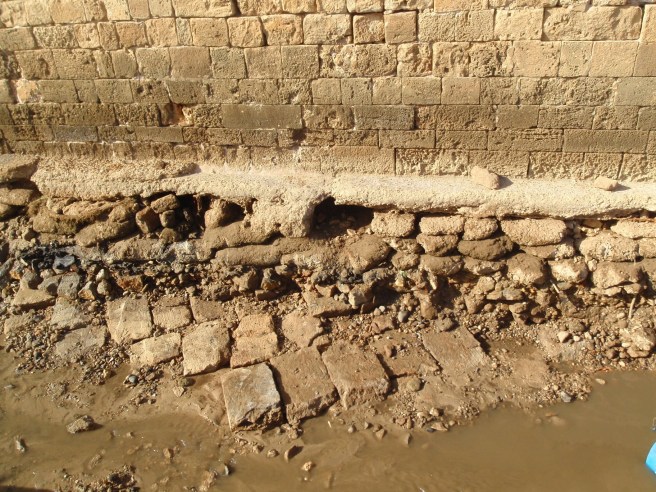
By whatever name you recognize it, this is interesting … the Israel Antiquities Authority has issued a press release (and photos) of evidence of a floor (pavement is probably a better word) one metre below the water level in the harbour at Akko, the erstwhile Ptolemais. An excerpt from the press release:

As part of the project, a temporary rampart that serves as both a road and dam was built in the sea. The pool of water that formed between the rampart and the seawall was pumped out so as to create dry conditions for rehabilitating the seawall.

The part of the floor that has been revealed so far extends for a distance of 15 meters and is 4 meters wide (the full dimensions of the floor have not yet been exposed). The floor was built of rectangular, smoothly dressed kurkar stones that were placed atop a foundation course of roughly hewn kurkar stones arranged next to each other as “headers”. In probes that were conducted beneath the floor, numerous fragments of ceramic jars of Aegean provenance (from Rhodes, Kos and elsewhere) were found that were used to transport wine, as well as tableware and cooking vessels. Among the other artifacts recovered were a Greek style bronze arrowhead and bronze coins that are covered with marine encrustations. A preliminary identification of the finds shows that the floor was constructed in the Hellenistic period (end of the third century until the middle of the second century BCE) as part of a national project.
According to Kobi Sharvit, director of the Israel Antiquities Authority Marine Archaeology Unit, “The location of the floor, its size, the building style and the building method, which is mainly known from the construction of harbor installations, indicate with a high degree of certainty that the floor has a marine connection suggesting it belongs to a large pier or dockyard structure”.

The floor constitutes an extremely important indicator for studies that deal with changes in sea level and in the location of the shoreline during the Hellenistic period in Akko. This find raises other questions regarding the tectonic changes that occurred in Akko, which is located on a geologic fault, and sea levels.

Not sure how they recognize this as part of a “national project”, unless that comes from text-based evidence vel simm. Whatever the case, here’s a relevant photo:

IAA photo
IAA photo

Restoring Philip II’s Palace

ANA has a brief item on the restoration work ongoing at Philip II’s palace at Aigai. From the conclusion:

The restoration of the two-storey gallery (stoa) in the building’s front section was a “revelation” for archaeologists’ studying ancient architecture, as it contradicted earlier beliefs according to which such galleries were a later practice, dating in the 2nd century BC. The galleries’ architectural sections are built based on the “golden mean” ratio (1 to 1.6). Archaeologists believe that Pytheos was the palace’s architect, who had also designed the mausoleum of Halicarnassus, while the mausoleum’s sculptor Leocharis had also worked on the palace of Aigai.