What Have the Greeks Ever Done For Us? Christmas Edition

Hopefully you’ve already read the Roman side of Christmas (see the previous post), which has some scholarship behind it … the Greek side, however, strikes me as a bit wanting and rather rambling. As often, it hails from the Greek Reporter, which seems to let its minimal editing down even more during holiday times:

Christmas is the most important, and perhaps the most treasured, celebration of Christianity filled with joy and love. Every country celebrates with different customs that have deep roots within history and tradition. We can find a variety of similarities in the commemoration of the birth of Christ and Dionysus between ancient and contemporary Greece. If we look at the ancient Greek history and the traditions within, we will see that some of our customs have their roots in ancient Greece.

In December, the Ancient Greeks celebrated the birth of Dionysus, calling him “Savior” and divine “infant.” According to Greek mythology, his mother was a mortal woman, Semele, and his father was Zeus, the king of the Gods. The priest of Dionysus held a pastoral staff as did the Good Shepherd. On December 30, ancient Greeks commemorated his rebirth.

The most well-known custom throughout the Christian world are the Christmas carols that have roots deriving from ancient Greece. Specifically, Homer — during his stay on the island of Samos, along with a group of children — composed the carols. In ancient Greece, carols symbolized joy, wealth and peace, and the children sang the carols only in the homes of the rich. Children would go from house to house, holding an olive or a laurel branch adorned with wool (a symbol of health and beauty) and different kinds of fruits. The children brought the olive branch to their homes and hung it on the doors where it remained for the rest of the year.

The Christmas tree appeared for the first time in Germany at the end of the 16th century. It became globally known in the 19th century. In our religion, the Christmas tree symbolizes the rejoicing of the birth of Jesus Christ. The tree was adorned first with fruits and later with clothes and other household objects. Ancient Greeks also used to decorate the ancient temples with trees, symbolizing the divine gift offering. The Christmas tree tradition made its way to Greece in 1833, when the Bavarians decorated the palace of King Otto.

Santa Claus, who travels around the world on Christmas Eve delivering gifts in a sleigh pulled by flying reindeer, is another impressive similarity. A similar tradition also existed during the celebration of Dionysus in ancient Greece who resembled light. Then, the chariot transformed into a sleigh and horses transformed into reindeer.

The New Year’s cake is also the evolution of an ancient Greek custom. Our ancestors used to offer Gods the “festive bread” during the rural festivals, like the Thalysia or the Thesmophoria.

In an interesting bit of synchronicity, if it can be called that, the original article tries to make a visual connection between Phaethon/Apollo flying in a chariot and Santa with his reindeer. I think my efforts from a decade ago — recalled by Dorothy Lobel King earlier today: A Rogue Classicism Christmas ..(thanks for the plug!) — is rather more convincing and probably has more scholarship behind it (maybe not). So often the historical/hysterical material in Greek Reporter seems to be cutting room floor items from My Big Fat Greek Wedding:

The rogueclassicist Skept-o-meter

While wading through my backlog the other day (which is huge) it occurred to me that I could start giving ‘points’ to articles cluttering my box making skeptical claims. To do so, of course, I would need some sort of metre stick of credulity, and came up with the following list of items which set of alarm bells in the rogueclassicist’s noggin:

  1. Claim is made by someone who is not a specialist (i.e. with a degree) in the discipline
  2. Claimant has an “Indiana Jones” type epithet, often self-imposed
  3. Topic of claim is one of the long-standing mysteries (e.g. Cleopatra’s tomb, Alexander’s tomb, anything related to Atlantis, the Ark of the Covenant, something biblical, etc.)
  4. Claim is initially made on a press release site and later picked up by mainstream media
  5. Claim has not appeared in a scholarly journal nor is ‘in press’
  6. The word “decode” is used at least once in the cliam claim
  7. The phrase “years of research” figures prominently
  8. Claimant justifies position with references to the Trojan War or Galileo
  9. Claimant suggests a “coverup” of some sort by academics
  10. Claim is made on a significant date (especially if related to early Christianity … Easter and Christmas are the big dates)
  11. Newspaper report doesn’t actually ask a specialist for a contrary opinion
  12. Mention of a documentary to come is made in the concluding paragraphs

Of course, many legitimate claims might fall into one or more of the above categories, but it’s the combination of (usually) 3 or so or more which set off the alarm bells. I’ll apply this scale to a really bizarre claim in the next day or so.

Bocce Origins Redux

Ten years almost to the day, we get another claim about Roman origins of bocce … from a WWAY3 feature:

The Romans first played the game around 300 BC with coconuts they brought back from Africa. Now it’s an age-friendly sport with a lot to offer.

… since we first dealt with this a decade ago (see: CHATTER: Bocce … you’ll have to scroll down a bit), all we can ask at this point is whether the Romans’ coconuts were borne by European or African swallows …

Did the Ancient Greeks Discover America?

In a word, no, but that doesn’t stop the Epoch Times for wasting electrons on a nutty theory … here are just enough exerpts to smack your gob:

The year 1492 is one of history’s most famous dates, when America was discovered by Europeans. However that “New World” may have been already known to the ancient Greeks, according to a book by Italian physicist and philologist Lucio Russo.

The translated title for Russo’s book would be “The Forgotten America: The Relationship Among Civilizations and an Error Made by Ptolemy.” But the author told the Epoch Times that the title for the English version, which isn’t ready yet, will probably be “When the World Shrunk.”
Some Clues

Among the many clues of contact between ancient Europeans and Native Americans are the few pre-Columbian texts to have survived the Spanish devastation.

In a book about the origins of the Maya-Quiché people there are many interesting points. The fathers of that civilization, according to the text, were “black people, white people, people of many faces, people of many languages,” and they came from the East. “And it isn’t clear how they crossed over the sea. They crossed over as if there were no sea,” says the text.

However, researchers later decided to translate the Mayan word usually meant for “sea” as “lake.”

There are also many Mayan depictions and texts about men with beards. But Native Americans do not grow beards.

Furthermore, some artworks of the ancient Romans show pineapples, a fruit that originated in South America.

Ways of Thought

Russo, who currently teaches probability at Tor Vergata University of Rome, says the main reason why researchers think America wasn’t known to ancient Greeks is not due to lack of proof, but to scientific dogma. […]

… now since they mentioned that old canard about pineapples in Roman art, we feel compelled to comment. We should make note of the photo that accompanies the original article:

Photo in the Epoch Times, apparently from Lucio Russo’s book

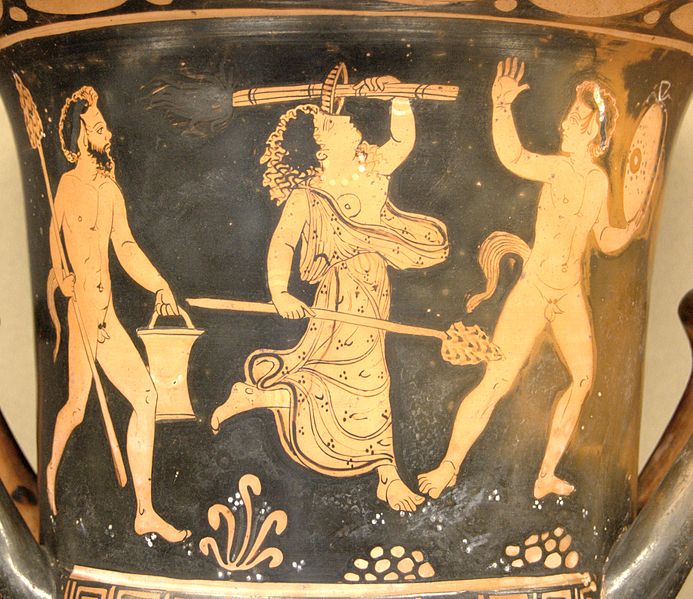
I won’t go too much into detail about the background on this claim (which ultimately goes back to Ivan Van Sertima … see Jason Colavito’s excellent post from a year or so ago: The “Pineapple” of Pompeii), but there clearly is something wrong with people if they look at those things and see pineapples. Begin with the mosaic and you’re looking at something that looks like it’s smaller than most of the fruit there. Then look at the fresco and see that the things are only slightly larger than the snake’s head. Then you can argue with yourself about the statue and decide whether it’s a child or an adult. If you’ve been around Classics for a while, however,  the thing is obviously a  pinecone, not a pineapple, which are similarly-depicted on plenty of pots relating to Dionysus/Bacchus and usually brandished by a Maenad, and often by Dionysus himself E.g.:

via Wikipedia

There are countless other examples, including architectural elements and the like. Once again we see the ‘danger’ of non-specialists building theories on rather common elements of ancient Greek and Roman life (more common than they want to believe) …

Macedonians in China? Yeah, about that …

We’ll preface this by noting it’s written by the same author who spread the misinformation about Amphipolis for the Greek Reporter:

In antiquity when the Ancient Greeks and Romans referred to the Chinese they used to call them by the Latin name Sinae, which the Chinese have kept until today (China). The greatest proof is the fact that the most important monument of China is known worldwide as the Great Sinic Wall.

Throughout the years, among other archaeological findings discovered in China, there is the Sampul tapestry, a woolen wall-hanging which depicts a soldier, probably Greek, and a Centaur. Moreover, there are also statues of Greek soldiers of the 3rd century B.C. Several statuettes and representations of Greek soldiers have been found north of Tien Shan. The above are both displayed in the Xinjiang Museum, Urumqi, China.

Moving on, today we know that the Chinese pyramids are in fact tombs-mausoleums, internationally known as tumulus mounds. But only ancient Macedonians used to build tombs for their kings. The existence of such sacred monuments in the “forbidden zone”, means that the local emperors of the time actually followed the sacred “road” chosen or suggested by the Macedonians, apparently soldiers of Alexander the Great, who did not wish to go their way back.They even adopted the same magnificent Macedonian way for burying their kings.

So far there have been at least 12 ancient Greek cities unearthed in China. That is the real reason why the Chinese government, dissatisfied, decided to put an end to all these archaeological missions.

However, since 1980 the ongoing archaeological interest around China once again pushed a group of both Chinese and Japanese researchers to begin searching for the rumored lost Kashgar Old city.

But it was in 1993, when an archaeological discovery really shook the historic waters. An ancient Greek civilization was revealed in the Chinese city of Niya in Taklamakan. Within the ruins, archaeologists found iron axes and sickles, wooden clubs, pottery urns and jars in the homes, coins bronze mirrors, rings and other possessions that were all of Greek origin.

Furthermore, all eight mummies and skeletons that were found had blonde and brown hair (European characteristics and not Chinese) along with other Greek features.

So, from all the above the following question is now raised: Since Alexander the Great officially reached the Ganges River, how on earth were Greek cities discovered beyond it in China?

Just some food for thought as it probably seems that history should be rewritten…

Wow … just wow. We should note that much of this seems to derive from the finds associated with the find of Chercen Man ages ago (see, e.g., Celtic Mummies in China) and the mysterious Yingpan Man (Yingpan Man), both of whom (along with others) were determined to be of Celtic ancestry DNA-wise, as far as I’m aware. Whatever the case, it seems Greek Reporter has someone covering the archaeology beat with a, shall we say, less-than-archaeological agenda.