A series of finds in 1980s completely changed the perception of the effect the Romans had on Guernsey.
Tanya Walls, La Société Guernesiaise archaeology secretary, said before the finds it had been thought they had little influence.
However, when evidence of settlements, trade and industry came to light it told a different story.
The island became a centre for trade, most obviously shown by the wreck of a Roman trading ship found off Guernsey.
Before the Romans, Guernsey had been well-known as a trading point for wine in the Iron Age as ships made their way north from Bordeaux.
The Romans capitalised on this settling in St Peter Port following their occupation of Gaul (modern day France).
In the 1980s a site was discovered at La Paladerie, in St Peter Port, where Roman artefacts and the remains of buildings were uncovered.
Amongst the items found on the site were locally produced Iron Age pottery alongside the finer type produced in Europe by the Romans and also remains of the household gods found in every Roman home before the empire’s conversion to Christianity.
A few years before this the Asterix, a Gallo-Roman trading vessel, was found in the mouth of the harbour and these two finds combined to show how Guernsey was used as a trading post.
Tanya explained that it is thought the Romans settled in Guernsey shortly after they conquered what is now France, but before they reached England, sometime in the first century BC, and: “Their influence would have been strong for around 300 years.”
Tiles from a Roman building were used in the construction of Castel Church
The idea that there was a Roman settlement in St Peter Port was furthered when the Town Market building was redeveloped in 2000 and a further series of settlements were found.
The incipit of a piece in Il Messaggero detailing restoration plans for the Colosseum (which began last year), including a less conspicuous fence, changing the lighting, and assorted other things with the ultimate goal of making all levels accessible to the public (I think):
Il terremoto del 2009 ha fatto danni e già si sta provvedendo. Altri lavori, grandi lavori, interesseranno a breve il simbolo di Roma, il Colosseo. «Il restauro è un progetto che fa parte dell’Alto piano strategico di sviluppo – annuncia il sindaco Gianni Alemanno – e sarà fatto con sponsor privati, il costo è elevato, pari a 20 milioni di euro. I lavori partono quest’anno».
Già a primavera i primi cantieri di quella che sarà una ristrutturazione complessiva: la Soprintendenza archeologica di Stato ha elaborato un progetto generale di restauro di tutto l’Anfiteatro Flavio, dagli ipogei all’ultimo livello, sollecitata particolarmente dal sindaco (che in passato ha definito il Colosseo «la sua inquietudine quotidiana») e incentivata dai fondi messi a disposizione dai Beni culturali con l’arrivo del commissario straordinario per l’area archeologica Roberto Cecchi (incarico assegnato inizialmente al capo della Protezione civile Guido Bertolaso, che ha lasciato per seguire il terremoto in Abruzzo).
Un progetto importante: pulizia della parte esterna, restauro, recinzione disegnata ad hoc e meno vistosa (l’attuale cancellata in tubi innocenti verrà sostituita e arretrata quasi a creare un’area pedonale: sarà meno vistosa, molto alta, tipo quella del Foro, del colore della pietra pulita), illuminazione studiata da un architetto della luce, spostati più all’esterno anche i metal detector. Almeno un anno, la stima della durata dei lavori. Attico, settore Stern, terzo ordine e ipogei, per un costo di 1,8 milioni di euro: «in realtà i lavori sono già iniziati a luglio scorso – spiega il commissario straordinario Roberto Cecchi – tutta la parte legata ai pronti interventi, in particolare al piano alto che ha risentito del sisma del 2009, quando le criticità già esistenti nell’area più esposta sono diventate urgenze. Per la parte sottostante sono in corso tre perizie di spesa. L’obiettivo finale è rendere fruibili tutti i livelli, è un peccato che siano tali solo il basamento e il primo piano. Abbiamo approfittato, per andare ad analizzare meglio lo stato del Colosseo, di quanto recita l’ordinanza dell’11 giugno scorso, disposizioni urgenti della Protezione civile, che chiede di garantire allo stesso modo sicurezza e fruizione dei beni». Quest’anno si comincia, i cantieri sono previsti a primavera, anche se Cecchi precisa: «E’ un progetto che in termini finanziari va al di là delle risorse disponibili».
The incipit of a piece describing a discovery I’m very surprised we haven’t heard more about (this seems to be the only coverage!) … during highway construction, a number of burials — one of which apparently includes a Roman chariot — has been found near the Centocelle airport:
Un eccezionale ritrovamento archeologico è venuto alla luce nelle settimane scorse durante i lavori della complanare alla A-24 nel quartiere di La Rustica. Una biga romana, diversi siti funerari con tanto di monumenti, suppellettili e scheletri di cui uno probabilmente appartenente ad un nobile, poiché accanto è stato ritrovato uno scettro.
Today I received a very interesting email from Ted O’Neill, who is one of the principals involved in the recent (re)discovery of what seems to be the source of the Aqua Traiana. Mr. O’Neill sent along a pile of interesting materials for me to share with y’all (thanks very much!||), so here goes … we’ll begin with some additional video footage (the text accompanying the videos is attached to them at the Vimeo site):
Descending under a ruined church in the Roman Countryside with the famous Archeologist Lorenzo Quilici, the Aqueduct Hunters discover the lost source of Trajan’s Aqueduct.
An extraordinary treasure has been discovered in a field north of Rome. But where is the river god displayed on a coin from 1900 years ago?And what will the archaeologists discover under 1900 years of mud? Music all included under Creative Commons Licence 3.0
Vodpod videos no longer available.
more about “The Emperor’s Sacred Spring – 7 minut…”, posted with vodpod
Scripsit Mr. O’Neill:
The site is the principal aquifer source of the Aqueduct, which was however stolen-off-with by the rogue Duke of Bracciano, Paolo Giordano Orsini in 1573. Paolo Giordano additionally had the distinction of Murdering the Pope’s nephew. So the source we discovered was not part of the Papal re-building of the same Aqueduct from the early 1600s.
The proof of this is in a document (letter from Arch. Luigi Bernini to Alessander VII) buried in the Chigi Archive in the Vatican. But an author called Carlo Fea saw that letter and published the attached pages in 1832.
… and here are the attached pages (the info is in the highlighted footnotes for those who wish to pursue it):
Carlo Fea, p. 41 (click for a larger view)Carlo Fea p. 42 (Click for a larger view)
Mr O’Neill continues:
In various times in history, it has been used to supply renewable energy, both to Trajan’s mills on the Janiculum Hill in Rome, and subsequently by the Orsini and
Odescalchi dukes for their industry in Bracciano (near lake Bracciano).
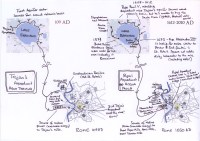
Also included was a very useful and interesting map:
Click for a larger view
… and the original press release:
Lost Aqueduct and beautiful nymphaeum REDISCOVERED near
ROME ON 1900th ANIVERSARY AFTER INAUGURATION
Rome, Italy, JANUARY 28, 2010: The primary source of the Emperor Trajan’s Aqueduct, the Aqua Traiana, has been identified north of Rome by British HD documentary team Michael and Edward O’Neill on the 1900th anniversary of the aqueduct’s inauguration. The significance of the site will be revealed at a press conference in Hotel Quirinale, via Nazionale 7, Rome, on Thursday, January 28th at 15:00.
On 24th June, precisely one thousand nine hundred years after the inauguration, worldwide aqueduct authority Prof. Lorenzo Quilici[1] visited the newly discovered springhouse-shrine and its labyrinth of underground water galleries.
“È TUTTO ROMANO!” – it’s ALL ROMAN! – he immediately exclaimed.
Documentary filmmakers Michael and Edward O’Neill discovered the site in extraordinary and adventurous circumstances, and are now raising money to film the ongoing preservation, excavation and opening to the public.
An ancient water source in Etruscan times, the web of springs was encapsulated by the Roman engineers in a vaulted, three-chambered semicircular ‘nymphaeum’, which served as a springhouse and probably contained the statue of a Roman river god or nymph. The ancient water source was commemorated by a sestertius coin minted by the Emperor Trajan when he inaugurated his aqueduct and his public baths in the centre of Rome, 1900 years ago.
For more than a thousand years, Trajan’s sacred water source was hidden under a Christian Church, now ruined and dismantled. The ancient aqueduct still emerges from under the church’s meagre remains. The water collection chamber of the Caput Aquae (headwaters) and 125 metres of the Roman Aqueduct gallery are still in pristine condition as compared with many crumbling ruins in the centre of Rome.
Ancient evidence and Papal records confirm that this shrine is almost certainly the primary water source of Trajan’s aqueduct:
The vaulted ceilings are all richly decorated with expensive Egyptian blue pigment, which strongly suggests that the great Emperor Trajan, proclaimed Optimus Princeps, almost certainly was here personally for his aqueduct’s inauguration.
Until recently, this water source was considered by some to be a local, regional aqueduct of eighteenth-century origin.
However, a descent below the chapel with powerful lights for filming of the underground galleries revealed that the brickwork and waterproof hydraulic cement lining the tunnels is absolutely characteristic of the Trajanic age.
Whilst filming the ancient roman Aqueducts in high definition, Michael O’Neill, Producer with MEON HDTV Productions, has descended below the chapel to explore into the stygian darkness of the ancient grottos and muddy tunnel, lined with classic Roman Opus Reticulatum brickwork.
“We are documenting a crumbling treasure,” he said. “The vaulted Roman concrete roofs with central oculus openings, thought originally to admit light like the Pantheon, are incredibly strong, but this unique Roman structure is being destroyed by neglect, and by aggressive fig tree roots.
Ted and Mike have invited two American scholars, Katherine Rinne (Institute of Advanced Technology in the Humanities, University of Virginia) and Rabun Taylor (University of Texas at Austin), to investigate the site further and to seek resources to undertake its survey, excavation, and publication.
Katherine Rinne, an expert on the hydraulic features of Rome in the Renaissance and Baroque periods, is drawn to the many extraordinary features of this site dating to the early modern period. The spring, which was still producing abundant water until quite recently, was commandeered in the seventeenth century to serve as a source of the Acqua Paola, one of the greatest of the Papal aqueducts of Rome. Some distance downhill from the grotto is a junction chamber where the Aqua Traiana and the Acqua Paola intersect.
Rabun Taylor wrote his dissertation on the ancient aqueducts of the city of Rome. He traced the course of the Aqua Traiana within the city, from its point of entry high on the Janiculum Hill to its crossing of the Tiber River near the modern Ponte Sublicio. “This is a discovery of almost unprecedented importance in the long history of aqueduct studies,” he said. “For all we know about the ancient city’s water supply—and we know quite a lot—it has to be understood that not a single architecturally defined spring source of any of ancient Rome’s eleven aqueducts has ever been discovered. And then Ted and Mike came along, put their amazing research and archival skills to work, and turned up one of the most spectacular—and pristine—Roman aqueduct sources in existence anywhere. The great aqueduct hunters of the twentieth century got within a couple of hundred meters of it, but never saw it.”
One of the most important features of this structure is the engineering of the water captivation chambers and galleries. “It’s like a gigantic upside-down coffee percolator built in stone,” said Mike. “This is a genre of Roman hydraulic engineering that has never been seen before. It is of unparalleled importance.”
… and a statement from Lorenzo Quilici of the University of Bologna:
STATEMENT BY Prof. Lorenzo Quilici,
UniversitÀ degli Studi DI Bologna
The Aqua Traiana was the penultimate of the eleven great aqueducts which supplied ancient Rome. It was inaugurated on June 24th, 109 A.D. to supply the urban zone of Trastevere and the city at large. It remained continuously functional, save a few interruptions, up to the period of the barbarian sieges, when Goths and Lombards seized and cut it. In the early 1600s, Pope Paul V undertook its restoration in order to guarantee the abundant provision of clean fresh water both to the Vatican and to the “Fontanone” Display Fountain on the Janiculum Hill, and it became known as the Acqua Paola.
The Aqua Paola was plagued with problems of hyigene and purity when it later took the water from Lake Bracciano at Anguillara. On the other hand, the original Roman aqueduct relied completely on fresh aquifers and captured all its water from clean springs along its route. The hills around the northern and eastern banks of the basin are rich with water: from Manziana to the Baths of Vicarello, to Trevignano and Anguillara where the channel proper begins. The water channel enters Rome at the ancient Aurelian Gate, today’s St. Pancras’ Gate.
The Roman aqueduct had the additional feature in Trastevere of the rapid drop in height offered by the Janiculum Hill. This was exploited to supply motor force to a chain of flour mills built in rows along its slopes: a real pre-industrial top-of-the-range facilty.
The Emperor Trajan minted coins to celebrate this work, which was constructed at his own expense. The sestertius coin shows a reclining figure of a river god under a great arch flanked by columns. This has previously been interpreted as the image of the ‘Display’ of water that Trajan must have built on the Janiculum, 1500 years before the great fountain of Pope Paul V.
The headwaters of the Roman aqueduct, constituting the first spring along the route around the lake, and the most important, remained forgotten in recent centuries until its re-discovery came about in extraordinary and adventurous circumstances.
Two British Citizens, Mike and Ted O’Neill, were preparing a series of documentaries regarding the ancient Roman Aqueducts for MEON HDTV Productions Ltd, researching the Trajanic conduit along the lake, when the Architect Giuseppe Curatolo, student of the Bracciano’s Odescalchi Aqueduct, directed their attention towards the springs which supply the local people of that city.
In a rough and wild patch alongside a stream, there is a spacious grotto that contained a chapel of the Virgin Mary. Today it’s an abandoned ruin, and at the bottom of the cavity, in her honour, there remains a beautiful molded baroque picture frame that would have contained her image. The cave is artificial and on each side of its great vault extend ancient crossed-vaulted rooms. These contained the springs. The rooms may have been reconfigured by the Odescalchi princes at the start of the 1700s when the the course of the waters was diverted to supply Bracciano, where they still arrive today. The water is currently collected by pumps in two adjacent bore-holes, which supply a good 50,000 cubic metres of water per day, an immense quantity.
Trajan’s Aqueduct, the ancient use of the springs, and the Christian chapel overhead were forgotten when the water was diverted to Bracciano. The ancient monument, however, would have taken the shape of a stunning nymphaeum, constructed at the primary source of the aqueduct: a central chapel dedicated to its god or nymphs, those on each side widened into two basins covered by extraordinary vaults still flecked with Egyptian blue paint. At the base of the side chambers can be seen an ingenious filtering system consisting of blocks laid with gaps between them. Water seeped in two basins, from which the aqueduct channel begins.
The structures are 8-9 metres high and perhaps more, given that they are partially buried and choked with vegetation that covers the site. They are built in very refined opus latericium brickwork and in opus reticulatum, a crosshatched pattern of stone facing for the underlying concrete. The chambers, with barrel and cross-vaults, the wells, the water-collection tunnels that converge there, the channel where the underground aqueduct gallery begins are all today, due to a lack of water, accessible by foot. Realistically, descending into the tunnels is not easy, because the place is overgrown, covered by a dense thicket of gigantic figs that threatens the concrete structures with roots that descend to the deepest level of the nymphaeum.
We can compare this partially subterranean nymphaeum with the Canopus of Hadrian’s Villa or with the Nymphaeum of Egeria in the Triopus of Herodes Atticus on the Appian Way!
The two Englishmen, excited about the discovery and wanting not only to document it but, with a true sense of community spirit, to achieve the stabilisation and restoration, excavation and evaluation of this monument, are attempting to involve in the initiative the local authorities, the Superintendents, Italian research organisations and foreign scholars.
It’s their inspired idea that Trajan’s famous coin does not represent his fountain on the Janiculum Hill, but the front of this nymphaeum-grotto, with the reclining god of the spring waters.
The research, restoration and stabilization of such an extraordinary monument requires funds, lots of funds: it is not, however, necessary to do everything immediately, but sufficent to start the work with the conscience and good will to prepare stage by stage the conditions for the future.
A very interesting find by some clumsy amateurs, apparently (when will the media stop having folks ‘stumble’ on things???) … this seems to be hype for a documentary, but that’s not a bad thing. Here’s the incipit of the Telegraph coverage:
The underground spring lies behind a concealed door beneath an abandoned 13th century church on the shores of Lake Bracciano, 35 miles north of Rome.
Exploration of the site has shown that water percolating through volcanic bedrock was collected in underground grottoes and chambers and fed into a subterranean aqueduct, the Aqua Traiana, which took it all the way to the imperial capital.
Centuries later, it provided water for the very first Vatican, after Rome began to convert to Christianity under the Emperor Constantine.
The underground complex, which is entangled with the roots of huge fig trees, was discovered by father and son documentary makers Edward and Michael O’Neill, who stumbled on it while researching the history of Rome’s ancient aqueducts.
They recruited a leading authority on Roman hydro-engineering, Prof Lorenzo Quilici from Bologna University, who confirmed that the structure was Roman, rather than medieval as had long been believed.
Using long iron ladders to descend into the bowels of the sophisticated system, they found that the bricks comprising the aqueduct’s walls are laid in a diamond shape known as “opus reticulatum” – a distinctive Roman style of engineering.
“A lot of the stone work bears the original Roman tool marks,” Edward O’Neill said.
The underground labyrinth of galleries has remained almost unknown to archaeologists because for hundreds of years it was full of water.
It was only when modern bore pumps started directing the supply to the nearby town of Bracciano that the water level dropped dramatically and the subterranean complex became accessible.
The vaulted ceiling was decorated with a rare type of paint known as Egyptian Blue, which led the O’Neills to speculate that the grotto was a Roman nymphaeum – a sacred place believed to be inhabited by water gods.
“The paint was very expensive to make, but it was painted all over the walls, which suggests an imperial link,” said Mr O’Neill.


 rogueclassicism