As the New Year festivities fade, each January reminds us of the passage of time. There is a tendency to look back with regret at roads not taken, and perhaps even despair at what the future holds.
Yet this time of year can also encourage more positive reflection. It was probably in early January of 44 BCE that Marcus Tullius Cicero, the Roman politician, orator, and philosopher, sat down to write On Old Age.
Goodreads
At 62, Cicero had endured personal and political losses. The year before, his daughter Tullia had died from complications from childbirth (the baby likely dying soon after), and Cicero had divorced his second wife, Publilia.
The Roman Republic was likewise in a dire state, in Cicero’s opinion, since Julius Caesar had recently been (or was about to be) named dictator for life.
Even amid this turmoil, and in the face of his own mortality, Cicero took pains to defend the experience of old age from its critics and to point out its many positive aspects.
Bust of Cicero, Musei Capitolini. Wikimedia Commons, CC BY
He did so by adopting the persona of Cato the Elder, one of the most prominent statesmen of the third and second centuries, who lived from 234-149 BCE until his death at the age of 85.
While it was common in Greece and Rome for philosophical treatises to be written in the voice of a historical figure, Cicero makes clear in this book that the opinions of this character “Cato” represent his own views on old age.
The virtues of old age
Cicero addresses four criticisms of old age. The first two are that it forbids active pursuits and weakens the body. His forthright response is as applicable today as 2000 years ago:
It is not by muscle, speed, or physical dexterity that great things are achieved, but by reflection, force of character, and judgement; in these qualities old age is usually not only not poorer, but is even richer.
Cicero points out that the Roman senate derives its name from the fact that it was originally an assembly of old men, or senes in the original Latin. Older people have the wisdom, judgement, and experience necessary for good government.
Even the accusation that the memory dims with old age can be challenged, he suggests. Mental faculties only decline if they are unused; occupations such as language learning can help the mind stay sharp. (Cato talks about studying Greek in his twilight years).
As for strength, Cicero says that there are different kinds of vigour needed. An old man has already served his country in war, so that type of strength is no longer required (and in any case, a weak body can often be blamed on a dissolute youth!). But an old man’s voice can still resonate powerfully and make its point eloquently.
Landcare over lust
The third criticism of old age is that it lacks sensual pleasures. Lust, Cicero says, is the worst vice of youth and we should rejoice in its passing.
For carnal pleasure hinders deliberation, is at war with reason, blindfolds the eyes of the mind, so to speak, and has no fellowship with virtue.
The same goes for other types of indulgence, such as eating and drinking:
Old age lacks the heavy banquet, the loaded table, and the oft-filled cup; therefore it also lacks drunkenness, indigestion, and loss of sleep.
One can derive enjoyment from many activities in old age, such as studying science or the law, writing poetry, and similar pursuits that stimulate the mind. Cicero has the character of Cato discuss his own personal source of delight: tending to the land.
The real Cato did indeed write a work, On Agriculture, which was essentially a guide to estate management for the wealthy. The cultivation of vines is a particular joy, writes Cicero:
But, that you may know what affords the recreation and delight of my old age, I will say that vine-culture gives me a joy of which I cannot get too much. […] Are not the results obtained from mallet-shoots, sprouts, cuttings, divisions, and layers enough to afford wonder and delight to any man?
Mosaic depicting Roman vine-workers (Cherchell Museum, Numidia) Wikimedia Commons, CC BY
The final charge levelled against old age is that it means one is near to death. This can be easily dismissed, according to Cicero, because death can happen at any age.
Nay, even youth, much more than old age, is subject to the accident of death; the young fall sick more easily, their sufferings are more intense, and they are cured with greater difficulty. Therefore few arrive at old age, and, but for this, life would be lived in better and wiser fashion. For it is in old men that reason and good judgement are found, and had it not been for old men no state would have existed at all.
Life is transitory. We should make the best use of the time we have to live honourably, take delight in our good fortune, and face the inevitable with steadfastness. We can take comfort in the fact that our achievements will be remembered after we perish.
Lessons for today?
Throughout the treatise, Cicero successfully advocates for the dignity and value of growing old. He masterfully defends old age against many of the stereotypical charges still levelled against the elderly in the modern world.
But, the critics say, old men are morose, troubled, fretful, and hard to please; and, if we inquire, we shall find that some of them are misers, too. However, these are faults of character, not of age.
And yet we must remember that Cicero and his proxy character Cato were both extremely wealthy, aristocratic politicians who constituted a privileged minority in the Roman Republic. This criticism is addressed early on in the work:
For amid utter penury, old age cannot be a light thing, not even to a wise man; nor to a fool, even amid utmost wealth, can it be otherwise than burdensome.
This justification allows Cicero to develop his argument about the importance of virtue and good character extending well into old age. It reflects the fact that his intended audience was other wealthy men like him (the dedicatee of his book, his friend Titus Pomponius Atticus, was a fabulously rich businessman in his sixties).
Throughout the work, all the examples provided for the reader to emulate are great men from Greece, Rome, and neighbouring regions, such as the philosophers Plato and Pythagoras and the generals Scipio Africanus and Fabius Maximus, who fought against Hannibal in the Second Punic War.
This is a far cry from the world of the labourer or farmer working to feed his family. As classicist Tim Parkin has shown, there was no state support system for the elderly in ancient Rome and all assistance had to come from one’s relatives.
Silent on women and slaves
There is no discussion in On Old Age of the experience of women of any social status. We hear nothing about how the perils of childbearing cut many women down in their prime nor the situation of elderly widows, who were committed to looking after their children and grandchildren.
Moulded jug in the form of an elderly woman (ANU Classics Museum). Bob Miller/ANU Classics Museum, CC BY
Though women were often traded and bartered as wives, Roman society still idolised the univira – literally the “one-man woman” – who never remarried after their husband’s death.
Nor is any mention made of the enslaved population who supported the leisurely retirement which Cicero so idolised or did all the hard labour on the estates owned by Cato. In his work On Agriculture, the real Cato wrote that “the old slave, the sick slave, and whatever else is superfluous” should be sold off, lest they compromise the workings of the estate.
Some enslaved people were able to buy their freedom, like Gaius Iulius Mygdonius, whose epitaph recorded that he was a Parthian, captured and enslaved by Romans in his youth. “From my boyhood onwards, I sought to reach old age”, he wrote on his tombstone, a poignant reminder of the adversity which he faced as human chattel.
Cicero’s work offers us salutary reminders about the joys of old age, but we should never forget that he represents the voice of privilege. For most Romans, men and women, free and enslaved, it was a daily struggle just to survive.
Celebrating Christmas and New Year’s in Athens, 1895-96: From the Letters of Nellie Reed, Student of the American School of Classical Studies at Athens. | From the Archivist’s Notebook
===========================================================
AUDIENDA
===========================================================
8. Augustus, Tiberius and Caligula: Urban Living in Rome with Andrew Wallace-Hadrill by The Classics Podcast
9. Claudius and Nero: Urban Living in Rome with Andrew Wallace-Hadrill by The Classics Podcast
Ancient Greece Declassified: 57 The Life of Plato w/ Robin Waterfield https://greecepodcast.libsyn.com/57-the-life-of-plato-w-robin-waterfield
===========================================================
VIDENDA
===========================================================
How to celebrate New Year’s like ancient Rome – YouTube
People throughout history have deliberately tried to forget corrupt or criminal leaders who offend the public’s sense of morality or justice. The term damnatio memoriae (“condemnation of memory”) describes this kind of deliberate forgetting in ancient times.
Damnatio memoriae refers to the deliberate political erasure of a person following their political failure and, usually, their death. It’s like a kind of post-mortem cancel culture.
So where did this idea come from and what did it look like in Ancient Rome?
An old idea
The term was probably first coined in the title of a thesis written by two late 17th century philologists named Christoph Schreiter and Johann Heinrich Gerlach. But it described a much older practice.
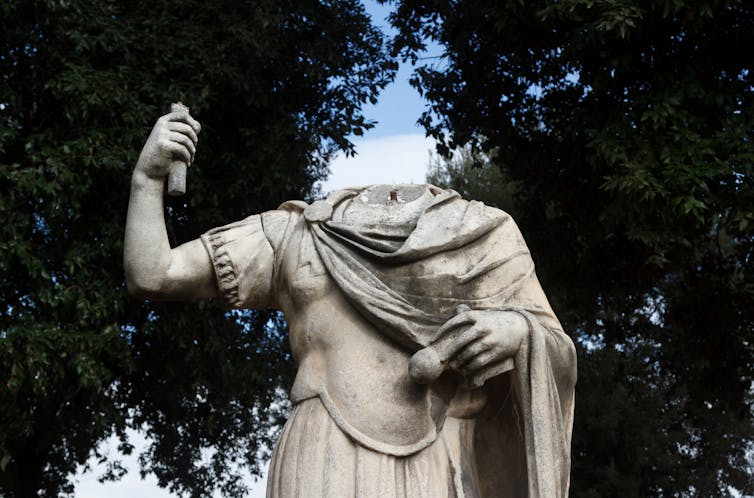
In antiquity, erasure might include the removal of heads from statues or the deletion of names on inscriptions.
Several emperors – including Nero and Domitian – were subject to the kind of erasure practices encapsulated by the term damnatio memoriae.
But one particularly good example of damnatio memoriae involves Crispus, the first son of the Roman emperor Constantine the Great (the first Roman emperor to convert to Christianity).
In 326CE, Constantine executed Crispus by – according to one version of the tale – “cold poison”. Constantine, in all likelihood, had discovered Crispus was having an affair with Constantine’s second wife, Fausta. This was especially scandalous because Fausta was Crispus’ own stepmother.
Fausta later died in an overheated bath. This may have been a botched abortion attempt or a deliberate albeit unusual method of execution.
Whatever the case, Crispus was killed and, in the aftermath, was subjected to damnatio memoriae.
Constantine wasn’t thrilled by the rumours about his wife and her stepson – his son from a previous marriage. chrisdorney/Shutterstock
Crispus the Cancelled
At the time of his death, Crispus was an important political figure. A political deal had raised him to the position of Caesar (which meant “junior emperor” and, arguably, heir to the throne).
Crispus’ military campaigns had been successful and he’d been the subject of public praise. He had held the highest constitutional office – the consulship – on no less than three occasions.
This meant Crispus’ name had been written on stone all across the Roman empire, from official government proclamations to the more mundane milestones marking Roman roads.
In 2022, I visited the northern Italian city of Brescia, which was once a significant Roman town. As I wandered through the museum, admiring its rich collection, I made my way down some stairs and was stopped in my tracks by one such milestone.
A line is clearly missing – this is where Crispus’ name would once have been. Michael Hanaghan
A line is clearly missing in the picture between the words victori semper Aug (meaning “the eternally victorious senior emperor”) and the next line Fl Iul Constantio (the name “Flavius Julius Constantius”).
The museum’s plaque confirmed Crispus’ name had once appeared there alongside his fellow junior emperors – his half-brothers Constantine II and Constantius II.
It once read in full:
To our four masters, Flavius Constantine the Great, the eternally victorious senior emperor, and to our most noble junior emperors, Flavius Julius Crispus, Flavius Claudius Constantine, and Flavius Julius Constantius.
The gap where Flavius Julius Cripus was once written is quite obvious – and that is really the point.
This is not a secret erasure of someone’s name, but a public display of its removal.
It served as a powerful reminder of the ongoing stigma that should be associated with Crispus’ name for all Romans making their way along the road in the years that followed.
At the same time, this erasure directly challenged Crispus’ importance and relevancy to history by removing a record of his existence, and in this particular case, of his prominence as a junior emperor.
The name of Crispus’ half-brother Constantine II was also chiselled away from this milestone, almost certainly after he was killed in a civil war against his younger brother Constans in the year 340.
How was damnatio memoriae done?
It was once assumed damnatio memoriae must have been ordered and organised. In recent years, however, scholars have come to understand the deliberate erasure of names as a far more organic and localised process.
Centuries before Crispus, inscriptions referring to Julius Caesar’s close confidant, Marc Antony, had been similarly deleted and removed. After Caesar’s death, Marc Antony had taken up with Caesar’s ex (Cleopatra) and fallen out spectacularly with Caesar’s heir (Octavian, who would soon rename himself Augustus).
Marc Antony – friend of Caesar, lover of Cleopatra – was subjected to damnatio memoriae after he died, following defeat in war by Augustus. The Metropolitan Museum of Art
Marc Antony was subjected to damnatio memoriae after losing his war against Augustus, but not all mentions of his name were erased – many, including some that
celebrate Antony’s sexual prowess, remain.
Prominent women could also be subject to this kind of memory erasure.
Messalina, the famously promiscuous second wife of Claudius, was the subject of a senatorial decree after her death that sought to erase her name and even ban its mention. Yet inscriptions referring to Messalina nevertheless remain.
But even if we don’t know exactly how damnatio memoriae was done, or how consistently it was applied, we do know it happened.
In the case of the milestone I saw in Brescia, we can only really speculate as to why Crispus’ name was removed from this one in particular. Maybe it was in a prominent position where it gained too much attention, or perhaps there was a localised push to remove his name.
Whatever the case, this milestone is physical evidence for something that we all instinctively do when a politician has failed in controversial, embarrassing or upsetting circumstances: we do our best to forget them.
160 Coins Minted by Hasmonean King Discovered on Hanukkah | The Jewish Press – JewishPress.com | David Israel | 29 Kislev 5785 – Monday, December 30, 2024 | JewishPress.com





 rogueclassicism
