The Conversation: Summer holidays haven’t changed much since ancient Greece and Rome (except maybe the sand wrestling)

Konstantine Panegyres, The University of Melbourne

Imagine a summer holiday at a seaside resort, with days spent sunbathing, reading books, exploring nature and chatting with friends.

Sounds like it could be anywhere in Australia or New Zealand in January, doesn’t it?

This is also how the Roman emperor Julian spent his summers in the 4th
century CE. Towards the end of 357 CE, Julian wrote a letter to his friend Evagrius, telling him how he spent his holidays at his grandmother’s estate as a boy and young man:

Very peaceful it is to lie down there and glance into some book, and then, while resting one’s eyes, it is very agreeable to gaze at the ships and the sea.

When I was still hardly more than a boy I thought that this was the most delightful summer residence, for it has, moreover, excellent springs and a charming bath and garden and trees.

As Julian got older, though, he had less time for summer holidays. Work consumed him. Even when he was on a break, he couldn’t fully relax.

This might sound familiar, too. It seems very little has changed from the days of the ancient Greek and Roman empires when it comes to finding time to unwind – and being on holidays, too.

Finding time for a break

Taking time off was important in ancient Greek and Roman times. Even Greek and Roman slaves were permitted to take a few holidays each year.

Not everyone could enjoy their holidays, however.

In 162 CE, Marcus Aurelius, then emperor of Rome, took four days of holiday at a resort in Alsium, a city on the coast of modern-day Italy.
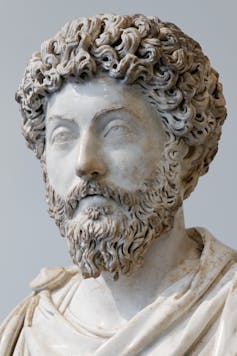
Marcus Aurelius had a tough time relaxing.
Borghese Collection/Wikimedia Commons

According to his friend Marcus Cornelius Fronto (c. 95-166 CE), though, the emperor could not stop working. In a letter, Fronto criticises Marcus for continuing to work hard rather than sleeping in, exploring the seaside, rowing on the ocean, bathing and feasting on seafood.

Fronto amusingly says that Marcus, rather than enjoy his holiday, has instead “declared war on play, relaxation, good living, and pleasure”.

Going to the seaside

Relaxing by the coast was one of the things people in ancient Greece and Rome most enjoyed doing in the summer.

The rich built summer residences on the coast, while people of all walks of life flocked to seaside resorts to enjoy the fresh air and cool water.

The orator Libanius (314-393 CE) wrote that the people who really enjoy life the most are those who have the freedom to “drive to their estates, visit other towns, buy land, and visit the seaside”.
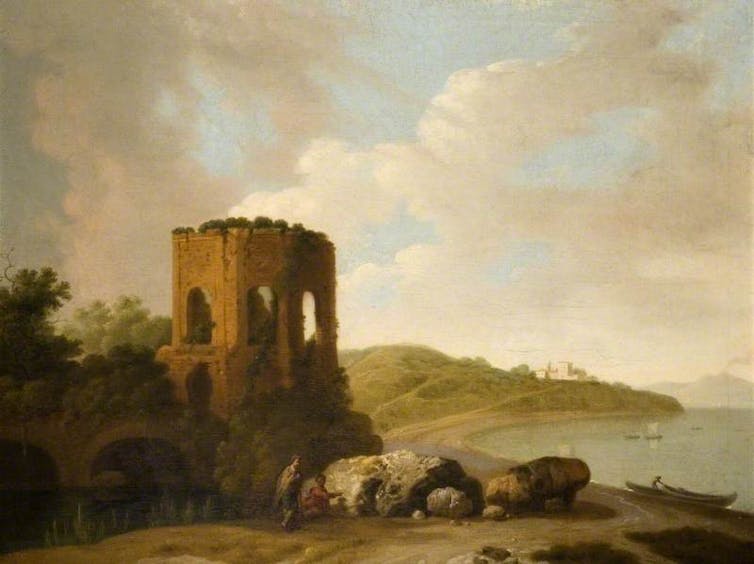
William Marlow painting of the ruins of the Temple of Venus at Baiae, a popular holiday spot for ancient Romans.
Birmingham Museums Trust/Wikimedia Commons

Health tourism was also a popular reason why people came to the seaside. Many ancient doctors recommended sea water and air as cures for all kinds of health problems, especially those related to the skin and respiratory system.

For example, the doctor Aretaeus of Cappadocia (c. 150-200 CE) recommended bathing in sea water, wrestling on sand and living by the sea as therapies for those who get frequent headaches.

Travelling abroad

Visiting foreign places was another of the things people in ancient Greece and Rome most enjoyed doing on their summer holidays.

For the Romans, trips to see Greece – and in particular Athens – were especially popular.

The Roman general Germanicus (15 BCE–19 CE) went on a tour of Greece in 18 CE, travelling from Athens eastward to Euboea, Lesbos, the coast of Asia Minor and then to Byzantium and Pontus.
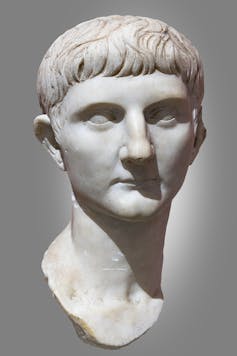
Germanicus was drawn to the Greek classics.
Musée Saint-Raymond/Wikimedia Commons

According to the Roman historian Tacitus, Germanicus was motivated by a desire to see famous ancient sites. Like many Romans, he was fascinated by the old stories of the Greek past, so he was “eager to make the acquaintance of those ancient and storied regions”.

Another popular destination for ancient Greeks and Romans was Egypt, which had always been regarded as a land of wonder.

Roman tourists could catch regular boats from Puteoli to the great Egyptian city Alexandria. The trip took anywhere from one to two weeks, stopping along the way in Sicily and Malta.

Once there, the highlights were typically the great Nile River and Pyramids. Tourists marvelled at the immense temples and walls of hieroglyphic writing.

When Germanicus visited Egypt in 19 CE, he was so curious about the meaning of the hieroglyphics that he asked an old Egyptian priest to translate some for him.

In Alexandria, another attraction was the tomb of Alexander the Great (356-323 BCE). His body was stored in honey in a coffin made of glass. Ordinary tourists were not allowed to visit it, but VIPs like Roman emperors were.

Tourists might also have enjoyed the different vibe in Alexandria. According to the Greek orator Dio of Prusa (c. 40-110/120 CE), the atmosphere in the coastal city was relaxed, with plenty of music, chariot racing and good food.
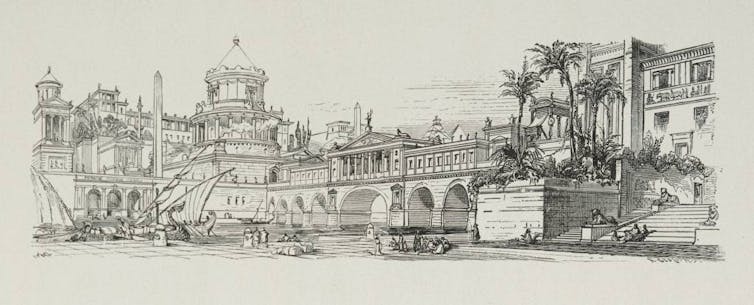
Line drawing of a scene from Alexandria in ancient times.
Adolf Gnauth/Wikimedia Commons

Lazy summer days

We can probably all relate to what the writer Pliny the Younger (61/62-112 BCE) said about his summer break.

Writing on a holiday in Tuscany, he said he can only work “in the lazy way to be expected during a summer holiday”. Working any other way was simply not possible. Many of us will be able to relate to that!The Conversation

Konstantine Panegyres, McKenzie Postdoctoral Fellow, researching Greco-Roman antiquity, The University of Melbourne

This article is republished from The Conversation under a Creative Commons license. Read the original article.
ROGUECLASSICIST’S BULLETIN January 2, 2025

===========================================================
LEGENDA
===========================================================
Large, well-preserved Roman-era bath mosaics discovered in Türkiye – Türkiye Today

Large, well-preserved Roman-era bath mosaics discovered in Türkiye

How Italy’s Carabinieri cultural heritage protection squad foiled tomb-raiders | Italy | The Guardian
https://www.theguardian.com/world/2025/jan/02/how-italys-carabinieri-cultural-heritage-protection-squad-foiled-tomb-raiders

Ancient Greek Shipwreck In Sicily Yields Rare “Atlantis Metal” Orichalcum

Ancient Greek Shipwreck in Sicily Yields Rare “Atlantis Metal” Orichalcum

Ancient Greek Inscriptions Found on Mountain in Central Asia – GreekReporter.com

Ancient Greek Inscriptions Found on Mountain in Central Asia

Unraveling the Secrets of Parion: An Ancient Greek City on the Hellespont – GreekReporter.com

Unraveling the Secrets of Parion: An Ancient Greek City on the Hellespont

‘Art in Gold: Jewellery in Hellenistic Times’ at Benaki continues

‘Art in Gold: Jewellery in Hellenistic Times’ at Benaki continues to April 2025

Lost site of Alexander the Great’s famous battle against ancient Persians discovered in Turkey | Live Science
https://www.livescience.com/archaeology/lost-site-of-alexander-the-greats-famous-battle-against-ancient-persians-discovered-in-turkey

Pyrrhus II, A Ruler Overshadowed By His Famous Grandfather

Pyrrhus II, a ruler overshadowed by his famous grandfather

Divers hoist 2,600-year-old shipwreck « Euro Weekly News
https://euroweeklynews.com/2025/01/02/spain-discovery-divers-hoist-2600-year-old-shipwreck-to-the-surface/

ArtDependence | Archaeologists discover Possible Bust of Cleopatra VII at Ancient Egyptian Temple
https://www.artdependence.com/articles/archaeologists-discover-possible-bust-of-cleopatra-vii-at-ancient-egyptian-temple/

Search for Cleopatra’s Tomb Yields Trove of Ancient Artifacts

Search for Cleopatra’s Tomb Yields Trove of Ancient Artifacts

A 2,000-year-old wooden tablet reveals the oldest Latin text written by – The Jerusalem Post
https://www.jpost.com/archaeology/archaeology-around-the-world/article-835799

Gauls, Galatians, and Galileans: Celts in the Holy Lands
https://substack.com/home/post/p-150308837

Beyond Togas and Gladiators: Why Latin Students Hate Roman Films – Inklings News

Beyond Togas and Gladiators: Why Latin Students Hate Roman Films

‘They see it is living’: Durham professor’s mission to get more pupils into classics | Classics and ancient history | The Guardian
https://www.theguardian.com/education/2025/jan/02/durham-professor-mission-classics-classical-education

Lessons for Keir Starmer from Cicero | The Spectator
https://www.spectator.co.uk/article/lessons-for-keir-starmer-from-cicero/

The ‘Myth and Marble’ of Rome Comes to America | National Review

The ‘Myth and Marble’ of Rome Comes to America

What Was Life Like in Pompeii? An Immersive Show Revives the Lost Roman City

What Was Life Like in Pompeii? An Immersive Show Revives the Lost Roman City

A Highly Hierarchical History: Same-Sex Relationships in the Biblical World | Bible Interp
https://bibleinterp.arizona.edu/articles/highly-hierarchical-history-same-sex-relationships-biblical-world

Blog Post #101: Peopling the Past Celebrates “Ancient Pasts for Modern Audiences” at the AIA – Peopling the Past

Blog Post #101: Peopling the Past Celebrates “Ancient Pasts for Modern Audiences” at the AIA

Roman Times: Gender fluidity in ancient Roman art
https://ancientimes.blogspot.com/2025/01/gender-fluidity-in-ancient-roman-art.html

Roman Times: The origin of elite red footwear in the ancient Mediterranean world
https://ancientimes.blogspot.com/2025/01/the-origin-of-elite-red-footwear-in.html

PaleoJudaica.com: Guide to ethnographic passages in Philo of Alexandria
https://paleojudaica.blogspot.com/2025/01/guide-to-ethnographic-passages-in-philo.html

Laudator Temporis Acti: A Wise Beast
https://laudatortemporisacti.blogspot.com/2025/01/a-wise-beast.html

Iceni updates: Expanding our understanding of Venta Icenorum – The Past

Iceni updates: Expanding our understanding of Venta Icenorum

Future Shock | Sphinx

Future Shock


===========================================================
AUDIENDA
===========================================================
Charlie Covell, Writer & Actor: Classics and Careers by The Classics Podcast

===========================================================
NOTANDA
===========================================================
Visiting Assistant Professor of Classics | Society for Classical Studies
https://classicalstudies.org/placement-service/2024-2025/38961/visiting-assistant-professor-classics

ROGUECLASSICIST’S BULLETIN January 1, 2024

===========================================================
LEGENDA
===========================================================
Guide to the classics: written more than 2000 years ago, Cicero’s On Old Age debunks stereotypes that persist today
https://theconversation.com/guide-to-the-classics-written-more-than-2000-years-ago-ciceros-on-old-age-debunks-stereotypes-that-persist-today-244173

British Museum unwraps secrets of Egyptian animal mummies using scans | The National
https://www.thenationalnews.com/news/uk/2025/01/01/british-museum-to-unwrap-the-secrets-of-its-animal-mummies-using-scans/

Ancient DNA sheds light on hidden European migrations in first millennium AD
https://phys.org/news/2024-12-ancient-dna-migrations-millennium-ad.html

Chilling Graffiti Found in an Ancient Greek Prison – GreekReporter.com

Chilling Graffiti Found in an Ancient Greek Prison

4th century mosaics from ancient Roman villa restored and reinstalled at – The Jerusalem Post
https://www.jpost.com/archaeology/archaeology-around-the-world/article-835645

Archaeologists Unearthed a Rare Hoard of Hasmonean Coins in Jordan Valley – Arkeonews

Archaeologists Unearthed a Rare Hoard of Hasmonean Coins in Jordan Valley

Colchester archaeologist recognised with MBE for Roman digs | Gazette
https://www.gazette-news.co.uk/news/24826385.colchester-archaeologist-recognised-mbe-roman-digs/

Deciphered Dead Sea Scroll Reveals 364-Day Calendar – Biblical Archaeology Society

Deciphered Dead Sea Scroll Reveals 364-Day Calendar

Archaeology in Turkey – 2024 in review | Turkish Archaeological News
https://turkisharchaeonews.net/article/archaeology-turkey-2024-review

December 2024 in Turkish archaeology | Turkish Archaeological News
https://turkisharchaeonews.net/article/december-2024-turkish-archaeology

AWOL – The Ancient World Online: Roundup of Resources on Ancient Geography
https://ancientworldonline.blogspot.com/2012/09/roundup-of-resources-on-ancient.html

AWOL – The Ancient World Online: List of Open Access Journals in Ancient Studies
https://ancientworldonline.blogspot.com/2015/12/alphabetical-list-of-open-access.html

Poëzie: het onontdekte land – Mainzer Beobachter

Poëzie: het onontdekte land

Anakreon – Mainzer Beobachter

Anakreon

Augustine’s “Enarrationes in Psalmos”, on Ps. 97/96:5 in the Vulgate – “terrae” or “terra” once more? – Roger Pearse

Augustine’s “Enarrationes in Psalmos”, on Ps. 97/96:5 in the Vulgate – “terrae” or “terra” once more?

PaleoJudaica.com: Satlow on what really happened on Hanukkah
https://paleojudaica.blogspot.com/2025/01/satlow-on-what-really-happened-on.html

PaleoJudaica.com: Minimal metal pollution at the Timna mines?
https://paleojudaica.blogspot.com/2025/01/minimal-metal-pollution-at-timna-mines.html
===========================================================
AUDIENDA
===========================================================
Anima Latina 01.01.2025 – Podcast – Radio Vaticana – Vatican News
https://www.vaticannews.va/it/podcast/rvi-programmi/anima-latina/2025/01/anima-latina-01-01-2025.html

2,000-Year-Old Mummy Unsealed in Italy’s Tomb of Cerberus | WION Podcast – YouTube

===========================================================
VIDENDA
===========================================================
Epiphany/Beckon/Banner #etymology – YouTube

A Very Basic Introduction To Ancient Carthage – YouTube

The Conversation: Written more than 2000 years ago, Cicero’s On Old Age debunks stereotypes that persist today

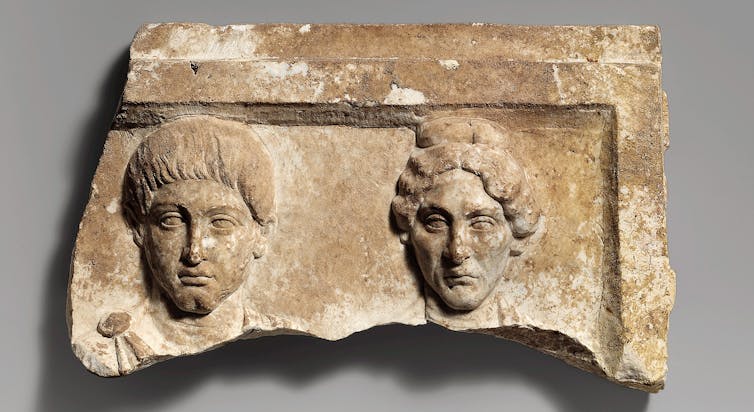
Roman funerary relief depicting a young man and an elderly woman.
Metropolitan Museum of Art/Wikimedia Commons.

Caillan Davenport, Australian National University

As the New Year festivities fade, each January reminds us of the passage of time. There is a tendency to look back with regret at roads not taken, and perhaps even despair at what the future holds.

Yet this time of year can also encourage more positive reflection. It was probably in early January of 44 BCE that Marcus Tullius Cicero, the Roman politician, orator, and philosopher, sat down to write On Old Age.

Cover of On Old Age
Goodreads

At 62, Cicero had endured personal and political losses. The year before, his daughter Tullia had died from complications from childbirth (the baby likely dying soon after), and Cicero had divorced his second wife, Publilia.

The Roman Republic was likewise in a dire state, in Cicero’s opinion, since Julius Caesar had recently been (or was about to be) named dictator for life.

Even amid this turmoil, and in the face of his own mortality, Cicero took pains to defend the experience of old age from its critics and to point out its many positive aspects.

Marble statue of a balding man.
Bust of Cicero, Musei Capitolini.
Wikimedia Commons, CC BY

He did so by adopting the persona of Cato the Elder, one of the most prominent statesmen of the third and second centuries, who lived from 234-149 BCE until his death at the age of 85.

While it was common in Greece and Rome for philosophical treatises to be written in the voice of a historical figure, Cicero makes clear in this book that the opinions of this character “Cato” represent his own views on old age.

The virtues of old age

Cicero addresses four criticisms of old age. The first two are that it forbids active pursuits and weakens the body. His forthright response is as applicable today as 2000 years ago:

It is not by muscle, speed, or physical dexterity that great things are achieved, but by reflection, force of character, and judgement; in these qualities old age is usually not only not poorer, but is even richer.

Cicero points out that the Roman senate derives its name from the fact that it was originally an assembly of old men, or senes in the original Latin. Older people have the wisdom, judgement, and experience necessary for good government.

Even the accusation that the memory dims with old age can be challenged, he suggests. Mental faculties only decline if they are unused; occupations such as language learning can help the mind stay sharp. (Cato talks about studying Greek in his twilight years).

As for strength, Cicero says that there are different kinds of vigour needed. An old man has already served his country in war, so that type of strength is no longer required (and in any case, a weak body can often be blamed on a dissolute youth!). But an old man’s voice can still resonate powerfully and make its point eloquently.

Landcare over lust

The third criticism of old age is that it lacks sensual pleasures. Lust, Cicero says, is the worst vice of youth and we should rejoice in its passing.

For carnal pleasure hinders deliberation, is at war with reason, blindfolds the eyes of the mind, so to speak, and has no fellowship with virtue.

The same goes for other types of indulgence, such as eating and drinking:

Old age lacks the heavy banquet, the loaded table, and the oft-filled cup; therefore it also lacks drunkenness, indigestion, and loss of sleep.

One can derive enjoyment from many activities in old age, such as studying science or the law, writing poetry, and similar pursuits that stimulate the mind. Cicero has the character of Cato discuss his own personal source of delight: tending to the land.

The real Cato did indeed write a work, On Agriculture, which was essentially a guide to estate management for the wealthy. The cultivation of vines is a particular joy, writes Cicero:

But, that you may know what affords the recreation and delight of my old age, I will say that vine-culture gives me a joy of which I cannot get too much. […] Are not the results obtained from mallet-shoots, sprouts, cuttings, divisions, and layers enough to afford wonder and delight to any man?

A mosaic showing people picking grapes.
Mosaic depicting Roman vine-workers (Cherchell Museum, Numidia)
Wikimedia Commons, CC BY

The final charge levelled against old age is that it means one is near to death. This can be easily dismissed, according to Cicero, because death can happen at any age.

Nay, even youth, much more than old age, is subject to the accident of death; the young fall sick more easily, their sufferings are more intense, and they are cured with greater difficulty. Therefore few arrive at old age, and, but for this, life would be lived in better and wiser fashion. For it is in old men that reason and good judgement are found, and had it not been for old men no state would have existed at all.

Life is transitory. We should make the best use of the time we have to live honourably, take delight in our good fortune, and face the inevitable with steadfastness. We can take comfort in the fact that our achievements will be remembered after we perish.

Lessons for today?

Throughout the treatise, Cicero successfully advocates for the dignity and value of growing old. He masterfully defends old age against many of the stereotypical charges still levelled against the elderly in the modern world.

But, the critics say, old men are morose, troubled, fretful, and hard to please; and, if we inquire, we shall find that some of them are misers, too. However, these are faults of character, not of age.

And yet we must remember that Cicero and his proxy character Cato were both extremely wealthy, aristocratic politicians who constituted a privileged minority in the Roman Republic. This criticism is addressed early on in the work:

For amid utter penury, old age cannot be a light thing, not even to a wise man; nor to a fool, even amid utmost wealth, can it be otherwise than burdensome.

This justification allows Cicero to develop his argument about the importance of virtue and good character extending well into old age. It reflects the fact that his intended audience was other wealthy men like him (the dedicatee of his book, his friend Titus Pomponius Atticus, was a fabulously rich businessman in his sixties).

Throughout the work, all the examples provided for the reader to emulate are great men from Greece, Rome, and neighbouring regions, such as the philosophers Plato and Pythagoras and the generals Scipio Africanus and Fabius Maximus, who fought against Hannibal in the Second Punic War.

This is a far cry from the world of the labourer or farmer working to feed his family. As classicist Tim Parkin has shown, there was no state support system for the elderly in ancient Rome and all assistance had to come from one’s relatives.

Silent on women and slaves

There is no discussion in On Old Age of the experience of women of any social status. We hear nothing about how the perils of childbearing cut many women down in their prime nor the situation of elderly widows, who were committed to looking after their children and grandchildren.

A terracotta jug depicting an old woman.
Moulded jug in the form of an elderly woman (ANU Classics Museum).
Bob Miller/ANU Classics Museum, CC BY

Though women were often traded and bartered as wives, Roman society still idolised the univira – literally the “one-man woman” – who never remarried after their husband’s death.

Nor is any mention made of the enslaved population who supported the leisurely retirement which Cicero so idolised or did all the hard labour on the estates owned by Cato. In his work On Agriculture, the real Cato wrote that “the old slave, the sick slave, and whatever else is superfluous” should be sold off, lest they compromise the workings of the estate.

Some enslaved people were able to buy their freedom, like Gaius Iulius Mygdonius, whose epitaph recorded that he was a Parthian, captured and enslaved by Romans in his youth. “From my boyhood onwards, I sought to reach old age”, he wrote on his tombstone, a poignant reminder of the adversity which he faced as human chattel.

Cicero’s work offers us salutary reminders about the joys of old age, but we should never forget that he represents the voice of privilege. For most Romans, men and women, free and enslaved, it was a daily struggle just to survive.The Conversation

Caillan Davenport, Professor of Classics and Head of the Centre for Classical Studies, Australian National University

This article is republished from The Conversation under a Creative Commons license. Read the original article.

ROGUECLASSICIST’S BULLETIN December 31, 2024

===========================================================
LEGENDA
===========================================================
French Egyptologists discover reburied 4,000-year-old sarcophagus in Lux – The Jerusalem Post
https://www.jpost.com/archaeology/archaeology-around-the-world/article-835350

Zahi Hawass anticipates a slew of major archaeological findings for 2025 – Egypt Independent

Zahi Hawass anticipates a slew of major archaeological findings for 2025

Lost Papyrus Discovered by Berlin Scholars Sheds Light on Jesus’s Early – The Jerusalem Post
https://www.jpost.com/archaeology/archaeology-around-the-world/article-835504

Head of ancient statue found in Libya’s Shahat | The Libya Observer
https://libyaobserver.ly/culture/head-ancient-statue-found-libyas-shahat

4th-century cancer talisman found in Pisidia Antiokheia, Turkey, as a fa – The Jerusalem Post
https://www.jpost.com/archaeology/archaeology-around-the-world/article-835357

Rare trove of ancient coins found in Israel: “Archaeological Hanukkah miracle” – CBS News
https://www.cbsnews.com/news/ancient-coins-found-israel-archaeological-hanukkah-miracle/

Hundreds Of Ancient Coins Uncovered In The “City Of Palm Trees” – Greek Inscription Adds Mystery

Hundreds of Ancient Coins Uncovered in the “City of Palm Trees” – Greek Inscription Adds Mystery

A Roman Statuette from the 2nd Century Found in Braga Reveals a Case of Crouzon Syndrome in Antiquity

A Roman Statuette from the 2nd Century Found in Braga Reveals a Case of Crouzon Syndrome in Antiquity

Why Is Twitter Talking About Emily Wilson’s Translation Of ‘The Odyssey?’ The ‘Tell Me About A Complicated Man’ Controversy Explained | Know Your Meme
https://knowyourmeme.com/editorials/guides/why-is-twitter-talking-about-emily-wilsons-translation-of-the-odyssey-the-tell-me-about-a-complicated-man-controversy-explained

Emily Wilson’s “The Odyssey” Translation Discourse | Know Your Meme
https://knowyourmeme.com/memes/events/emily-wilsons-the-odyssey-translation-discourse

Penn professor’s translation sees renewed interest, thanks to Christopher Nolan’s ‘The Odyssey’
https://www.inquirer.com/entertainment/movies/christopher-nolan-the-odyssey-penn-professor-20241230.html

The Guardian of Amphipolis: Full Documentary – GreekReporter.com

The Guardian of Amphipolis: Full Documentary

‘Kaos’: Netflix Cancels Jeff Goldblum’s Greek Mythology Comedy After One Season – IMDb
https://www.imdb.com/news/ni64874208/

Conversation: What was damnatio memoriae? How to get cancelled in Ancient Rome – rogueclassicism

Conversation: What was damnatio memoriae? How to get cancelled in Ancient Rome

Everyday Orientalism’s Top 15 of 2024 – Everyday Orientalism

Everyday Orientalism’s Top 15 of 2024

PaleoJudaica.com: ANE & Mediterranean top ten discoveries 2024
https://paleojudaica.blogspot.com/2024/12/ane-mediterranean-top-ten-discoveries.html

PaleoJudaica.com: Top ten 2024 discoveries in Egypt
https://paleojudaica.blogspot.com/2024/12/top-ten-2024-discoveries-in-egypt.html

PaleoJudaica.com: The Bible Places Blog comprehensive “top ten” 2024 list
https://paleojudaica.blogspot.com/2024/12/the-bible-places-blog-comprehensive-top.html

PaleoJudaica.com: PaleoJudaica’s top ten (with bonuses) for 2024
https://paleojudaica.blogspot.com/2024/12/paleojudaicas-top-ten-with-bonuses-for.html

PaleoJudaica.com: Bible History Daily’s top ten 2024 stories
https://paleojudaica.blogspot.com/2024/12/bible-history-dailys-top-ten-2024.html

PaleoJudaica.com: Christianity Today’s biblical archaeology top 10 for 2024
https://paleojudaica.blogspot.com/2024/12/christianity-todays-biblical.html

PaleoJudaica.com: Top Haaretz biblical archaeology stories 2024
https://paleojudaica.blogspot.com/2024/12/top-haaretz-biblical-archaeology.html

Nestor – January 2025 issue available
https://classics.uc.edu/nestor/pages/news/807-january-2025-issue-available

Vragen rond de jaarwisseling (3) – Mainzer Beobachter

Vragen rond de jaarwisseling (3)

The sculpture treasure of Tomis – Constanța | Spartokos read

Le trésor de sculpture de Tomis – Constanța

Roman Christmas Days VI: 25 December 336 – The Earliest Christmas Feast in Rome « The Classical Association in Northern Ireland

Roman Christmas Days VI: 25 December 336 – The Earliest Christmas Feast in Rome

2024 On The Sphinx | Sphinx

2024 On The Sphinx

My 2024 in Words – Noodlings

My 2024 in Words

My 2024 in Books – Noodlings

My 2024 in Books

missing Persephone, raging Demeter sought to exterminate humanity – purple motes

missing Persephone, raging Demeter sought to exterminate humanity

Celebrating Christmas and New Year’s in Athens, 1895-96: From the Letters of Nellie Reed, Student of the American School of Classical Studies at Athens. | From the Archivist’s Notebook

Celebrating Christmas and New Year’s in Athens, 1895-96: From the Letters of Nellie Reed, Student of the American School of Classical Studies at Athens.

Roman Christmas Days V: 25 December 333 – The Elevation of Constans to Caesar « The Classical Association in Northern Ireland

Roman Christmas Days V: 25 December 333 – The Elevation of Constans to Caesar

Searching for Severus: Did a Roman emperor visit Carlisle? – The Past

Searching for Severus: Did a Roman emperor visit Carlisle?

Aeschylus – The Historian’s Hut

Aeschylus

Skyrocketing prices are an age-old problem. Here’s how Roman emperors battled runaway inflation
https://theconversation.com/skyrocketing-prices-are-an-age-old-problem-heres-how-roman-emperors-battled-runaway-inflation-243921

AWOL – The Ancient World Online: NinMed: Medicine fit for a king
https://ancientworldonline.blogspot.com/2024/12/ninmed-medicine-fit-for-king.html

Alesia: Site of Caesar’s Greatest Victory – Time Travel Rome

Alesia: Site of Caesar’s Greatest Victory


===========================================================
AUDIENDA
===========================================================
8. Augustus, Tiberius and Caligula: Urban Living in Rome with Andrew Wallace-Hadrill by The Classics Podcast

9. Claudius and Nero: Urban Living in Rome with Andrew Wallace-Hadrill by The Classics Podcast

Ancient Greece Declassified: 57 The Life of Plato w/ Robin Waterfield
https://greecepodcast.libsyn.com/57-the-life-of-plato-w-robin-waterfield
===========================================================
VIDENDA
===========================================================
How to celebrate New Year’s like ancient Rome – YouTube

Roman Daily Life Mod for Minecraft – YouTube

===========================================================
NOTANDA
===========================================================
UNC Greensboro Employment Opportunities | Assistant Professor
https://spartantalent.uncg.edu/postings/30887