Greek ‘Stone Crown’ from Syria

This one’s kind of confusing for me … from the Global Arab Network:

via Global Arab Network

Remarkable archaeological finds from the Greek and Roman eras have been found in different archaeological sites in Deir Ezzor Province during current excavation season.

A Greek stone crown, the first of its kind in the region, was discovered by the Syrian-French mission operating in Dura Europos site, Director of Deir Ezzor Antiquities Department Amir al-Haiyou told Syrian local media.

A 30 cm statue of a man on top of a camel, and a number of coins and clay pieces were also unearthed in the site, added al-Haiyou.

The Syrian-Spanish archaeological mission working in the site of Tell Qaber Abu al-Atiq (hill), 75 km north of Deir Ezzor, found a collection of cuneiforms dating back to the Middle Assyrian period.

The city of Dura Europos was founded around 300 BC by the Seleucids in the Hellenistic era and was discovered accidentally in 1920. It became a battlefield between the Seleucids, the Parthians, the Romans and the Sassanids.

via: Syrian-Spanish archaeologists find Greek stone crown | Global Arab Network

… I’m not sure what a ‘stone crown’ is … is it just another type of capital?

Etruscan House from Grosseto

Not sure if this is the one mentioned by Francesca Tronchin on Twitter (if so, tip o’ the pileus!):

An ancient Etruscan home dating back more than 2,400 years has been discovered outside Grosseto in central Italy. Hailed as an exceptional find, the luxury home was uncovered at an archeological site at Vetulonia, 200 kilometres north of Rome.

Archeologists say it is rare to find an Etruscan home intact and believe the home was built between the 3rd and 1st century BC.

Using six Roman and Etruscan coins uncovered at the home, archeologists believe the house collapsed in 79 AD during wars unleashed by Roman general and dictator, Lucio Cornelio Silla.

Archeologists have discovered a large quantity of items which have revealed a great deal about life in the home and the construction techniques of the era.

“These are the best ruins that have ever been found in Italy,” said Simona Rafanelli, director of the Isidoro Falchi archeological museum in Vetulonia, told journalists.

“They represent something incredibly important from an archeological and historical point of view, because they finally give us an understanding of new techniques linked to Etruscan construction that we did not know until today.

“Here today we are rewriting history. It is a unique case in Italy because with what we have found we will be able to completely reconstruct the entire house.”

From the ruins they discovered a basement or cellar in which the family is believed to have stored foodstuffs.

A beautiful earthenware pot was found in the corner of the room and an olive press.

Pieces of vases and plates were also uncovered at the house, while the walls were made of sun-dried clay bricks.

via Italy: Ancient Etruscan home found near Grosseto | Adnkronos.

That Shipwreck Full of Lead

A while ago we mentioned that lead recovered from a Roman shipwreck was going to be used to help in neutrino research. I’m sure I’m not the only one who was more interested in the shipwreck than the lead, so I’m happy to share this very interesting video/slideshow thingy by Rossella Lorenzi of Discovery News fame. All about the wreck:

Roman Altar from Ashkelon

Readers of my Explorator newsletter will be familiar with the ongoing dispute in Ashkelon, where hospital expansion has uncovered a number of burials. The Israel Antiquities Authority has said for quite a while that it was a ‘pagan’ cemetery, and a recently-discovered altar seems to back up the claim. Here’s the IAA link (tip o’ the pileus to Joseph Lauer):

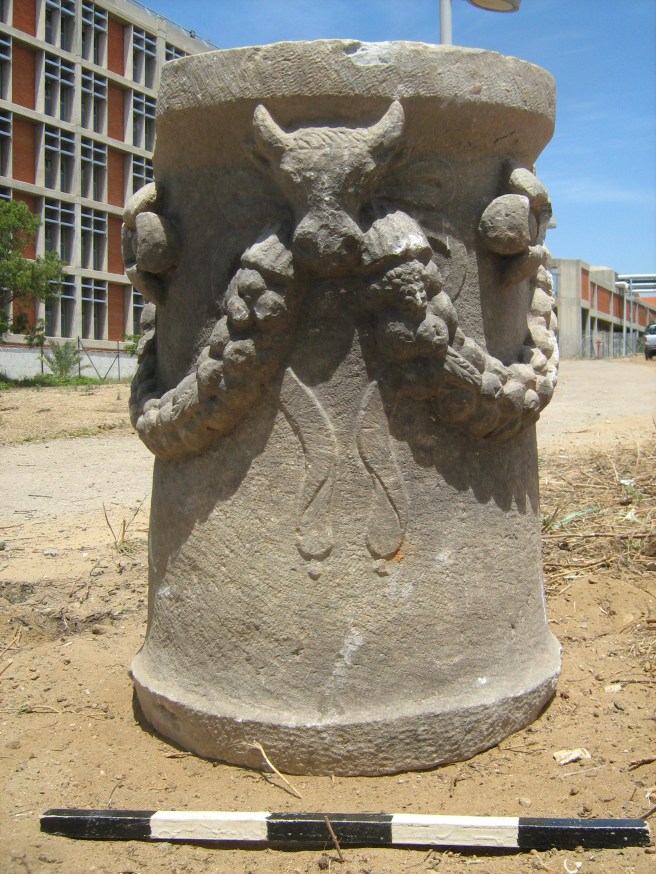
The development work for the construction of a fortified emergency room at Barzilai Hospital, which is being conducted by a contractor carefully supervised by the Israel Antiquities Authority, has unearthed a new and impressive find: a magnificent pagan altar dating to the Roman period (first-second centuries CE) made of granite and adorned with bulls’ heads and a laurel wreaths. The altar stood in the middle of the ancient burial field.

According to Dr. Yigal Israel, Ashkelon District Archaeologist of the Israel Antiquities Authority, “The discovery further corroborates the assertion that we are dealing with a pagan cemetery. It is an impressive find that has survived 2,000 years. The altar is c. 60 centimeters tall and it is decorated with bulls’ heads, from which dangle laurels wreaths. There is a strap in the middle of each floral wreath and bull’s head. The laurel wreaths are decorated with grape clusters and leaves. This kind of altar is known as an “incense altar”. Such altars usually stood in Roman temples and visitors to the temple used to burn incense in them, particularly myrrh and frankincense, while praying to their idols. We can still see the burnt marks on the altar that remain from the fire. The altar was probably donated by one of the families who brought it to the cemetery from the city of Ashkelon”.

Dr. Israel adds that during the archaeological supervision of the development work burial structures were discovered, which served as family tombs, and cist tombs that were used for interring individuals. In addition a large limestone sarcophagus (stone coffin) with a decorated lid was also found. The sarcophagus stands 80 centimeters high is 60 centimeters wide and is 2 meters long. Part of the stone in the sarcophagus was left rather high in the spot where the head of the deceased was placed and resembles a kind of pillow.

via Pagan Altar was Exposed while the IAA was Overseeing Development Work at the Barzilai Hospital. [article will move in the near future]

Here’s an image of the altar itself (provided by the IAA:

Israel Antiquities Authority

Interesting that it’s round … I’ve never seen a round Roman altar before; Ferrell’s Travel Blog provides some comparanda:

Useful comments on the dispute at Jim West’s blog:

Purloined Kouroi Recovered

Getty Images via ABC

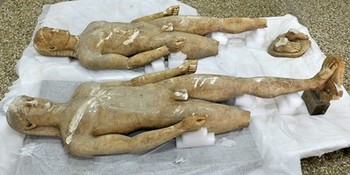
Kouros-style marble statues, dated to the 6th century BC, are displayed on Tuesday at the National Archaeological Museum in central Athens.

The priceless artifacts were recovered by authorities three days ago during a sting operation in the Corinth prefecture of southern Greece, and specifically near the village of Klenia, which is located in vicinity of ancient Nemea. Two local men, identified as farmers, were charged with antiquities smuggling, while another is wanted.

The wanted man is allegedly the mastermind of the ring and has a previous criminal record with antiquities smuggling offenses.

According to reports, the two statues were dug up in the area eight months ago. The emblematic kouros, kouroi in the plural, were presented to the press during World Museum Day.

Speaking at the museum, Culture and Tourism Minister Pavlos Geroulanos and Greek Police (EL.AS) Chief Eleftherios Economou detailed the efforts made by authorities to apprehend the suspects as well as an ongoing probe into possible overseas buyers.

The sculptures, 1.82 and 1.78 meters tall, are considered unique works dating back to the late 6th century BC. According to archaeologists, the fact that makes them unique is that they are almost identical works sharing the same facial characteristics.

The damage observed on them, cut limbs and a head is recent and probably caused by excavation machinery, although archaeologists said the statues will be restored in full.

via Priceless ancient statues recovered by authorities.

Plenty of press piling up on this one (I’ll add some more later) … a thought that just occurred to me was that these are probably depicting Cleobis and Biton, no? One or both of them were victors at Nemea and statuary of them might be appropriately found in that vicinity …

Addenda: the Cleobis and Biton claim comes from a paper by M. Miller; see, however: Sophocles S. Markianos, “The Chronology of the Herodotean Solon “Historia: Zeitschrift für Alte Geschichte, Vol. 23, No. 1 (1st Qtr., 1974), pp. 1-20, esp. the discussion in note  66 (sorry! had 23 there before … reading on a small screen) (The Miller paper is referenced there as well).

More coverage: