New Classics Major In Buffalo!

Yay!

Canisius College will introduce a new bachelor’s degree in classics, the study of ancient Greek and Roman civilizations and the Greek and Latin languages, in fall 2010.

The new classics major will prepare students for graduate work in the field and also train a new generation of Latin teachers to meet increasing demand across the United States and Canada. The new major enhances the study of classics at Canisius, which already supports two popular classics minors. The classics major also aims to attract a greater number of academically gifted students to Canisius, and provide additional support and visibility to the college’s quality academic programs.

Students may choose one of two tracks within the new classics major: Greek and Hellenic studies or Latin and Roman studies. Course work in each track includes components of classical language, history and literature, as well as art history, philosophy, political science, and religious studies and philosophy.

“The study of classics is an integral part of a liberal arts education and of a Jesuit education in particular,” says Thomas Banchich, PhD, professor and chair of the Classics Department at Canisius College. “Classics develops in students an understanding of the historical dimension of the human condition and of the complex relationships between religion, language, philosophy and social structures, as well as the legacy of classical antiquity.”

The acceptance rate into graduate programs and professional schools is consistently high for classics students. Canisius classics alumni have entered medical schools, law schools and graduate programs in many humanities fields. They have become university presidents, directors of major publishing companies, bankers, scientists, software designers, classics professors and high school Latin teachers.

via: Fall Semester Brings New Major In Classics | Canisius College

Greek Bearing … Fruit?

Some good news from the Telegraph:

Some 160 pupils in three schools will be given lessons in the native tongue of Archimedes and Herodotus from September.

The move follows the successful introduction of Latin to dozens of state primaries in England.

The Iris Project, a charity campaigning for the teaching of the Classics, which is leading the latest drive, said the subject had substantial knock-on benefits across the curriculum.

Lorna Robinson, charity director, who will be teaching the one-hour lessons every two weeks, told the Times Education Supplement: “People can be daunted at the idea of learning a language that has a different alphabet as it may feel like an additional challenge.

“Actually, though, we¹ve found that while it does add an extra dimension to the learning it¹s one that people take to quite quickly and really enjoy once they get going.

“Ancient Greek is just a wonderful language, full of beautiful words and fascinating concepts.”

Pupils will be taught the alphabet, basic grammar and vocabulary, as well as learning about ancient Greek culture, such as the development of the Olympic Games and the comedies of Aristophanes.

Latin is currently more widely taught than ancient Greek, although it is still mainly confined to private schools.

Advocates include Boris Johnson, the Mayor of London, who recently gave a Latin lesson to teenagers at a London secondary.

Under new plans, three Oxford primary schools will be given Greek lessons from September. A further 10 will get one-off taster sessions.

Sue Widgery, head of East Oxford primary in Cowley, where children speak 26 different languages, said: We were sufficiently enthused by Latin to give it a go with ancient Greek. It heightens children’s sense of language, they can see the connections between languages and it is fun.”

Congrats to Lorna Robinson … a tireless campaigner for such things.

Classical Ink

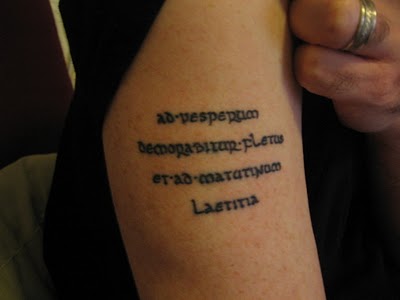
So there was a bit of twitter chatter about the Daily Mail’s claims about celebrity tattoos ‘causing’ a revival of interest in Latin, and it was decided that we’d start a new feature here which possibly is a bit more realistic in regards to Latin and tattoos by showcasing the Latin/Classical ink festooning the dermises (dermides? dermida?)  of Classicists and/or folks who actually work in Latin or Greek. Francesca Tronchin graciously consented to inaugurate this ongoing series:

Next we have a medievalist — Liam — who works with Latin, of course:

So … if you’re a Classicist or regularly use Latin and/or Ancient Greek in your daily pursuits, whether student or prof, and you sport some Classical ink, feel free to send it in so we can help drive this Latin revival along  (don’t forget to send a link to your blog or website if you have one too!)…

Saving Latin in Scotland – Followup

In today’s Scotsman:

IT IS the dead language of ancient Rome, the Declaration of Arbroath, law books and medical terminology.

But a new campaign is using that most modern of inventions – Facebook – to wage a battle to save Latin in Scottish schools.

An online bid to protect qualifications in the study of the ancient language is picking up global support with the rallying
cry “Heri, hodie, semper!” – “Today, tomorrow, always!”

The campaign was launched in response to proposals by the Scottish Qualifications Authority to cut back the exam options available to pupils.

Entry-level exams in the subject could go, deterring pupils from taking the language at a higher level, say opponents.

The plans have been branded “elitist nonsense” and a “regression to past inequality” by allowing only the brightest pupils to gain qualifications and axeing options for youngsters with lower academic ability.

Helen Lawrenson, a recently retired teacher of Latin and English in Fife who launched the online campaign, said: “I would argue that Latin isn’t a dead language, but a timeless language.

“And the acquisition of Latin is undoubtedly an advantage in the study of law and medicine.”

The Facebook page has attracted support from pupils, teachers and academics around the world, many of whom have also written to the SQA and education minister Mike Russell in protest.

via Modern drive for ancient language – Scotsman.com News.

Latin Tattoos Causing Revival in Latin?

Angelina Jolie at the New York "A Mighty ...
Image via Wikipedia

Tip o’ the pileus to Dorothy King for alerting us to this somewhat strange connection being made by the Daily Mail:

Celebrity Latin tattoos may be fuelling a revival of the ancient language in schools, it emerged today.

Pupils are increasingly demanding to study the subject, according to an exam board, as tattooed celebrities such as David Beckham and Angelina Jolie enhance Latin’s profile.

The OCR exam board today launched a new Latin qualification aimed at teenagers as secondary schools increasingly offer the subject, either during the curriculum or after-hours.

But examiners urged pupils not to emulate model Danielle Lloyd, whose Latin tattoo is riddled with errors.

While Beckham and Jolie’s Latin inscriptions are grammatically correct, Lloyd’s is meaningless, they said.

Her tattoo, ‘Quis attero mihi tantum planto mihi validus’, which is etched on to her shoulder, is intended to translate as ‘To diminish me will only make me stronger’.

But experts say the words in fact translate into something more akin to ‘Who I wear away for me only for me strong’.

Beckham, on the other hand, gets full marks for his two Latin tattoos.

The footballer has ‘Ut Amem Et Foveam’ (meaning ‘So that I love and cherish’) inscribed on his left forearm and ‘Perfectio In Spiritu’ (meaning ‘Perfection in spirit’) on his right.

Meanwhile Jolie chose ‘Quod me nutrit me destruit’, which means ‘What nourishes me also destroys me’.

Other celebrities embracing the trend include actor Colin Farrell, who has ‘Carpe Diem’ or ‘Seize the day’ inscribed on his left forearm.

OCR said the continuing influence of Latin in day-to-day life could be seen in baby naming.

It said three of the four top girls’ names have Latin origins – Olivia (from Latin ‘Oliva’ meaning Olive), Emily (from the Latin ‘Aemilianus’, a Latin family name) and the Grace (from Latin ‘Gratia’, meaning goodwill or kindness).

The OCR exam board said schools and youngsters were aware of the continuing influence of Latin and had expressed an interest in a qualification to recognise basic achievement in the subject.

The new ‘Entry Level Certificate in Latin’ is a qualification in its own right or could be taken as a precursor to a GCSE or A-level in Latin. It is likely to be taken by 13 to 17-year-olds.

It follows a surge in the number of secondary schools offering Latin over the past decade.

Surveys suggest that one in five secondaries now teaches the subject, including several hundred comprehensives.

A computer-based Latin course backed by Cambridge University is said to have made it easier for schools to offer Latin.

The team behind the project say schools are held back by a lack of access to Latin, rather than a lack of interest in it.

Boris Johnson, the Mayor of London and a long-standing advocate of Latin, said: ‘I’m delighted that OCR are introducing the first ever Entry Level Qualification in Latin.

‘It proves how much demand there is for this great subject and will provide the perfect platform for the next generation of classicists.’

Students will be introduced to the Latin language, including a list of 100 Latin words. They will also study aspects of Roman culture.

Paul Dodd, qualifications manager for languages and literature at OCR, said: ‘Latin vocabulary has had a rich and lasting influence on English, as well as being the foundation for modern day Spanish, French and Italian.

‘Latin language and culture have played a major part in shaping our own intellectual, literary, artistic and political traditions.

‘Many schools already teach Latin alongside other subjects but have no way of formally recognising their learners’ achievements below GCSE.

‘Our new Entry Level qualification provides a good bridge to further attainment as well as providing a way of recognising the skills learned.’

via: The celebrity tattoos that have sparked a Latin craze among schoolchildren | Daily Mail

The Daily Mail also has a sidebar with translations of assorted celeb tattoos. That said, all I can say is “Wow” … classic Daily Mail. Without even reading between the lines much it is pretty clear that the folks at OCR didn’t make this connection, nor does it seem like they even mentioned ink when launching this exam. Indeed, here’s the announcement from their site:

OCR has announced the launch of the first ever Entry Level qualification in Latin. The pre-GCSE level qualification, available from September 2010 for first teaching, is funded for use by the state sector and can be used as a stand-alone qualification or as a stepping stone to further study of the subject at GCSE and A Level.

The qualification provides learners with an introduction to the Latin language, and also includes study of aspects of Roman culture. Learning centres can choose the topics that they feel will best support their candidates’ introduction to the Latin language. Supporting topics include literature – either in translation or in Latin – a Roman site, Roman artefacts, slavery, the gladiators, the Roman army and more. The wide range of materials available to work with means teachers have flexibility to make the course both appealing and fun.

Boris Johnson, Mayor of London and longstanding advocate of the value of Latin, said: “I’m delighted that OCR are introducing the first ever Entry Level Qualification in Latin. It proves how much demand there is for this great subject and will provide the perfect platform for the next generation of Classicists.”

Paul Dodd, OCR’s Qualifications Manager for Languages & Literature said: “Many schools already teach Latin alongside other subjects but have no way of formally recognising their learners’ achievements below GCSE grade. Our new Entry Level qualification provides a good bridge to further attainment as well as providing a way of recognising the skills learned.”

… which is clearly echoed in the Daily Mail piece. Now I’m all for highlighting celebrity tattoos in Latin and regular readers of rogueclassicism will know that I’ve made comments on same in the past (e.g. here and here), but to make the leap from one of Angelina Jolie’s body parts to some sudden surge in Latin interest seems a bit of a stretch and, quite frankly, is somewhat insulting.