
Month: January 2010
Also Seen – Greek Milton? Milton’s Greek?
The Seattle p-i has a reviewish sort of thing of an exhibition at Princeton of images various authors, including this one of Milton:
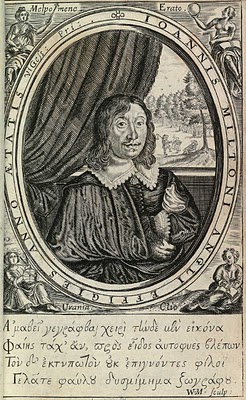
William Marshall’s 1645 Engraving Of John Milton.
This portrait, produced for John Milton’s first published book of verse, includes the writer’s opinion of his likeness in the caption. Written in ancient Greek–which the artist could not understand–Milton invited the reader to “laugh at the artist’s botched attempt” at portraiture.
via Famous Authors Drawn, Not Quartered.
Around the blogosphere:
- Spitting Image | Angelo Mercado (includes a translation)
Abstract – Arethusa – Plagiarism or Imitation?: The Case of Abronius Silo in Seneca the Elder’s Suasoriae 2.19–20
Scott McGill
Plagiarism or Imitation?: The Case of Abronius Silo in Seneca the Elder’s Suasoriae 2.19–20
Arethusa – Volume 43, Number 1, Winter 2010, pp. 113-131
The Johns Hopkins University Press
Abstract:
Disagreements over whether an author imitated or plagiarized a predecessor are a part of Latin literary history, with Virgil’s ancient reception providing striking examples. This article argues that Seneca the Elder’s Suasoriae 2.19–20 sets forth another case where a Roman author’s perceived textual borrowing was labeled both imitation and plagiarism. The author is Abronius Silo, who adapts a sententia from the declaimer Porcius Latro. In addition, I explore ways of conceptualizing the imitation and plagiarism that appear in Seneca’s passage, situate the discussion in the context of Seneca’s work and intellectual milieu, and link his ideas and critical practices to those found in Latin literary culture more broadly.
Abstract – Arethusa – The Scent of a Woman
Shane Butler
The Scent of a Woman
Arethusa – Volume 43, Number 1, Winter 2010, pp. 87-112
The Johns Hopkins University Press
Abstract:
At Aeneid 1.691-94, Venus sets Ascanius down to sleep on a bed of aromatic marjoram; Servius seizes the opportunity to recount the origins of perfume. Revealing that the note is no antiquarian coincidence, this article argues that the Vergilian passage and others in Greek and Latin poetry echo, to important effect, the remarkable tradition of one of antiquity’s most famous fragrances. Along the way, an investigation of botanical and medical sources clarifies our picture of how perfume was used, explaining the vicious humor of a passage in Lucretius and suggesting a new solution to a famous interpretive crux regarding Catullus 13.
Abstract – Arethusa – Making History Mythical: The Golden Age of Peisistratus
Claudia Zatta
Making History Mythical: The Golden Age of Peisistratus
Arethusa – Volume 43, Number 1, Winter 2010, pp. 21-62
The Johns Hopkins University Press
Abstract:
This paper examines the association in Aristotle (Ath. Pol. 16.7) of the mythical Golden Age with the tyranny of Peisistratus and, by means of an array of both iconographic and textual evidence, suggests that Peisistratus made use of Golden Age imagery during his regime. This paper also discusses the tyrant’s attempts to relieve the twin problems of overpopulation in the city and lack of cultivation of the countryside, and addresses the overall policy of coordination between astu and chōra.
via Project MUSE – Arethusa – Making History Mythical: The Golden Age of Peisistratus.
 rogueclassicism