Capitoline She-Wolf: 12th Century

I’m kind of confused why this didn’t get picked up in more sources and am dismayed at the lack of

Lupa Capitolina: she-wolf with Romulus and Rem...
Lupa Capitolina: she-wolf with Romulus and Remus. Bronze, 12th century ADhttp://news.bbc.co.uk/1/hi/world/europe/7499469.stm, 5th century BC (the twins are a 15th-century addition). (Photo credit: Wikipedia)

detail … the original comes from Corriere della Sera:

Più giovane di 17 secoli. La Lupa capitolina, statua simbolo di Roma, raffigurata mentre allatta i gemelli Romolo e Remo, è stata scolpita nel Medioevo. Cioè 1.700 anni più tardi di quanto di era ritenuto finora: la scultura dunque non è etrusca, non è stata realizzata nel V secolo avanti Cristo. ma tra l’XI e il XII dopo Cristo. DUE SECOLI DI DIBATTITO – Sono gli studi più recenti condotti sulla Lupa a chiudere la querelle sulla sua datazione, che anche di recente ha diviso restauratori e storici dell’arte. Ne hanno dato conto in una conferenza stampa il direttore dei Musei capitolini Claudio Parisi Presicce, dove la statua è conservata, il sovrintendente ai Beni culturali Umberto Broccoli e l’assessore alla Cultura del Campidoglio Dino Gasperini. «La tesi – ha spiegato quest’ultimo – è che sia la copia medievale di un originale etrusco». «Il dibattito scientifico dura da secoli, almeno da Winckelmann in poi – ha commentato Broccoli – e a mio parere una risposta definitiva non verrà mai, perché ci sarà sempre una forchetta di oscillazione temporale. Però certamente è stata fatta molta chiarezza in più». Il sovrintendente Umberto BroccoliIl sovrintendente Umberto Broccoli IL RUOLO DELLA SCIENZA – Per cambiare la data di nascita della Lupa, gli esami sono iniziati 1996, con l’avvio del restauro, e sono proseguiti tra il 2009 ed il 2011. La tecnica della spettrometria di massa con acceleratore ha permesso di estrarre e analizzare campioni organici adatti alla datazione con il radiocarbonio. In particolare sono stati esaminati numerosi campioni di resti vegetali dalle terre di fusione utilizzate per realizzare la statua. Da questi test sono emersi una serie di dati che hanno consentito, tramite una combinazione statistica, di spostare l’origine della Lupa al medioevo. L’università del Salento, che ha eseguito le analisi, ritiene che ] Più giovane di 17 secoli. La Lupa capitolina, statua simbolo di Roma, raffigurata mentre allatta i gemelli Romolo e Remo, è stata scolpita nel Medioevo. Cioè 1.700 anni più tardi di quanto di era ritenuto finora: la scultura dunque non è etrusca, non è stata realizzata nel V secolo avanti Cristo. ma tra l’XI e il XII dopo Cristo.

DUE SECOLI DI DIBATTITO – Sono gli studi più recenti condotti sulla Lupa a chiudere la querelle sulla sua datazione, che anche di recente ha diviso restauratori e storici dell’arte. Ne hanno dato conto in una conferenza stampa il direttore dei Musei capitolini Claudio Parisi Presicce, dove la statua è conservata, il sovrintendente ai Beni culturali Umberto Broccoli e l’assessore alla Cultura del Campidoglio Dino Gasperini. «La tesi – ha spiegato quest’ultimo – è che sia la copia medievale di un originale etrusco». «Il dibattito scientifico dura da secoli, almeno da Winckelmann in poi – ha commentato Broccoli – e a mio parere una risposta definitiva non verrà mai, perché ci sarà sempre una forchetta di oscillazione temporale. Però certamente è stata fatta molta chiarezza in più».

IL RUOLO DELLA SCIENZA – Per cambiare la data di nascita della Lupa, gli esami sono iniziati 1996, con l’avvio del restauro, e sono proseguiti tra il 2009 ed il 2011. La tecnica della spettrometria di massa con acceleratore ha permesso di estrarre e analizzare campioni organici adatti alla datazione con il radiocarbonio. In particolare sono stati esaminati numerosi campioni di resti vegetali dalle terre di fusione utilizzate per realizzare la statua. Da questi test sono emersi una serie di dati che hanno consentito, tramite una combinazione statistica, di spostare l’origine della Lupa al medioevo. L’università del Salento, che ha eseguito le analisi, ritiene che l’attribuzione all’XI-XII secolo sia attendibile al 95,4%.

The only English coverage so far, oddly enough, is in Gulf Times:

A study has shown that the Capitoline Wolf, a bronze statue representing Ancient Rome’s most famous symbol, was probably sculpted during the Middle Ages, some 17 centuries later than what has long been thought, media reports said yesterday.
Researchers at the University of Salento, who carried out radiocarbon and thermoluminescence tests, believe the statue dates from around the 12th century AD and not the 5th BC, daily Corriere della Sera said.
The statue, which is kept at Rome’s Capitoline Musuems, depicts a she-wolf suckling human twins.
The pair represent Romulus and Remus, brothers who, according to legend, founded Rome in 753 BC.
Most experts believe the twins were added in the late 15th century AD, probably by the sculptor Antonio Pollaiolo.
However, the she-wolf was thought to have been a much older work, possibly pillaged by conquering Roman soldiers and then used as a symbol of the founding myth of their city.
“(Now) the thesis is that it is medieval copy of an original Etruscan work,” Rome’s municipality supervisor for culture, Umberto Broccoli, said at a news conference.
Broccoli noted that 18th-century German art historian Johann Joachim Winckelmann had first attributed – based on how the wolf’s fur was depicted – the statue to an Etruscan maker in the 5th century BC.
“The scientific debate has lasted for centuries, at least from Winckelmann onwards and it is my opinion that we will never have a definitive answer,” Broccoli said.
However, the latest study had brought “much more clarity”, Broccoli added.

This seems to be a followup to a little brouhaha that rearose back in November (see, e.g., in the Telegraph: Romulus and Remus symbol of Rome could be medieval replica) which I don’t think we got around to blogging about. Folks should read Dorothy King’s post from the time: The Capitoline Lupercalia … I think the objections remain. The Corriere della Sera piece mentions radiocarbon dating again, but they’ve done some statistical shifting (i.e. it doesn’t appear they’ve done new tests, but they’ve fudged the numbers … I can’t really find anything on this at the USalento site). The Gulf piece mentions thermoluminescence as well, but I’m not sure how that would apply in this situation. Whatever the case, we seem to be on the cusp of turning the Capitoline She Wolf into the Shroud of Turin of the Classics set …

Folks might also be interested in a couple of posts from 2006:

Ancient Roman Cinema Projector? I Hae Me Doots Big Time

This has been an aggravating post to get out … first of all, tip o’ the pileus to Richard Campbell for alerting us to this story early this a.m.; a pox on my slow internet connection which prevented me from writing while it was still fresh in my mind. Now I see the story popping up in my Twitter feed and it’s bugging me even more. The story seems to be breaking in Filmaker Magazine, which is a magazine devoted to independent film, in a blogpost with an extremely provocative title: DO ANCIENT ROMAN ARTIFACTS REVEAL THE WORLD’S FIRST MOTION PICTURE PROJECTOR?

After a brief intro to the thing, folks can watch a youtube video which is designed to promote/drum up funds for a project. Here’s the video (and it really should be watched in its entirety … and listen very carefully!):

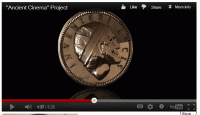
If you listened carefully, there is a pile of stunning doublespeak about a ‘multimedia installation’ about a ‘speculative archaeological discovery in Zadar’ which ‘may be’ the world’s first cinema projector. I don’t know about you, but I’ve never heard of the phrase ‘speculative archaeology’ before, so alarm bells should be going off. Immediately after telling us that archaeologists are divided about the Antikythera Mechanism (which suggests this guy doesn’t keep up with research) we are told that a coin found ‘nearby’ supports his claim (shades of some Talpiot Tombs, no?). So here’s the coin, supposedly, with one side which says Inventori Lucis (“to the contriver of light” … all pix can be clicked for larger versions):

Screencap from the video

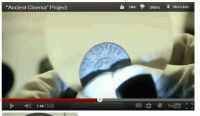
… then they show a shiny new version:

I have never seen this phrase on a coin (not that that means much) but it’s worth mentioning that even Wikipedia mentions its existence not on a coin, but on a phalera (a ‘medal’, for want of a better term) dating stylistically to the Second Century A.D. (there is a reference there to an article by Guarducci, which I am not in a position to track down). The phrase does, of course, refer to Sol Invictus, who was popular among the military set. The other side of this ‘coin’ is similarly Sol-oriented:

Screencap from the Video

… and the shiny new one:

Screencap from the Video

Here we have a reference to Sol Indiges, whose title is pretty controversial as I mentioned years ago before this blogging thing was even thought of. As far as I know, the Sol Indiges thing was largely Republican and so having the ‘Sol Invictus’ on one side and ‘Sol Indiges’ on the other seems kind of strange. I will happily be disabused of this notion, but this medal doesn’t strike me as genuine.

In a similar category are the supposed painted glass panes which — we are led to believe — are Roman in date. Here’s a photo of one of them:

Screencap from the video

I’m sure I’m not the only person who watched this and said, “Hey, that looks just like that Primavera/Flora thing from Stabiae.” In case you’re wondering what I’m referring you, this should give you an ‘oh yeah’ moment:

The dress-off-the-right-shoulder clearly suggests that the ‘glass slide’ was either inspired by or derived from this one. It’s also salutary to point out that the glass slide seems to have a clear border all arond the outside. That’s a giveaway that it was meant either to go in a frame or some sort or that it actually is a Magic Lantern slide from the 1800s (tons of examples on eBay), if it isn’t actually a modern copy. Why would it be modern? Here’s a little quote from the video:

The installation will feature the original archaeological evidence from Zadar, all of which has been fabricated by me …

There’s more info to be had at the Ancient Cinema Project webpage, including more photos that aren’t screencaps. Of particular importance is a quote there which I don’t think is in the video:

Yet another archaeological mystery was recently discovered at a flea market in Zadar: oxidized piece of metal, a cache of hand-painted glass tablets (mostly shattered), a clay lamp, and an unusual coin with the Latin inscriptions “Sol Indiges” and “Inventori Lvcis”. These artifacts form the basis of the installation “Ancient Cinema,” a meta-historical reflection on archaeology and storytelling.

‘Meta-historical’ and ‘speculative archaeology’ with ‘fabricated evidence’. All based on items found at that place where provenance goes to die known as the flea market. Don’t eat that Elmer … there’s nothing ancient Roman here and the double speak being used to raise funds (after a Canada Council Grant ran out??? That’s my tax money!) borders on dishonesty.

[by the way, I am aware of the possibility of Aristotle knowing how the ‘camera obscura’ worked; this has nothing to do with that]

A Pandect of Gripes: Crucifixions, Earthquakes, Open Access, and Outreach

Okay … this one hit the internets yesterday and I’ve been nursing vipers in my breast ever since. It begins with an item at Discovery Newswhich begins thusly:

The front side (recto) of Papyrus 1, a New Tes...
The front side (recto) of Papyrus 1, a New Testament manuscript of the Gospel of Matthew. Most likely originated in Egypt. Also part of the Oxyrhynchus Papyri (P. oxy. 2) Currently housed in: (Photo credit: Wikipedia)

Jesus, as described in the New Testament, was most likely crucified on Friday April 3, 33 A.D.

The latest investigation, reported in the journal International Geology Review, focused on earthquake activity at the Dead Sea, located 13 miles from Jerusalem. The Gospel of Matthew, Chapter 27, mentions that an earthquake coincided with the crucifixion:

“And when Jesus had cried out again in a loud voice, he gave up his spirit. At that moment the curtain of the temple was torn in two from top to bottom. The earth shook, the rocks split and the tombs broke open.”

To analyze earthquake activity in the region, geologist Jefferson Williams of Supersonic Geophysical and colleagues Markus Schwab and Achim Brauer of the German Research Center for Geosciences studied three cores from the beach of the Ein Gedi Spa adjacent to the Dead Sea.

Varves, which are annual layers of deposition in the sediments, reveal that at least two major earthquakes affected the core: a widespread earthquake in 31 B.C. and an early first century seismic event that happened sometime between 26 A.D. and 36 A.D. […]

… I won’t bother getting into my abject disappointment that Discovery News could not even think of the obvious major difficulties of assigning an exact date to an otherwise unspecifically-dated ancient earthquake (although we will note that April 3 is one of the calculated dates for the crucifixion which we annually mention in our This Day in Ancient History feature; it is mentioned in Wikipedia as well). I also won’t bother commenting on all the various text-critical difficulties with the claim, which seems more the realm of our Biblioblogger colleagues and has been more-than-adequately dealt with by Mark Goodacre and Tom Verenna.

What actually bothered me the most about this was that it was yet another article with an ancient history sort of bent published in a high end journal outside of our field. They way I figure it, the publisher (Taylor and Francis) must have sent the article out as a way to promote the current issue of the journal — I really have a hard time believing that journalists sit around and suddenly think, “Hmmm … seems to be a slow day … think I’ll wander to the library and see what’s happening in the latest International Geology Review … I can’t wait to see the followup to that middle Cenozoic ignimbrite flareup thing I was reading about a while ago.” So it seems obvious that the publisher sent it out.

As such,  if some roguescholar wants to see if the journalist is passing on sufficient information for the author of the article not to be ridiculed and happens to check it out, he/she will come across a nice abstract:

This article examines a report in the 27th chapter of the Gospel of Matthew in the New Testament that an earthquake was felt in Jerusalem on the day of the crucifixion of Jesus of Nazareth. We have tabulated a varved chronology from a core from Ein Gedi on the western shore of the Dead Sea between deformed sediments due to a widespread earthquake in 31 BC and deformed sediments due to an early first-century earthquake. The early first-century seismic event has been tentatively assigned a date of 31 AD with an accuracy of ±5 years. Plausible candidates include the earthquake reported in the Gospel of Matthew, an earthquake that occurred sometime before or after the crucifixion and was in effect ‘borrowed’ by the author of the Gospel of Matthew, and a local earthquake between 26 and 36 AD that was sufficiently energetic to deform the sediments at Ein Gedi but not energetic enough to produce a still extant and extra-biblical historical record. If the last possibility is true, this would mean that the report of an earthquake in the Gospel of Matthew is a type of allegory.

… which seems to suggest that there might indeed be some disconnect between the Discovery News article and the original journal article. Of course, if further perusal is wanted by the likes of myself), he/she will have to shell out $43.00!!!! (I really need to figure out how to put interrobangs in my posts). If not, one would have to hope to have access to an institution which was willing to fork out over two grand for an annual subscription (I don’t think regular folks can even subscribe)! Personally, if I were a scholar and some journal was promoting my article to get attention for their journal, I’d be doing all I could to ensure that the people to whom the article was being promoted — i.e. the general public — could access the article so I didn’t come across looking silly, unless I don’t know any better.

What’s even more annoying is the viral nature of the internet news cycle. The Discovery News coverage has already been picked up/is being rewritten by a number of other outlets (e.g. the Daily Mail and Huffington Post) Whatever the case, all this silliness merely emphasizes/underscores/insert-the-synonym-of-your-choice what I was suggesting earlier this week about the need for organizations like the APA and CAC to  forge direct ties with journalists to promote conferences (Something That’s Been Bugging Me: Outreach II ~ The Conference).  Give the journalist something to write about and they’ll run with it.

Them Crucifyin’ Romans

I’m sure plenty of readers of rogueclassicism saw/heard the comments of a US EPA official in the past week or so … if not, here’s the incipit of some typical coverage:

A top EPA official has apologized for comparing his agency’s enforcement strategy to Roman crucifixion — as Republican Sen. James Inhofe launched an investigation and told Fox News the comments are part of a campaign of “threats” and “intimidation.”

Al Armendariz, the EPA administrator in the Region 6 Dallas office, made the remarks at a local Texas government meeting in 2010. He relayed to the audience what he described as a “crude” analogy he once told his staff about his “philosophy of enforcement.”

“It was kind of like how the Romans used to, you know, conquer villages in the Mediterranean,” he said. “They’d go in to a little Turkish town somewhere, they’d find the first five guys they saw, and they’d crucify them.

“And then, you know, that town was really easy to manage for the next few years,” he said. […]

Last week our old Classics list friend Jan Gabbert asked if I could recall any such incident, and after much poking around, I’ve come up empty. I’m pretty sure it’s safe to say this wasn’t ‘standard practice’, but can anyone think of an example where it may have happened once? Or maybe this happened in some movie or novel?  This seems to me to be Historia Augusta type material, if it is genuine at all …

Vergil and Woody Guthrie

Interesting item from a piece on Woody Guthrie, inter alia:

[The ancient Roman poet] Virgil could sit and speak in iambic pentameter, like a modern rap artist. Woody could do the same thing. He could speak in poetry.”

I’ve never heard that about Vergil before … anyone know of a source?